Introduction
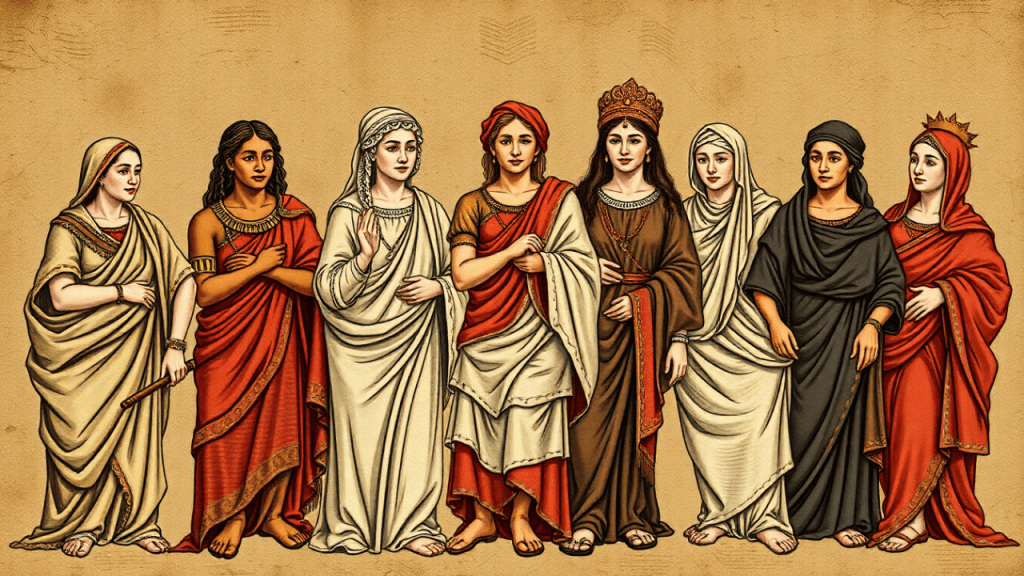
Whenever we think of women in History, we first think of the witch burnings, the female infanticides, the widow burnings, women as sex slaves, and women behind curtains. That was not always the case, not at least in the Ancient, Classical, and Early Medieval Ages. In this blog, we discuss the women who shaped the early intellectual thoughts, whether in science, spirituality, or literature. Many of them faced huge hindrances in their career, but still, with their intuitive ideas and thoughts, became immortal in the history of mankind. Some of the earliest names mentioned lack some historical evidence and may be legendary, although most of them are historically established.
Chapter 1 – Scientists, Mathematicians & Inventors
- Tapputi Belatekallim – She was one of history’s first chemists, perfumers, and alchemists. Hailing from 1200 BCE, Babylon, she is said to have performed one of history’s earliest distillations when she separated various solvents from water several times. She wrote the first recorded treatise on perfume making, as discovered on a cuneiform clay tablet.
- Merit Ptah – She was the chief physician of the royal court of ancient Egypt at around 2700 BCE, and is recognized as the first female doctor of human history. In her tomb, as inscribed by her son, she was stated as the chief physician, acting as a professor of medicine and supervising several male physicians. There are some arguments in modern times that identify her to be a pure legendary character, although many still consider her as historical.
- Aglaonike – Also known as Aglaonice, she was a Greek (Thessalian) astronomer from the 2nd century BCE. She was known to accurately predict lunar eclipses, which led her to be branded as a witch by the general public. A crater on the planet Venus is named after her.
- Hypatia of Alexandria – She was a Neo-Platonic philosopher, astronomer, and mathematician from Alexandria, Egypt, in the 4th century CE. She was a prominent professor and researcher in Alexandria, who taught many scholars who came to study from all over the then-known world. She is known to have written commentaries on Diophantus’s thirteen-volume Arithmetica. She also constructed astrolabs and hydrometers, which show her skills as an early engineer. She was murdered by a Christian mob in 415 CE amid religious and political conflicts.
- Maria Hebraea / Mary the Jewess – Also known as Mary the Prophetess or Mary the Copt, she was an alchemist and an inventor from Hellenistic Egypt. She is credited with having invented various chemical apparatus and is considered the first true alchemist of the Western world. She had been beautifully described by the 300 CE alchemist Zosimos of Panopolis and several other Greco-alchemist authors. Some of her inventions include the Tribikos (an apparatus for distillation), Kerotakis ( used in heating substances and collecting vapors for alchemy), and Bain-marie (used to limit the maximum temperature of an apparatus to the boiling temperature of a separate liquid).
- Trotula of Salerno – She was an 11th-century Italian medical practitioner who became a pioneer in women’s health. Her famous work, De passionibus mulierum curandorum (On the Diseases of Women), discussed pregnancy, childbirth, cosmetics, and gynecology with remarkable empathy and precision. Later, male physicians tried to obscure her authorship by branding her as a legend or a myth, but several manuscripts from the medieval ages prove her authenticity.
- Hildegard of Bingen – She was a medieval German scientist, herbalist, and composer, making her a polymath. She wrote theological, botanical, as well as musical works and is considered to be the founder of scientific natural history in Germany. In 2012, she was named a doctor of the church, one of only four women to be named so. She is also considered a patron saint for musicians and composers.
Chapter 2 – Philosophers, Theologians & Mystics
- Gargi Vachaknavi – She was an Indian Vedic Philosopher of around 1000 BCE. She was said to be a great philosophical debater. In the sixth and the eighth Brahmana of the Brihadaranyaka Upanishad, she is said to have participated in a great philosophical debate organized by King Janaka of Videha, where she challenged and debated the philosopher and sage Yajnavalkya on the issues of the atman (consciousness) and life. She is considered one of the great philosophers of ancient India.
- Maitreyi – A contemporary of Gargi Vachaknavi, she was the wife of sage Yajnavalkya. She was herself a great philosopher who explored concepts like consciousness and immortality. She is said to be one of the earliest proponents of Advaita Vedanta, or the Indian philosophical school of non-dual panentheism.
- Diotima of Mantinea – She was a mentor to the great Greek philosopher Socrates, and her dialogues with him are said to be the origin of the concept of Platonic Love. She is said to have guided Socrates through an ascent of physical attraction to the contemplation of beauty itself, emphasizing spiritual love.
- Rabi’a al-Adawiyya – Also known as Rabia Basri, she was an 8th-century mystic sufi from Basra, in modern-day Iraq. She is considered one of the most important female characters in Islam. She was an ascetic who believed in self-denial and complete devotion to Allah. According to Sufi traditions, she was the first one to set up the doctrine of divine love known as ishq. She is considered one of the Qalandars, the most spiritual Sufis.
- Akka Mahadevi – She was a 12th-century mystic from the region of modern-day Karnataka, India. Married to a king against her will, she renounced her husband and wandered naked, singing hymns for her true love, “Lord Shiva or Mahadeva.” She wrote around 430 vachanas (mystical poems) and two short writings called Mantrogopya and Yogangatrividh, for which she is considered one of the pioneers of Kannada literature.
- Lalleshwari / Lal Ded – She was a 14th-century Hindu philosopher and mystic from Kashmir, India. She is an important figure in the Kashmiri Shaivism school of Hindu Philosophy. She was the creator of mystic poetry called vakhs. Sources say that after years of harsh treatment from her husband and mother-in-law, she left home after twelve years of marriage and dedicated her life to the devotion of Lord Shiva, composing philosophical poems around him. She is one of the most influential persons in Kashmiri literature.
- Julian of Norwich – She was a 14th-century English Christian mystic and anchoress, known for her revelations of divine love to God, after receiving sixteen divine visions during an illness in 1373. She lived in Saint Julian’s Church in Norwich, England, where she preached her spiritual wisdom connected to God.
- Christine de Pizan – She was a French philosopher and one of the first professional writers, around the 14th-15th century. She was an advocate for women’s upliftment and preached gender equality in every sphere of life. She was a court writer of King Charles VI of France. Her famous works include “The Book of the City of the Ladies” and “The Treasure of the City of the Ladies,” both containing philosophical, social, and political analysis.
Chapter 3 – Poets, Writers & Musicians
- Enheduana – She was an Akkadian poet and high priestess around 2300 BCE, known as the world’s first author by name. She was the daughter of King Sargon of Akkad. She was the high priestess of Ur when she authored hymns to the Goddess Inanna. Her works melded Sumerian and Akkadian deities, thereby melding the culture of the Empire.
- Sappho – A Greek lyric poet of the 7th century BCE, her works inspired love and desire, especially between two female lovers, thus contributing to the origin of the words “Sapphic” and “Lesbian” (She was from the island of Lesbos).
- Andal – Also known as Godhai, Nachiyar, and Godha Devi, she was a 9th-century Tamil poet from India. She is considered by some as an avatar of the Goddess Bhumi. Her works contain devotion to Lord Krishna, the eighth avatar of Lord Vishnu. Her most famous works include Tiruppavai and Nachiyar Tirumoli, which are some of the most famous devotional works that are still recited by the Tamil devotees in the winter festival season of Margali.
- Mirabai – She was a 16th-century “Bhakti” saint who wrote devotional hymns for Lord Krishna. She was a Rajput princess, the only child of Ratan Singh, the younger brother of the king of Merta. In 1516, she was married to the crown prince of Mewar at the age of 18. She became a widow five years later, when the prince died in a battle. She was ill-treated and later persecuted by his brother-in-law, who became the crown prince. She left for Merta but found unacceptable behavior from her own family. Then she sat for a pilgrimage in Dwarka, the holy city of Krishna, where she composed poems and hymns which made her immortal. Later, when her in-laws came to bring her back, she mysteriously disappeared.
- Hrosvitha of Gandersheim – She was a German playwright of the 10th century, who is known for blending classical drama with Christian ethics. She spent most of her life as a nun in the Benedictine convent in Gandersheim. Writing in Latin at a time when women’s intellectual works were rare, she reimagined the comedies of the Roman writer Terence into moral dramas celebrating faith, courage, and female virtue. Her plays gave an early glimpse of feminine strength expressed through art rather than rebellion. She also composed legends and historical poems, which later became famous all over Europe.
Conclusion
So in this blog, we saw how twenty women from the pre-modern world shaped science, philosophy, and literature. Obviously, there are thousands of such examples, which are beyond the scope of this blog. Anyway, that is all for this blog. This blog was written to remember and celebrate the feminine of the past. Hope you all enjoyed the blog. Please like and share if you find this helpful. Thank you.
Suggested Readings
- Britannica
- Women Awakened: Stories Of Contemporary Spirituality In India by Swati Chopra
- The Book of Women: Celebrating the Female Spirit by Osho
Disclosure: This post contains affiliate links. As an Amazon Associate, I earn from qualifying purchases. I only recommend books I truly value.
 The Indic Scholar
Leave a comment