Introduction
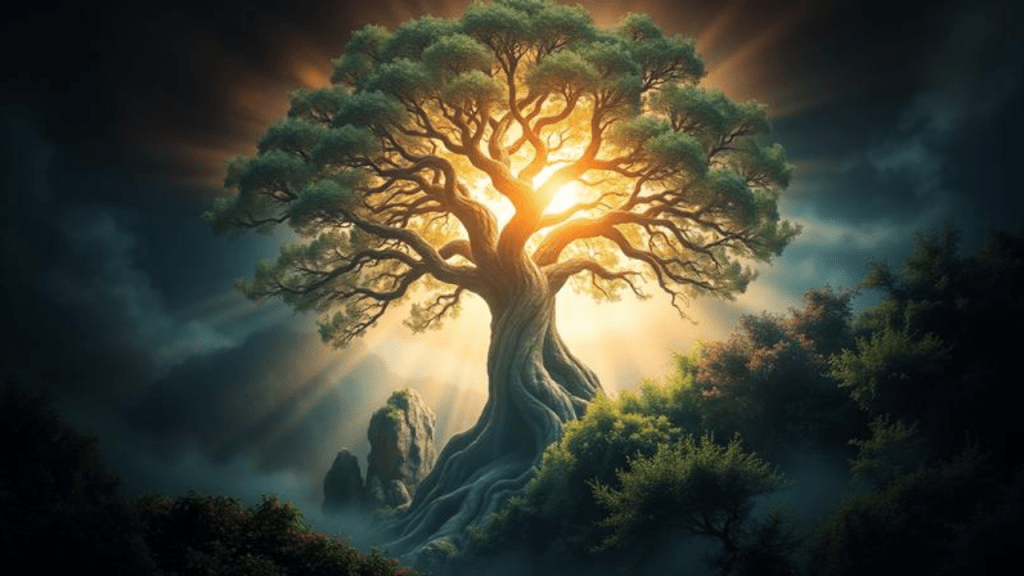
Plants and trees have played crucial roles in human society since the beginning. From agriculture to medicinal use to botanical gardens, the plant kingdom has always been integral to human lives. Humans, thus, with respect and celebration, have created numerous stories, myths, legends, and folklores involving plants and trees across various cultures and civilizations. One such example is the concept of different “World Trees,” which connect the different realms, including the Earth, heaven, and the underworld. These World Trees have been systematically embedded in various cultural metaphysics and cosmologies. In this blog, we discuss seven world trees starting from the Siberian Turks to the Chinese to the Norse. The list is not exhaustive, and many sacred trees have been omitted to keep the blog concise and suitable for completing in a single reading. So, let’s begin.
1. Bay Térék (Turkic-Siberian)
The Bay Térék is the foundational world tree in Siberian and Turkic Shamanic cosmology, which can be traced back to the Paleolithic Age. The tree is seen as a spiritual ladder connecting the underworld, the earth, and the sky. The trunk represents the earthly plain, the roots penetrate the ground to the home of the ancestors in the underworld, while the branches reach the heavens, where the Gods and other celestial beings dwell.
Shamans invoke the tree in healing, divination, and initiation ceremonies, often using drums and chants. Birds and snakes are said to be living within the tree, acting as the messengers to the sky and the underground. The Bay Térék is perhaps the earliest example of a sacred world tree among all the cultures of the world.
2. Aśvattha (Vedic-Indian)
The Aśvattha is one of the most philosophically profound trees in Vedic-Hindu mythology, appearing in both the Rig Veda and later the Bhagavad Gita. It is described as an inverted cosmic tree whose roots are said to extend to heaven, while its branches reach the Earth. This inversion symbolizes the illusory nature of the world (Maya) and the primacy of the spiritual realm.
The tree is depicted as evergreen, a visual metaphor for continuity and persistence, resonating with the concepts of dharma and cosmic order. In the 15th chapter of the Bhagavad Gita, the tree is used as a metaphor for the human body and the soul: “ The unreal has no roots, the real has no branches.” Here, the Aśvattha functions as a philosophical device, guiding seekers to understand the transient nature of worldly existence and the eternal essence of the self.
The tree is culturally associated with the Banyan Tree, used as a meeting place, traditional schools, and shrines.
3. Jianmu (Chinese)
The Jianmu Tree occupies a central place in Chinese mythology as a cosmic axis connecting Heaven and Earth. It is mentioned in texts like the Shan Hai Jing (Classic of Mountains and Seas) and various shamanic stories. Its trunk is said to extend from the earthly plane into the heavens, while its branches stretch across the sky, supporting celestial bodies and divine realms. Jianmu also acts as a support for the Sun and Moon, sometimes depicted with birds perched in its branches, representing the passage of time and the regulation of celestial movements. It also serves as a bridge for humans and deities, facilitating divine interventions, spiritual journeys, and communication between realms.
Symbolically, the tree represents stability, continuity, and moral order, echoing the Confucian and Daoist emphasis on harmony with nature. In essence, Jianmu is more than a tree; it is a cosmic scaffold, embodying heavenly order, moral harmony, and the bridges between the human and the divine worlds.
4. Gaokerena (Zoroastrian)
The Gaokerena is the central sacred tree in Zoroastrian cosmology, embodying immortality, divine blessing, and the regeneration of life. According to Bundahishn (Zoroastrian Creation Texts), Gaokerena sprang from the seed of all seeds, planted by Ahura Mazda, the supreme God, to sustain life and provide divine nourishment to humanity and all living beings. Its fruits and trees possess healing properties, ensuring health, longevity, and the continuation of life.
Gaokerena is also the origin of all plants and seeds, linking it directly to agriculture, human survival, and the ethical responsibility to care for creation. It also represents the Zoroastrian dual idea of asha (truth, order) and druj (chaos, falsehood). In some traditions, the seeds of Gaokerena were guarded by divine beings until they could spread life across the world, further emphasizing the tree’s role in creation and universal generation.
5. Yax Che’ (Maya)
The Yax Che’, or “First Tree”, is a foundational sacred tree in Maya cosmology, representing the axis mundi that connects the underworld, earth, and heavens. Central to the Maya creation myth, Yax Che’ serves as the cosmic pillar around which the universe is organized, linking the terrestrial world of humans with the divine realms above and the Xibalban underworld below. Its roots, trunk, and branches symbolize the flow of life, energy, and spiritual communication across planes of existence.
Symbolically, the Yax Che’ embodies life, fertility, and continuity, reflecting the Maya emphasis on cycles of creation, death, and rebirth. It also serves as a guide for shamans, enabling spiritual journeys and communication with ancestors or Gods, reinforcing its function as a conduit of sacred knowledge.
6. Ceiba Tree (Aztec)
In Aztec cosmology, the Ceiba Tree symbolizes the structural and spiritual backbone of the universe, anchoring sacred sites, cities, and ceremonial centers in alignment with Cosmic order.
The tree acts as a bridge between realms, with roots extending into Mictlan, the underworld, the trunk representing the human and earthly realm, and branches reaching into the celestial domain of the Gods and stars.
7. Yggdrasil (Norse)
Also known as the “World Tree,” the Yggdrasil is the central tree in Norse mythology, connecting the Nine worlds and serving as the axis of existence. It is often depicted as an immense ash tree, its branches stretching into the heavens and its roots extending into various realms, including Asgard, Midgard, and Niflheim, embodying the interconnectedness of the Gods, humans, and the underworld.
In myth, the tree is a home to a variety of mythical beings, including the dragon Niðhöggr, the eagle Hræsvelgr, and the squirrel Rataoskr. The tree’s three main roots are situated in Urðanbrunnr (Well of Fate), Mímisbrunnr (Well of Wisdom), and Hvergelmir (the source of rivers), highlighting Yggdrasil’s role as a source of knowledge, destiny, and life.
Culturally, the tree influenced Norse rituals, poetry, and cosmological storytelling, appearing in the Poetic Edda and Prose Edda. Its enduring imagery emphasizes the Norse worldview that nature, divinity, and human life are inseparable, with the World Tree serving as a symbol for cosmic harmony, spiritual guidance, and moral order.
Conclusion
The World Trees can be said as one of the peaks of human imagination, where they combine botany with metaphysics, using a living organism as a bridge between separate worlds. Some sacred and mythological trees, like the Huluppu Tree, the Perkūnas Oak, the Celtic Oak, and the Baobab Tree, have been intentionally excluded as they function primarily as symbols for certain Gods or ancestors, and not as a cosmic pillar. Anyhow, if any important “World Tree” has been accidentally omitted by me, do write in the comments.
That’s all for this blog. Do like, comment, and share if you find this blog interesting. Also, subscribe to my newsletters through your email if you want notifications for future blogs. I will be heavily motivated by your reactions and come up with future blogs, whether in Science or Philosophy, History or Mythology. Finally, thank you for reading the blog.
Suggested Ideas
- Myths And Legends From Around The World by Sowmya Rajendran
- The Little Book of World Mythology: A Pocket Guide to Myths and Legends by Hannah Bowstead
Disclosure: This post contains affiliate links. As an Amazon Associate, I earn from qualifying purchases. I only recommend books I truly value.
 The Indic Scholar
Leave a comment