Introduction
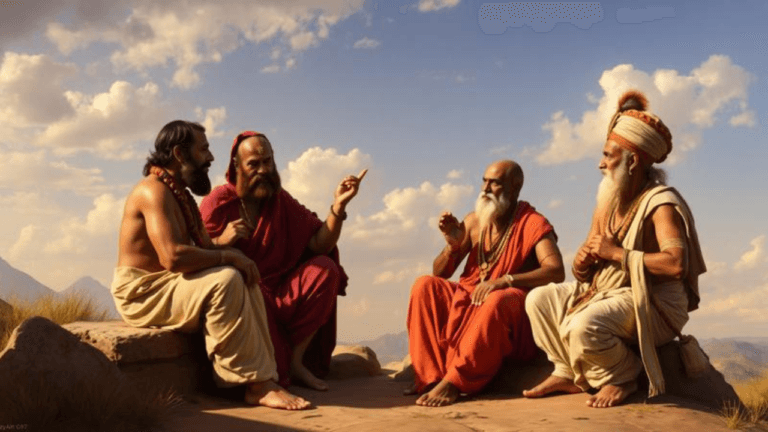
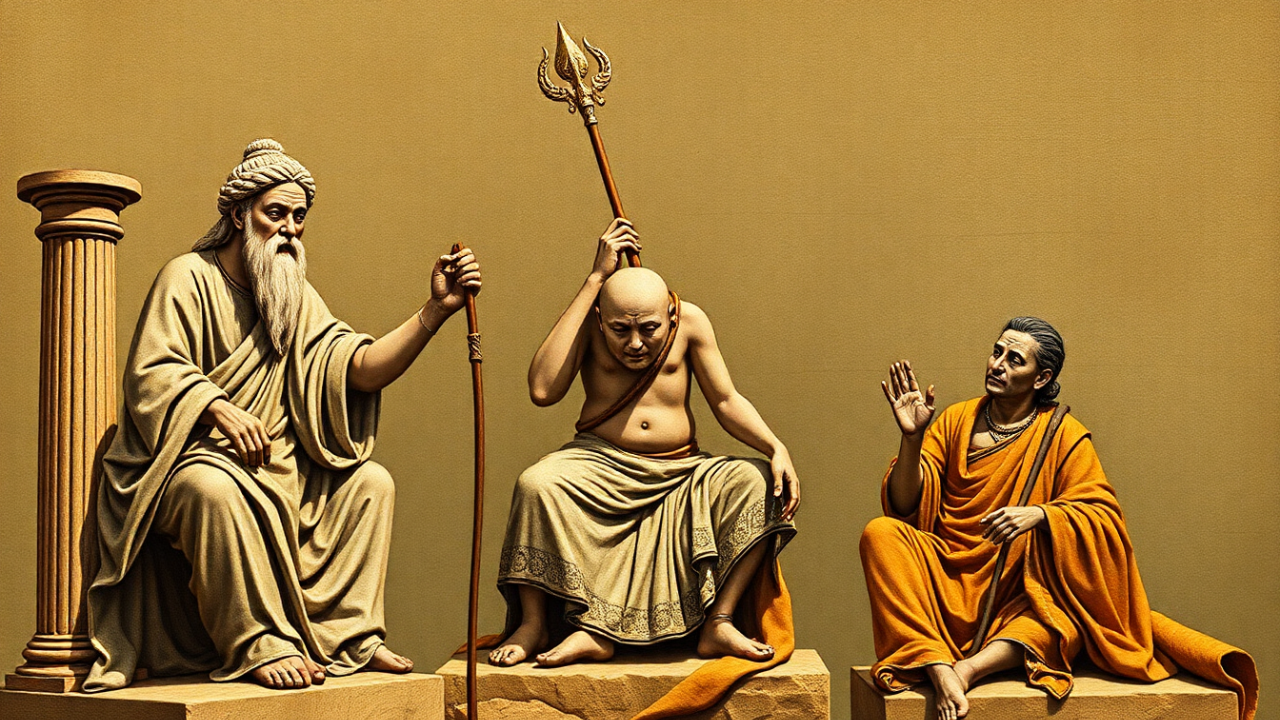
Long before modern science and psychology, people across the ancient world were already asking the same questions that are still unanswered: What is real? What is good? What is the purpose of life? From the coasts of Greece to the forests of India and the courts of China, early thinkers (especially in the Axial Age) tried to make sense of existence through reason, observation, and introspection.
These pioneers built the first schools of philosophy – communities of debate, meditation, and inquiry – each offering its own map of reality.
This post takes a quick journey through 30 ancient philosophy schools – from the Stoics and Pythagoreans to the Buddhists and Confucians – to see how humanity’s oldest ideas about truth and meaning still shape our world today.
Table of Contents
Chapter 1: Greek Schools
- Milesian School – The Milesians– Thales, Anaximander, and Anaximenes – were the first to seek natural rather than divine explanation of the world. Living in the Ionian city of Miletus, they asked what the universe was fundamentally made of: water, air, or an undefined, boundless substance called apeiron. In doing so, they transformed myth into reason and laid the groundwork for science itself.
- Pythagorean School – Founded by Pythagoras, the ancient philosophy school saw numbers as the hidden structure of reality. To them, harmony, proportion, and mathematical order governed both music and the cosmos. They mixed mysticism with mathematics, teaching that the soul was immortal and the universe was a grand symphony of numerical relationships.
- Heraclitean School – Heraclitus of Ephesus saw the universe as constant change – “you cannot step into the same river twice.” Fire, for him, symbolized the ever-living process of transformation. Beneath this flux, however, was logos – a rational order guiding the chaos. His vision inspired later thinkers who sought unity within motion.
- Eleatic School – The Eleatics, led by Parmenides and Zeno, turned Heraclitus upside down. They argued that change and plurality were illusions – that reality is one, eternal, and unchanging. Zeno’s paradoxes, like Achilles and the tortoise, challenged the very logic of motion, forcing philosophers to rethink how we perceive truth and illusion.
- Pluralistic school – Thinkers like Empedocles and Anaxigoras tried to reconcile change and permanence. Empedocles proposed that all things were made from four roots – earth, air, fire, and water – combined by love and strife. Anaxigoras added the mind as the cosmic force organizing matter. They bridged mythic unity and scientific multiplicity.
- Atomist School – Leucippus and Democritus imagined the universe as composed of indivisible particles – atoms – moving in the void. They rejected divine causes, suggesting that natural laws and random motion explained everything. Their vision of a mechanical universe later echoed in modern physics, centuries before it was discovered.
- Platonic School – Plato saw the visible world as a shadow of a higher reality – the world of forms or ideas. True knowledge, he said, comes not from the senses but from remembering these eternal truths. His dialogues blended reason, myth, and moral idealism, shaping thought for over two millennia.
- Aristotelian School – Aristotle, Plato’s greatest student and critic, brought philosophy down to earth. He emphasized observation, classification, and logic, believing that form and matter coexisted in everything. His Golden Mean defined virtue as balance, and his systematic works on ethics, politics, and science built the foundation of rational inquiry.
- Epicurean School – Epicurus taught that happiness lies in simple pleasures, friendship, and the absence of fear- especially fear of the Gods and death. He saw the world as atoms in motion, not a divine design, and encouraged moderation over indulgence. His quiet garden school was a sanctuary of calm reason against superstition.
- Stoic School – The Stoics – from Zeno of Citium to Marcus Aurelius – believed that virtue alone leads to happiness. They taught self-mastery, duty, and acceptance of fate, viewing reasons as the divine fire within all. Their strength lay in serenity: aligning one’s will with nature’s law brings true freedom.
- Cynic School – Founded by Antisthenes and made famous by Diogenes, the Cynics rejected luxury and convention, living in radical simplicity. They believed virtue was the only true good, and social norms were mere illusions. Their defiance of comfort and hypocrisy inspired later philosophies of freedom and authenticity.
- Skeptic School – The Skeptics, led by Pyrrho and later Sextus Empiricus, doubted the possibility of certain knowledge. They advised suspending judgment and living according to appearances rather than dogma. Paradoxically, their doubt brought peace, for when one stops insisting on the truth, the mind rests in quiet balance.
- Neoplatonic School – In the 3rd Century CE, Plotinus revived Plato’s vision through mysticism. He taught that all reality flows through the One, a transcendent source beyond being and thought. The soul, through contemplation, can ascend back to the divine unity. Neoplatonism bridged Greek reason and Eastern spirituality, influencing early Christian and Islamic thought alike.
Chapter 2: Canaanite Schools
- Judaism – Emerging in ancient Canaan and later crystallized through prophets and rabbis, Judaism framed philosophy not around speculation but covenant – a moral relationship between humans and the divine. Its wisdom tradition, from Job to Ecclesiastes, wrestled with suffering, justice, and meaning. Rather than abstract metaphysics, it offered an ethical vision: one God, one moral law, and a call to live rightly in a world shaped by divine purpose. Greek thinkers sought truth through logic; the Hebrews sought it through righteousness.
- Samaritanism – A sister faith to Judaism, Samaritanism preserved an older version of the Israelite religion centered on Mount Gerizim rather than Jerusalem. Its philosophy lay in fidelity to divine law and sacred geography – the belief that holiness resides in obedience and place. While smaller in influence, the Samaritans represented a quiet protest against central authority, valuing purity of faith over expansion of empire. Their endurance for millennia makes them a living echo of philosophy rooted in devotion and identity.
Chapter 3: Persian Schools
- Zoroastrianism – Founded by the prophet Zarathustra around the 2nd millennium BCE, Zoroastrianism framed the universe as a battleground between truth and falsehood. Its supreme god, Ahura Mazda, represents light, wisdom, and justice, eternally opposed by the spirit of chaos, Angra Mainyu. Unlike fatalistic myths, it gave humanity moral agency – each choice contributing to the victory of good. This ethical dualism influenced later religions, from Judaism’s angels and demons to Christian and Islamic ideas of heaven and hell.
- Manichaeism – Emerging in the 3rd century CE through the Persian prophet Mani, Manichaeism fused Zoroastrian dualism with Christian and Gnostic mysticism. It saw the cosmos as divided between light and darkness, spirit and matter, and portrayed human life as a struggle to free the divine spark trapped in flesh. Its mix of philosophy, mythology, and ascetic discipline spread across Asia and Europe before persecution nearly erased it. Yet its influence endures in every worldview that sees existence as a moral and metaphysical tension between purity and corruption.
Chapter 4: Indian Schools
- Samkhya – Samkhya, one of India’s most ancient philosophy schools, teaches that reality consists of two eternal principles – Purusha (consciousness) and Prakriti (matter). Liberation arises when the self realizes it is pure awareness, separate from nature’s restless dance. Samkhya’s rational, dualistic framework became the backbone of later Hindu and yogic thought, offering one of humanity’s first psychological models of existence.
- Yoga – Built upon Samkhya’s metaphysics, the Yoga school, summarized by Patanjali, turned philosophy into a disciplined practice. It taught that through ethical living, breath control, concentration, and meditation, the mind can be stilled and the soul united with its pure source. Yoga was not merely an exercise, but a study of consciousness – philosophy turned inward experience.
- Nyaya – Nyaya was India’s school of logic, founded by Gautama. It argued that liberation requires right knowledge, and right knowledge comes through rigorous reasoning. By classifying perception, inference, comparison, and testimony as valid sources of truth, Nyaya built the foundation for India’s analytic tradition – philosophy as clarity and precision.
- Vaisheshika – Closely related to Nyaya, Vaisheshika, founded by Kanada, offered an atomic theory of the universe. It divided existence into categories – substance, quality, motion, and more – and proposed that all matter is made of eternal atoms. Though metaphysical, its aim was spiritual: by understanding the universe’s structure, one learns detachment from it.
- Mimamsa – Mimamsa, or Purva-Mimamsa, saw the Vedas not as myths but as eternal laws governing the body. Founded by Jaimini, it focused on ethical action and ritual precision, teaching that moral order sustains both society and the cosmos. It treated language, ritual, and ethics as tools of liberation through righteous living rather than mystical knowledge.
- Vedanta – Vedanta, or Uttara-Mimamsa, took the Upanishads as its core and declared that the individual soul and the ultimate reality are one. Thinkers like Shankara, Ramanuja, and Madhva offered different interpretations – from non-dualism to theism – but all sought union within the infinite. Vedanta became the crown of Indian philosophy, blending logic, devotion, and mystic insight.
- Carvaka (Lokayata) – The Carvaka school was India’s bold materialist voice. It rejected the authority of the scriptures, denied karma and the afterlife, and held that perception is the only valid source of knowledge. Life, they said, is short and sensual – enjoy it while it lasts. Though mostly lost to time, Carvaka’s skepticism proved that ancient India also made room for atheism and reasoned doubt.
- Jainism – Jain philosophy, founded by Mahavira, taught that all souls are bound by karma, subtle matter that clings to consciousness through violence and desire. Liberation comes through non-violence, truth, and ascetic discipline. Its vision of a living, moral universe made compassion and self-control the highest forms of wisdom.
- Buddhism – Born from the insights of Siddhartha Gautama, Buddhism turned philosophy into a path of liberation through mindfulness and compassion. It rejected speculation about eternal souls or Gods, focusing instead on suffering and its cessation. Through the Four Noble Truths and the Middle Way, it taught that freedom lies not in belief, but in awakening – the end of craving and illusion.
Chapter 5: Chinese schools
- Taoism (Daoism) – Rooted in the teachings of Lao Tzu and Zhuang Zhou, Taoism sought harmony with the Tao – the Way, the natural flow of all things. It taught that wisdom lies not in control but in effortless action, living gently in accord with nature’s rhythm. Through paradox and poetry, Taoism celebrated simplicity, spontaneity, and mystery beyond words – the silence that makes music possible.
- Confucianism – Confucius turned philosophy into a moral art of living. In a time of social chaos, he taught that virtue begins with respect – in family, in friendship, and in governance. Through ren (humaneness) and li (ritual propriety), he envisioned harmony between personal ethics and public order. His disciples built one of the most enduring systems of ethical and political philosophy in human history.
- Mohism – Founded by Mozi, Mohism arose as a challenge to both Confucian hierarchy and feudal warfare. It promoted universal love – the idea that all people deserve equal care, regardless of kinship or status. Rational and practical, Mohists valued merit over birth and sought social welfare through ethical governance. Though later eclipsed, their ideals foreshadowed utilitarian thought and humanitarian ethics.
- Legalism – Legalism, the harsh counterpart to Confucian Virtue, believed that order could only be achieved through strict laws and enforcement. Figures like Han Feizi argued that humans are driven by self-interest, not morality – so rulers must govern through reward and punishment, not virtue. It unified China under the Qin dynasty, but at the cost of freedom, reminding later thinkers that power without ethics leads to tyranny.
Conclusion
Across millennia and continents, these thirty ancient philosophy schools spoke in different tongues but asked the same questions: What is real? What is right? What is enough? The Greeks sought order through reason, the Canaanites through covenant and faith, the Persians through moral struggle, the Indians through liberation, and the Chinese through harmony. Each offered not just theories, but ways of living – paths toward wisdom in a world that has always felt uncertain.
Through temples have crumbled and languages changed, their echoes remained. Stoic calm still guides psychology, Buddhist mindfulness shapes modern therapy, and Confucian ethics underlie our ideas of duty and family. Even the skeptics and materialists whisper in science and humanism today. To study these schools is not to look backward, but inward – to rediscover how the ancient mind still beats within us.
That’s all for this blog. If you enjoyed this post, please comment, share, and subscribe below. Thank you a lot.