Introduction
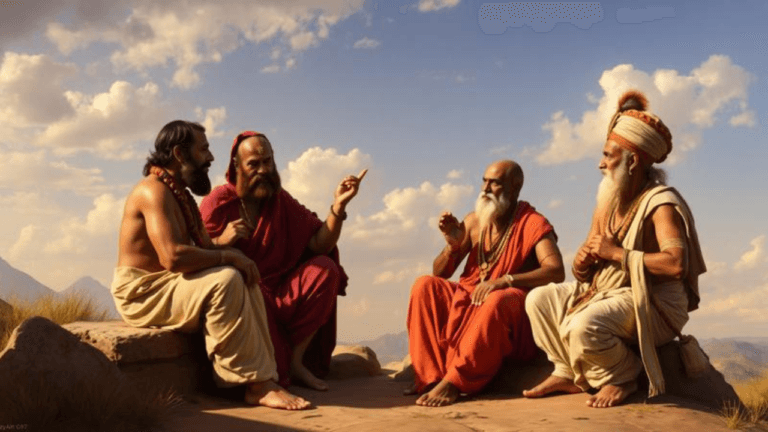
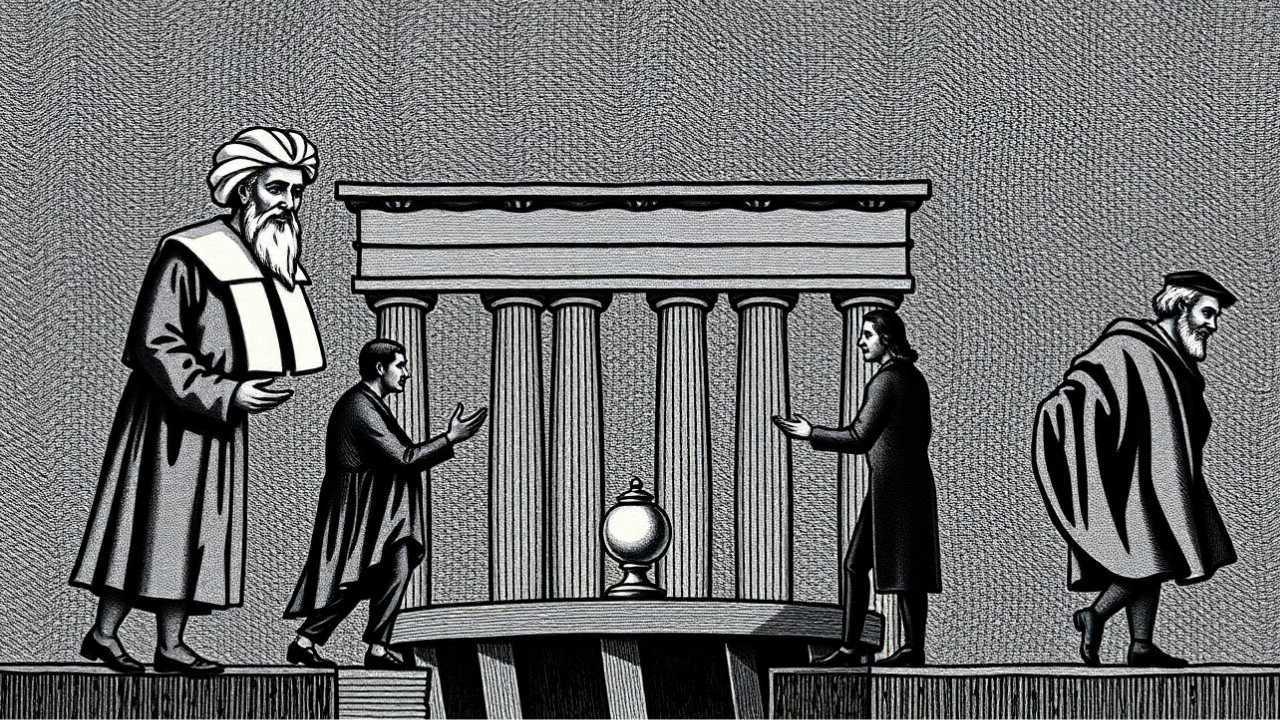
Homo sapiens is considered an intellectual species. For over 60,000 years, human beings have slowly evolved through time with the help of cognitive, agricultural, and scientific revolutions. Through logic, reason, trial and error, the primitive humans have evolved to their modern selves. During the course of this intellectual evolution, although agreement by the general public played an important role, disagreement and even rivalries played an important role in enquiry and further evolution.
In this blog, we talk about seven such famous intellectual rivalries that shaped the course of human history. From classical Greece to modern science, these rivalries played an important role in how human beings began to understand the universe.
Table of Contents
1. Platonism vs Aristotelianism
The school of Platonism believed that the world around us is a shadow of a higher one. Plato argued that true knowledge comes from pure reason and turning inward. He suggested not to trust our imperfect senses. For the Platonists, the real world was abstract and eternal, which cannot be perceived or understood by our five senses.
Then came the Aristotelians. They suggest that the real world can only be seen by studying everything around us through our senses, including various substances, causes, and observable patterns. According to Aristotle, true knowledge can be achieved through practical experiences, and not from theories and inner contemplations.
This rivalry became the foundation of modern Western thought, specifically between idealism and empirical realism.
2. Nyaya vs Buddhism
The Nyaya Philosophers of ancient India believed in a realistic world that can be known through perception, inference, comparison, and testimony. They gave importance to logic above all else. They believed in a permanent self (atman) and an objective world that works alone on pure logic and reasoning.
Buddhists, on the other hand, believed everything is temporary, including the self, which is just a collection of experiences. They were skeptical of Nyaya’s claim of objectivity and propagated relativism.
This rivalry shaped India’s intellectual debate over objective vs subjective truth for centuries.
3. Confucianism vs Legalism
Confucius and his followers saw society as something that flourishes through virtue, morals, and proper relationships. They believed humans could evolve through proper guidance, education, and ethics. They proposed an ethical world that would be ruled by virtuous rulers for inspiration.
Legalism argued the opposite: a society could function properly only through strict laws and firm punishments. They believed the world could be in perfect order through proper law enforcement, and not through morals and virtues.
Both the schools influenced China in different periods (Legalism during the Qin Dynasty and Confucianism during the Han Dynasty), before finally merging with the societies of the Chinese Civilization forever.
4. Advaita vs Dvaita
Adi Shankara and his school of Advaita Vedanta taught that reality is ultimately the nondual Brahman. They claimed that liberation from illusion occurs when the self realizes that God, the self, and the universe are all one.
Dvaita Vedanta, founded by Madhva, debated that God, the self, and the universe are distinct forever. The world is fully real and not an illusion. According to them, liberation will occur not through any realization, but through complete devotion to God (Vishnu).
This debate shaped Indian Philosophy and continues to thrive in Hindu philosophical discussions.
5. Rationalism vs Empiricism
Rationalists like René Descartes and Baruch Spinoza believed that the mind contains innate ideas, and reason is the strongest path to truth. Mathematics and Logic come from proper reasoning and critical thinking, and are independent of the senses.
Empiricists like John Locke, David Hume, and George Berkeley argued the reverse: the mind begins as a blank slate, and is filled by knowledge from experience. According to them, sense organs are the ultimate tools of understanding, and even complex ideas evolve from simpler impressions.
This debate laid the foundation of modern science and shaped the Enlightenment Period.
6. Lamarckism vs Darwinism
Jean-Baptiste Lamarck proposed that species evolve because organisms adapt during their lifetimes and pass these traits to their offspring. Giraffes stretch their neck to eat leaves from tall trees, and their children inherit longer necks. According to him, evolution was driven by need and effort.
Charles Robert Darwin showed that evolution works through natural selection. Random mutation occurs, and those better suited for their surroundings survive and reproduce. Traits don’t arise because they are needed; they remain because they work.
Darwin’s model replaced Lamarck’s theory, completely changing the direction of the study of genetics and evolution.
7. Relativity vs Quantum Mechanics
Albert Einstein’s Relativity described the universe as smooth, continuous, and governed by precise laws. According to his theory, space and time curve around mass, resulting in deterministic patterns. It works beautifully on celestial objects like galaxies, stars, and planets.
Quantum Mechanics, led by the likes of Max Planck and Niels Bohr, challenged the picture. At the smallest scales, reality becomes probabilistic, discontinuous, and uncertain. Particles behave like waves, and both position and momentum cannot be determined simultaneously.
Both the theories still work, but they don’t agree with each other, leading to one of Physics’ greatest intellectual rivalries.
Conclusion and Reflection
These seven intellectual rivalries showed that contradicting ideas can survive in the same world and often lead to some kinds of revolutions. Debates, discussions, and disagreements are some of the strongest tools that humans possess and should always be encouraged, cherished, and promoted. If everyone agreed to the same idea, humans would still be hunters and gatherers in the 21st century CE.
That’s all for this blog. Please comment, share, and subscribe if you find this interesting. Thank you for reading this blog.