Tag: comparative-philosophy

  • The Long History of Free Will: From Greece to India to China

    The Long History of Free Will: From Greece to India to China

    Introduction

    Since the beginning of human history, one question has always troubled human cognition and, in turn, human philosophy: Does free will exist? For millennia, scholars, thinkers, philosophers, and theologians have sought to answer the question in their own way, considering their time and place. In this blog, we discuss various theories regarding free will from twenty ancient philosophy schools across Greece, India, and China. We also discuss their basic ethics, metaphysics, and epistemology, which helped determine their stance on free will.

    Chapter 1: Platonism

    Platonism was the ancient Greek school, based on Plato’s teachings. They believed that moral goodness comes from aligning the soul with the good. They considered the soul to be eternal and indestructible, while the material world was considered to be continuously changing.  For them, the ultimate virtue was knowledge, while the real evil was ignorance. According to them, free will depended on recollection of knowledge. The more the soul makes a decision based on knowledge and reason, the more freedom it has over its will. In short, free will increases with rational thinking. Although officially, the school ended, their idea of free will shaped early Christian theology, creating an amalgamation of idealism and moral realism.

    Chapter 2: Aristotelianism

    Aristotelians gave more priority to practical knowledge over reason and induction. For them, the substances were composites of form and matter, and causes explained changes. Thus, they believed that humans have complete free will, as they could make informed choices, assisted by rational thinking. Aristotelianism gave the foundation to modern Western ethics as well as many concepts within psychology and psychoanalysis.

    Chapter 3: Stoicism

    Stoicism was an hellenistic school, which considered living according to reason and nature as the highest virtue. According to them, everything unfolded necessarily, as the cosmos was governed by Logos (a kind of divine universal reason). The external events were already determined, but the inner ascent based on knowledge gained was free, thus giving assurance to a limited free will.  Stoicism, centuries later, strongly influenced modern CBT and psychology.

    Chapter 4: Epicureanism

    The Epicureans were the descendants of the ancient Greek Atomist school. They considered that the world is made of atoms, roaming freely in space, thus denying an overlooking God. They believed pleasure (absence of pain) to be the highest virtue and the sensory experience to be the foundation of knowledge as free will. Since the Epicureans defined the world to be independent of any external forces, they advocated for complete free will, breaking strict determinism. Epicurean thoughts can be found within modern secular ethics and materialism, particularly in the Western world.

    Chapter 5: Skepticism

    The Skeptics were rationalists with no claim about either an ultimate reality or an overlooking power. They considered knowledge to be always contestable and preached living life pragmatically. The skeptic school believed in free will and avoided any theory regarding predestination. Skepticism shaped scientific reason and critical thinking, even centuries after the school formally ceased to exist.

    Chapter 6: Cynicism

    The Cynic school had a radical virtue that rejected any type of convention and promoted living according to nature in a minimalistic and anti-speculative way. They believed that truth is lived, not theorized, and intellectual systems corrupt authenticity. When it comes to free will, they avoided answering that directly and considered true freedom came from detachment from social and psychological constraints. Cynic values are today found in some form within anti-consumerism and moral minimalism.

    Chapter 7: Neoplatonism

    It was a school that rose at the end of the Hellenistic period and influenced the Roman Empire after Greece became a colony of Rome. They were the believer of a hierarchical world. The highest of the realities was the One, an ultimate reality beyond thought, followed by the Intellect or Nous, where thoughts and ideas thrived. The third level was that of the Soul or Psyche, which animated the world and acted as a bridge between the higher and the lower levels. The final bottommost level was the material world, a gross world filled with imperfections changing continuously. The school gave intuition priority over reasoning, and believed that the soul is free to turn inward or outward to the material or the intelligible realms. Neoplatonism greatly affected Western mysticism as well as medieval and early-modern philosophy.

    Chapter 8: Sāṁkhya-Yoga

    Sāṁkhya and Yoga were two of the oldest Indian philosophy schools. The twin schools were dualistic in nature, believing the world is made of Puruṣa (consciousness) and Prakṛti (nature). They considered liberation as a result of acquiring discrimination between consciousness and matter. To them, although psychological processes were determined, they believed in limited free will through the process of non-identification and detachment. The schools gave birth to meditation techniques for various Eastern traditions and also contributed to the modern mind-body dualism debates.

    Chapter 9: Nyāya-Vaiśeṣika

    They were the proponents of ancient realist pluralism. The Nyāya school used highly developed logic with great emphasis on inference and debate, while Vaiśeṣika believed the world is made up of smaller indivisible particles called Anu, thus both school rejecting a creator God. They believed that humans are moral agents capable of choice, and their karma (action) determines the karmaphala (outcomes). The schools, although nearly extinct today, became the foundation of logic and epistemology for the Indian religions.

    Chapter 10: Mīmāṁsā

    It was a non-theistic school that emphasizes dharma (righteous conduct) and rituals over everything else. The followers gave importance to language and testimony (Vedas) as the authoritative sources of knowledge. They believed in limited free will, as they debated that will is mostly determined by the moral and righteous act, thus limiting free will to a lower importance. Mīmāṁsā influenced the later Hindu rituals as well as the rule-based ethics system.

    Chapter 11: Advaita Vedānta

    The Indian non-dual philosophy school and tradition, Advaita Vedānta, believes that only Brahman (collective consciousness) is real, while the entire universe is merely a reflected/limited projection of it because of Māyā (cosmic illusion). For the Advaitins, avidyā (ignorance) causes bondage, resulting in the debate of whether free will exists or not. But acquiring self-knowledge (jñāna) makes one realise that everything is Brahman, so the question of free will becomes somewhat meaningless. The Advaita Vedantā school still exists today and strongly influences consciousness studies and non-dual philosophies all over the world.

    Chapter 12: Theistic Vedānta 

    All the other Vedānta schools (Vedānta means that which ends or completes the Vedas, i.e., the Upaniṣads, which all the Vedantins follow) except Advaita Vedanta are theistic in nature, i.e., they believe in a personal God with qualities or attributes. Important schools like Viśiṣṭādvaita Vedanta and Dvaita Vedanta believed in a creator God, independent consciousness, and a very real world. Although the schools ranged from qualified non-dualism to complete dualism, all of them believe that real and moral free will exists within divine governance, and thus emphasize bhakti (devotion to God) over jñāna (self-knowledge). They are some of the dominant philosophical schools in India today and have heavily impacted Hindu cultural ethics and devotional theology.

    Chapter 13: Theravāda Buddhism

    They are the oldest branch of Buddhist philosophy, which emphasizes that reality is impermanent and conditioned. They believe that no enduring self exists, and true insight can be gained through mindfulness and direct experiential observation. They believe in a conditioned free will, which can be transformed through rigorous disciplinary practices. Theravāda is most famous today in Sri Lanka and Southeast Asia, and has greatly impacted mindfulness-based therapies, meditation, and cognitive psychology.

    Chapter 14: Mahāyana Buddhism

    Mahāyana or the Greater Vehicle Buddhists believe that emptiness (śūnyatā) denies the fundamental nature of all phenomena, and everything is relative. They emphasize interdependence and compassion as some of the highest virtues. Regarding free will, they believe that the freedom of someone increases as they get to understand the relativity of everything around, and also the importance of relational causality and interdependence. Mahāyana today exists and dominates the Himalayan regions as well as the East Asian countries, and contributes heavily to the ethics of care and interdependence.

    Chapter 15: Jainism

    Jains are the proponents of absolute non-violence. They believe in pluralistic realism, as souls are distinct and eternal. According to their epistemology, truth can have multiple interpretations, suggesting that different people perceive it in various ways. This principle is called anekāntavāda. Regarding free will, they have a strong emphasis on individual responsibility and self-control over complete freedom. Jainism today exists mostly in western India and is a true leader when it comes to ethics, environmentalism, and agency debates. 

    Chapter 16: Cārvāka

    It was the Indian materialistic school that believed neither in any consciousness nor in any afterlife. They were the ultimate anti-ascetic, pleasure-oriented, pragmatists, who saw only perception as a valid knowledge. They believed in complete free will, which is unconstrained by any God, karma, responsibility, or anything. As they believed nothing exists after death, they advocated living life to the fullest. Although the original atheistic school went extinct, it gave rise to early secularism and rational critique of any kind of metaphysics.

    Chapter 17: Confucianism

    Confucianism is an Ancient Chinese school which gives emphasize or moral cultivation through roles, rituals, and virtue. It advocates deep respect for tradition and self-cultivation. According to the school, true freedom lies in self-discipline, and not in individual autonomy. Confucianism is completely absorbed within most of the East Asian cultures and acts as a guide for social ethics, proper education, and political philosophy.

    Chapter 18: Daoism

    The Daoists believe in effortless action (wu-wei) and harmony with nature. They consider Dao as the ultimate source or principle of the universe, which also maintains the natural order over everything. They emphasize intuition over analytical reasoning and believe that free will emerges from non-resistance to natural flow. Presently, Daoism is greatly present in China, Korea, Taiwan, and Vietnam as it continues teaching systematic thinking along with considering the ecological consequences.

    Chapter 19: Legalism

    Legalism was a Chinese philosophy that considered law and order as more ethically important than virtue. They had a pragmatic worldview and considered knowledge as a tool for power. Regarding free will, they had the belief that human nature should be shaped externally with law and punishment. Legalism significantly influenced the political realist and authoritarian governance model in China over the centuries.

    Chapter 20: Mohism

    Mohism was an important school in ancient China based on universal concern and social utility. It was naturalistic and anti-ritualistic. The Mohists considered that humans have a considerable amount of free will, as they can make decisions based on logical argument and reason. The school strongly impacted the scientific and logical development in the Sinosphere throughout the millennia.

    Conclusion

    Thus, we see that the question of free will was answered by different ancient philosophical schools differently. While the Epicureans and the Cārvākas believed in complete freedom, the Cynics and the Legalists advocated nearly no free will. Most schools tried answering not whether free will exists, but whether free will should be exercised in their own way. From Neoplatonists to Advaitins, from Daoists to Jains, all had their own conclusion. Hope you followed the individual perspectives of these schools regarding free will clearly. 

    That is all for today. Hope you enjoyed it. Please like, share, and subscribe to keep me motivated. And finally, thank you for reading the blog.
  • Understanding God in Indian Thought: An Introductory Overview of Hindu, Buddhist, Jain, and Sikh Perspectives

    Understanding God in Indian Thought: An Introductory Overview of Hindu, Buddhist, Jain, and Sikh Perspectives

    Introduction

    Since the time of cognitive evolution, humans have continually sought reasons for our existence and our surroundings. As a result, our ancestors developed their own metaphysics, cosmology, and the concept of God based on their cultural surroundings. In Indian civilization, the people slowly developed a unique way of understanding the divine creation, which is very different from the Abrahamic traditions more popular in the West. A verse from the Ṛgveda, the earliest known scripture of India, beautifully captures the Indian way of thought and the freedom of thought. It quotes, “ekam sat viprā bahudā vadanti,” which translates to “Truth is one, but the wise call it by various names.” All the traditions of India that emerged later, fully or partially, were inspired by this very verse, which led to a diverse understanding of the truth and the path for finding the truth. In this blog, we discuss the most important 20 philosophical thoughts and traditions that emerged in the Indian civilization through the lens of how they view the concept of God and the universe. This blog doesn’t intend to give any judgment on which path is superior, as ultimately all path ultimately leads to the same truth, with the right intention. This blog can be considered an introductory article for understanding the Indian philosophical school, without going deeper into any, as it’s nearly impossible to give detailed information on every school in a single blog. Most schools are arranged in a chronological order, except for a few exceptions for better comparative understanding. So let’s begin.

    1. Cārvāka (Lokāyata)

    The Cārvāka school is one of the earliest philosophical schools in India. They are the ultimate materialists. According to them, there is no God, and no individual or collective consciousness (ātman & brahman), and no transcendental principle. According to them, only matter exists, and reality is composed of four elements (earth, water, fire, air). They reject any form of scripture and give priority to only perception (pratyakṣa) as valid knowledge. They don’t believe in any form of karma, rebirth, heaven, or liberation. They are radical atheist who believe ethics is pragmatic, and not cosmic.

    2. Sāṃkhya-Yoga

    The Sāṃkhya and Yoga were separate philosophical traditions with a lot of similarities and shared doctrines. They slowly merged such that in today’s world, it’s impossible to study or follow one without studying the other. Both schools are dualistic, and according to their metaphysics, reality is composed of Puruṣa (pure, passive, multiple, eternal consciousness) & Prakṛti (primordial, active, unconscious matter). Sāṃkhya believes in no God, while Yoga believes in Īśvara (personal God – who is not a creator God but a special Puruṣa, unaffected by karma and suffering, who is an idle object for meditation). Both schools believe liberation comes from discriminative knowledge between Puruṣa & Prakṛti. According to them, reality is made up of 25 tattvas (elements) like intellect, ego, senses, and natural elements. Thus, both schools describe reality without a creator God, treating liberation as a psychological-metaphysical separation.

    3. Nyāya-Vaiśeṣika

    They are twin schools, which originally started as separate schools during the Axial Age, but were merged millennia later around the 10th-13th century CE. Both schools are pluralistic and believe in many consciousnesses (ātman) and many substances. They accept a personal God (Īśvara) as an intelligent ordering principle. They believe God is not the material cause but the efficient cause of the universe. The  Nyāya school is the school of logic, which believes in four means of knowledge: perception, inference, comparison, and testimony. They believe God’s existence is established through inference and not through revelation alone. They also believe rational argument is central and more important than faith. According to Vaiśeṣika ontology, the universe is composed of eternal atoms (earth, water, fire, air), which are arranged by Īśvara according to karma, and suffering comes from karma alone, not any divine will. Both the schools present a rational theism where God is an architect and moral governor, who is discovered through logic rather than mystical insight.

    4. Mīmāṃsā (Pūrva Mīmāṃsā)

    The Mīmāṃsā scholars believe that no creator God is required to explain the universe, and reality is governed by dharma or righteous duty. They believe the Vedas are authorless and eternal. The Gods mentioned in the Vedas are considered by them as functional entities, invoked through ritual, not supreme creators. According to their cosmology, the universe is beginningless, and ritual action itself produces results through an unseen potency (apūrva), not divine intervention. They give more preference to the verbal testimony (śabda) of the Vedas over perception and inference. Mīmāṃsā presents a ritual-centered, non-theistic worldview, where cosmic order functions without a supreme God.

    5. Advaita Vedānta

    According to Advaita Vedānta, only Brahman (infinite, changeless, non-dual consciousness) is real, while the world is mithyā, i.e, dependent and provisional. According to them, the individual soul (ātman) is the same as the eternal soul (brahman). They believe in Īśvara (personal God), who exists at the empirical level, and is actually Brahman reflected through māyā (cosmic illusion or ignorance). They believe the universe appears through māyā and is not a real creation but a mere manifestation, as the only truth, i.e., Brahman itself does not change or act. Epistemologically, they believe liberation comes through direct, non-dual insight or knowledge (jñāna) that removes ignorance, rather than through any ritual or belief. They give importance to the teachings of the Upaniṣads (the fourth and the last section of the Vedas) that help in attaining jñāna. In short, Advaita Vedānta presents God as ultimately impersonal and non-dual, with the personal God serving as a pedagogical reality within ignorance.

    6. Viśiṣṭādvaita Vedānta

    According to Viśiṣṭādvaita Vedānta, Brahman is personal and identified with Viṣṇu/Nārāyaṇa. God is considered as one, and consciousness (cit) and matter (acit) are real and dependent attributes of God. For them, the world is real, and not illusory. Their God, unlike that of Advaitins, possesses infinite auspicious qualities, and ātmans are modes (prakāra) of Brahman, not identical to him. Their cosmology shows the universe existing as God’s body, and creation as a real transformation of God’s power. For Viśiṣṭādvaitins, knowledge is important, but devotion (bhakti) and grace are central. Complete surrender (prapatti) leads to liberation. Viśiṣṭādvaita presents God as a personal, all-compassing reality, where unity and difference coexist without illusion.

    7. Dvaita Vedānta

    This is a dualistic school and tradition that considers reality as irreducibly dualistic. In Dvaita Vedānta, the God (Viṣṇu), individual consciousnesses, and matter are eternally distinct. The difference (bheda) is real, and neither provisional nor illusory, like the previously mentioned two schools. To them, God is supreme, independent (svatantra), and personal. Consciousnesses and matter are dependent realities (paratantra). They consider five real distinctions or pañcabheda. They are: God-consciousness, God-matter, consciousness-consciousness, consciousness-matter, matter-matter. These differences persist even after liberation. Dvaitins also believe liberation leads to eternal proximity to God, and not union. Dvaita presents God as a supreme, personal ruler, eternally distinct from anything else, rejecting all forms of non-dual identity.

    8. Dvaitādvaita Vedānta

    According to them, reality is characterized by both difference and non-difference. To them, Brahman (Kṛṣṇa/Rādhā) is the supreme reality, and consciousness and the world are distinct yet inseparable from God. God is seen as personal, loving, and relational, and is considered the cause, sustainer, and inner controller of the universe. Both knowledge and devotion together are seen as the means of liberation, with special importance given to bhakti for Kṛṣṇa. Dvaitādvaita portrays God as a unity that naturally includes differences, avoiding both absolute identity and absolute separation.

    9. Śuddhādvaita Vedānta

    According to Śuddhādvaita Vedānta, Brahman alone exists, but unlike Advaita, the world is fully real. Brahman manifests the universe without losing perfection. God is seen as Śrī Kṛṣṇa, the complete and joyful Brahman, and the world is a real expression of divine play (līlā). According to them, liberation is achieved through Bhakti and loving participation in God’s līlā. This school presents God as pure, joyful reality, where the world is not a problem to escape, but a divine expression to be embraced.

    10. Acintya Bhedābheda

    The last of the Vedānta schools, Acintya Bhedābheda, believes reality is simultaneously one and different, in a way that is acintya (inconceivable to logic). They consider Kṛṣṇa as the supreme personal manifestation. God is personal, relational, and supreme, with all his energy (śaktis) manifesting both the world and the individual consciousnesses. They consider creation as purposeful and not illusory. According to this school, pure bhakti is the highest means to reach liberation. Acintya Bhedābheda presents God as a personal absolute, whose unity with the world and various consciousnesses transcends human logic rather than denying it.

    11. Pāśupata Śaivism

    It is a school or tradition where Śiva, in the form of Paśupati, is seen as the supreme, eternal God. He is completely distinct from consciousnesses (paśu) and the world. Pāśupata Śaivism defines reality as fundamentally theistic and dualistic. God is omnipotent, independent, and the giver of liberation. It is grace, not knowledge, which leads to complete freedom. According to them, the consciousnesses are bound by impurities (pāśa). Mokṣa or liberation here is seen as release from bondage, and not identity with God. Consciousnesses remain eternally distinct, but free and blissful. Pāśupata Śaivism presents God as a sovereign Lord, where liberation depends on divine grace rather than metaphysical identity.

    12. Śaiva Siddhānta

    This is another śaiva school whose metaphysics is structured around three categories- Pati (Lord Śiva), Paśu (individual consciousness), and Pāśa (impurities like karma, māyā, and other impurities), and all three are real and distinct. Śiva is seen as the supreme personal God, both transcendental and immanent. He is the effective cause, not the material substance of the universe. Emphasis is given on ritual devotion (kriyā), ethics (caryā), and spiritual knowledge (jñāna). Mokṣa or liberation in this school refers to union without identity, where souls attain  Śiva-like bliss but do not become Śiva themselves. Śaiva Siddhānta, in short, envisions God as a personal, liberating Lord, balancing devotion, ritual, and metaphysical realism.

    13. Kashmir Śaivism (Trika)

    This is a non-dual śaiva school, which considers Śiva to be the only consciousness, and the reality is dynamic, not static. God is considered to be Śiva-Śakti, the inseparable consciousness and power. According to their metaphysics, the universe consists of 36 tattvas (elements or levels of reality). Māyā is not considered an illusion but rather the self-limitation of consciousness. According to them, knowledge arises through direct recognition (pratyabhijñā), and Mokṣa or liberation occurs by recognizing oneself as Śiva. Kashmir Śaivism presents God as living consciousness, where realizing God means recognizing the divine nature of one’s own awareness.

    14. Śākta Tantra

    In this school, the ultimate reality is seen as Śakti, the Divine Mother, the dynamic power of existence. Śiva without Śakti is considered inert, while Śakti without Śiva is considered inconceivable. The reality is seen as non-dual, experiential, and embodied. The Divine Mother is worshiped in various forms:  Kālī, Tārā, Tripurasundarī, etc. According to Tantra cosmology, the universe emerges from Śakti’s vibration, the creation is cyclical, sacred, and alive, and matter is not considered inferior to spirit. Śākta Tantra epistemology considers knowledge as something that comes from direct experience, and not the denial of life. Their practices include mantras (sacred sounds), yantras (sacred diagrams), ritual, and inner discipline. One attains mokṣa or liberation after recognizing oneself with Śakti. Śākta Tantra sees the Goddess as the immanent power, where divinity is encountered through experience, embodiment, and disciplined awareness.

    15. Jainism

    Jainism is a non-theistic school and tradition, which is nowhere near materialism. According to them, reality consists ofjīva (conscious souls) and ajīva (non-conscious matter, time, space, motion, rest), and there is no creator God. By “God”, they refer to liberated souls known as Tīrthankaras, and not a creator. They are perfected souls possessing infinite knowledge, perception, bliss, and energy. The universe is considered beginningless and eternal. It operates through natural laws and karma, with no divine intervention. Jains emphasizeahiṃsā (non-violence), ascetism, knowledge, and right conduct. According to Jainism,mokṣa is the complete isolation of the soul from matter, after which the liberated soul attains a higher plane called Siddha-loka and is beyond rebirth. Jainism replaces God with moral law and self-effort, making liberation a consequence of discipline rather than grace.

    16. Theravāda Buddhism

    It is the earliest known Buddhist school. The school rejects a creator God. Gods (devas) may exist, but they are impermanent and non-liberating. According to Theravadins, reality is impermanent with no permanent self (anātman), and existence is structured through dependent origination (pratītyasamupāda). Theravāda Buddhism considers the universe as cyclic and is governed by karma and causality,  with multiple realms of existence and no cosmic designer. They emphasize knowledge gained through direct insight into impermanence, suffering, and non-self. Liberation or Nirvāṇa is discovered through attaining knowledge, accompanied by monastic discipline, meditation, and ethical conduct. Theravāda removes God entirely from metaphysics, placing causality and insight at the center of liberation.

    17. Madhyamaka

    Madhyamaka is a Buddhist school that emphasizes emptiness. According to them, all phenomena are empty (śūnya) of inherent existence. Emptiness does not mean nothingness, but dependence itself, rejecting all metaphysical absolutes. They don’t believe in any creator God or metaphysical ground, and even nirvāṇa is empty of inherent essence. They use radical dialectical reasoning to dissolve views, thereby following the middle way, avoiding both eternalism and nihilism. They consider liberation as the state of attaining freedom from all fixed views. Madhyamaka dismantles the very idea of God as an ultimate entity, replacing it with relational emptiness.

    18. Yogācāra (Vijñānavāda / Cittamātra)

    Yogācāra is the Buddhist school that suggests reality is mind-only (citta-mātra), with external objects having no independent existence apart from consciousness, and experience arises from layered mental processes. They don’t believe in a creator God or a supreme being, and the ultimate reality is purified consciousness, not a deity. According to Yogācāra, the world arises from storehouse consciousness (ālaya-vijñāna), with karma as preserved mental seeds. Cosmos is psychological rather than material. According to this school, liberation occurs through transforming consciousness with meditation and ethical cultivation. Yogācāra replaces God with mind itself, making consciousness the source of the world and liberation.

    19. Vajrayāna Buddhism

    Mostly followed in Northern India, Nepal, Bhutan, Tibet, and Mongolia, Vajrāyana Buddhism states that the ultimate reality is non-dual awarteness, inseparable from emptiness. According to the school, Buddhahood is inherent but obscured, and Samsāra (existence) and Nirvāṇa (liberation) share the same ground or plane. They believe in no creator God, while deities (yidams) are symbolic manifestations of the awakened mind. They view the universe as the sacred geography, mirroring inner mental structures. Practitioners of Vajrāyana use mantra (sacred sounds), mudrā (hand signs), and various tantric methods, with the direct aim of rapid realization. In this school, the Guru (teacher) is considered very essential as a living transmission. Through tantric practices, including proper usage of body, speech, and mind, enlightenment is possible within a single lifetime. Vajrāyana treats deities as skillful means, turning symbolism into a direct path of awakening.

    20. Sikhism

    One of the two youngest philosophies of the list (the other being Acintya Bhedābheda), Sikhism believes the ultimate reality is Ik Oṅkār, i.e., one, singular, all-pervading reality. They believe God is transcendent and immanent, the reality is non-dual, but creation is real. They consider God as both nirguṇ (without form or attributes) and saguṇ (with attributes), although God does not incarnate in human form. According to their custom, personal devotion to God is central, but God is beyond anthropomorphism. According to their cosmology, the universe is created and sustained by divine will (hukam), and creation is meaningful and structured with no illusionism. Ethical practice includes emphasis on nāma simaraṇ (remembrance of God), honest work, and service (seva). The tradition rejects ritualism and ascetism, and liberation or mukti is considered as freedom from ego and separation, not escape from the world. Sikhism presents God as one universal reality, accessible through devotion, ethics, and grace rather than metaphysical speculation.

    Conclusion

    This blog is written with the intention of giving a short introduction to the metaphysics, cosmology, ethics, and epistemology of nearly all core Indian philosophical and spiritual schools. I have tried to make the blog as unbiased and respectful as humanly possible. As per the Ṛgvedic verse mentioned in the intro, they are all interpreting the same truth in their very own way, so any form of negative comparison is ethically unjust. This blog was also written to show the spiritual diversity in India, which is mostly unknown not only to foreigners, but also to many Indians themselves. That is all for this blog. I know the blog was a bit long, in fact, my longest blog till now. Sorry for that, but I couldn’t make it shorter without avoiding any important school or principle. I feel they are all equally important with no hierarchy of importance. Hope you enjoyed the read. Do like, comment, and share if you feel so; this will encourage me to study and write more such blogs on philosophy, science, and other ideas. And also subscribe to my newsletter via email if you want to get notified for future blogs and updates. Thank you.


    Suggested Readings

    Disclosure: This post contains affiliate links. As an Amazon Associate, I earn from qualifying purchases. I only recommend books I truly value.

  • East Meets West: The Six Philosophical Parallels Linking India and Greece

    East Meets West: The Six Philosophical Parallels Linking India and Greece

    Introduction

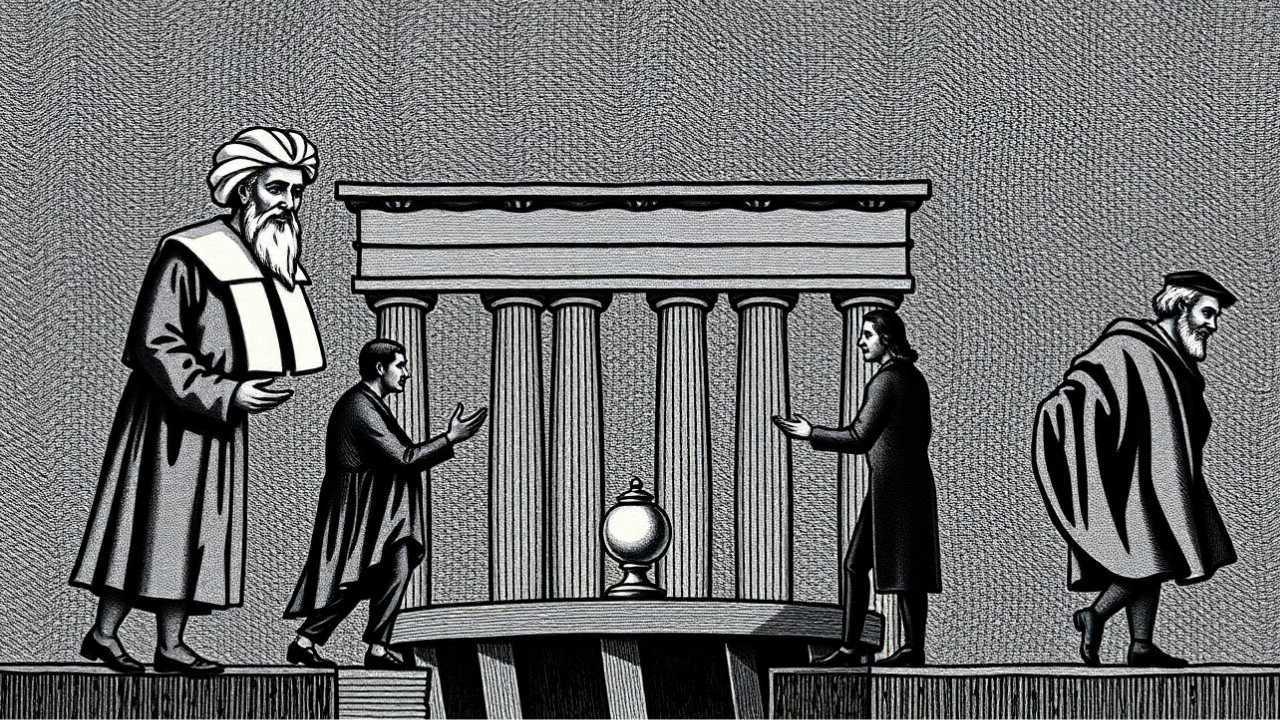
    Ancient India and Greece were two of the hubs of the world’s greatest philosophical thought. Both being great contributors to the Axial Age, the civilizations produced distinct philosophical schools and ideas, each with its own ethics, epistemology, and metaphysics. Interestingly, some of the bigger schools from both cultures shared interesting similarities and parallels across the continents. One of the reasons for this similarity is attributed to the invasion of Alexander the Great in the East. The schools from both cultures might have exchanged some ideas after that, although most schools have their core principles defined centuries before the invasion. In this blog, we discuss six such interesting parallels between the schools of Greek and Indian Philosophy. So, let’s begin.

    Chapter 1: Sāṃkhya and Greek Pluralism

    The schools of Sāṃkhya and Greek Pluralism are two of the oldest in world philosophy, both dating much before the pre-Socratic era. Both traditions reject simplistic monism in favour of multiple fundamental principles for explaining the universe.

    Sāṃkhya defines a dualistic ontology consisting of Puruṣa (consciousness) and Prakṛti (primordial matter). The universe emerges as Prakṛti unfolds into twenty-four additional principles, including intellect (buddhi), ego (ahaṅkāra), mind (manas), the five subtle elements (tanmātras), and the five gross elements (mahabhutas). Liberation occurs when Puruṣa realises its separation from Prakṛti.

    Greek Pluralism, on the other hand, explained the diversity of phenomena in terms of small sets of fundamental elements, namely, earth, air, fire, and water. Philosophers such as Empedocles postulated that the elements interact through cosmic forces of Love(attraction) and strife(separation). Another philosopher, Anaxigoras, introduced the concept of seeds (spermata) – minute, eternal particles which are ordered by Nous (intellect), an immaterial principle to provide structure. They explained observable phenomena without invoking a creator God.

    Both schools show striking parallels – they both believe in a pluralistic universe, consisting of multiple irreducible principles; for Sāṃkhya, these are the 25 categories, while for Greek Pluralism, these are the five elemental roots. Both schools are also extremely naturalistic and reject any form of divine intervention.

    Along with many similarities, there are some core differences, which include that Puruṣa, in the case of Sāṃkhya, is a passive witness to the evolution of Prakṛti, while Greek Pluralists rarely invoke consciousness, and if it appears in the form of Nous, it is an ordering principle and not a passive witness. Another important difference is in the goal or aim of the schools. While Sāṃkhya is deeply tied to the object of liberation, the Greek Pluralists use their principles for cosmological, ethical, and societal purposes.

    Chapter 2: Nyāya and Aristotelianism

    The schools of Nyāya and Aristotelianism form two of the most rigorous and systematic traditions of logical reasoning in world philosophy. Both emphasize logical thought over everything else and promote structured analysis for understanding the universe.

    Nyāya’s central epistemology is based on four means of knowledge-

    1. Pratyakṣa (perception) – direct sensory experience.
    2. Anumāna (inference) – logical reasoning from the beginning to the end.
    3. Upamāna (analogy) -knowledge via comparison.
    4. Śabda (verbal testimony) – knowledge obtained from reliable sources, like the Vedas.

    Casualty, inference patterns, and methods of refuting fallacies are central, making Nyāya a rigorous science of reasoning and debate.

    Aristotle, in his works, the Organon and natural philosophy, provided a comprehensive approach to logic, ontology, and causation. His central contributions include – 

    1. Syllogistic Logic – deductive reasoning from the beginning to the end.
    2. Categories of being – based on substance, quantity, quality, relation, place, time, etc.
    3. Four Causes (aitia) – material, formal, efficient, and final causes explaining existence.
    4. Empirical Observation – Aristotle integrated logic with systematic observation and generalization.

    Aristotle emphasized teleology, where natural phenomena are oriented towards ends, and logical structure underpins both science and metaphysics.

    Both schools thus have many parallels. They treat logic as the ultimate foundation of philosophy, and both embrace realism over metaphysics. Both of them also prioritize methodological rigor, whether it’s Nyāya’s structural debates or Aristotle’s careful logical demonstration.

    Like other schools, they have some dissimilarities, which include Nyāya’s primary focus on knowledge, inference, and metaphysics, while Aristotle’s integration of biology and teleology. Another important difference is that Nyāya sometimes integrates theism as a metaphysical postulate, while Aristotelianism’s Prime Mover is impersonal and non-interfering.

    Chapter 3: Vaiśeṣika and Greek Atomism

    The Vaiśeṣika school, attributed to Kaṇāda, deals primarily with metaphysical and logical understanding and organizes reality into discrete categories (padārthas). The classical system categorizes the world into seven or nine categories, depending on sub-branches, including-

    1. Substance (dravya) – the enduring substratum (earth, water, fire, air, void, time, space, and self)
    2. Quality (guṇa) – attributes to substances (color, taste, number, etc.)
    3. Action (karma) – any type of motion or change to substance.
    4. Universal (sāmānya), Particularity (viśeṣa), Inherence (samavāya) – relations connecting substance and qualities.
    5. Non-existence (abhāva) – absence.

    Vaiśeṣika also develops an atomic theory, proposing that substances are composed of paramāṇus (atoms) – eternal, indivisible units of matter. These atoms combine in pairs, triads, and higher structures to form the macroscopic objects we see.

    Greek Atomism emerged under Leucippus and Democritus, and was further developed by the Epicureans. Its core principles include-

    1. Indivisible atoms – the fundamental units of all matter, energy, and unchangeable.
    2. Void (kenon) – space in which atoms move freely.
    3. Mechanical Causation – macroscopic properties emerge from shape, size, motion, and the arrangements of atoms.
    4. Naturalistic explanation – phenomena, including celestial motion, are reducible to atomic interactions.

    Epicureans later added an ethical dimension – atoms interact naturally, and understanding these interactions reduces fear and enables ataraxia (peace of mind).

    The structural parallels between Vaiśeṣika and Greek Atomism include that both schools’ foundations are based on fundamental constituents of reality (paramāṇus and atoms). Combining the fundamental constituents, both the school explained the natural macroscopic world. Both gave naturalistic explanations such that every complex matter has some underlying simple entities, which are in turn divisible until the fundamental constituents.

    These schools have a few differences; some of them are that Vaiśeṣika goes beyond atoms, includes quality, action, universals, and inherence, while Greek Atomism is linear, focusing just on atoms and voids. The former treats atoms as a part of a broader, structured ontology, including time, space, and substance, while Greek Atomism operates within a simpler, mechanical universe of atoms in a void.

    Chapter 4: Vedānta and Neoplatonism

    Vedānta, particularly Advaita Vedānta, and Neoplatonism represent two of the greatest sophisticated metaphysical traditions that explore the relationship between the ultimate unity and the multiplicity of the world. Both schools grapple with one-many problem, offer accounts to the ultimate reality, and propose pathways for the soul or consciousness to realize its true nature.

    Advaita vedānta, systemized by Śaṅkara, proposes Brahman as the absolute, non-dual reality. The phenomenal world (jagat) is understood as māyā, a manifestation of Brahman’s apparent multiplicity. The individual self (ātman) is ultimately identical to Brahman, and ignorance (avidyā) creates an illusion. Liberation (mokṣa) occurs when the self realizes the non-duality, ending the cycle of birth and death (saṃsāra). It emphasizes knowledge (jñāna) as the primary means to liberation, often supplemented by ethical conduct and devotion (karma and bhakti).

    Neoplatonism, articulated by Plotinus, posits the One as the ineffable source of all reality. From the One emanates the Nous (intellect), followed by the Soul (psyche), which ultimately manifests the material world. The world is real but derivative, and multiplicity emerges from the absolute unity of the One.

    Both traditions share many similarities. They describe reality as emerging from an ultimate, unitary principle – Brahman or the One. Both prescribe a transformative journey for the self. Both recognize that the ultimate principle of reality cannot be fully captured in words or concepts, and it is beyond dualities, qualities, and ordinary experience.

    Differences between the schools mainly include the nature of the phenomenal world, which Vedānta treats as māyā or temporary illusion, while Neoplatonism treats it as real but independent. Vedanta emphasizes karma and bhakti alongside jñāna as pathways to liberation, while Neoplatonism focuses on intellectual and contemplative purification, giving lesser importance to ethical guidance.

    Chapter 5: Jainism and Pythagoreanism

    The tradition of Jainism was systematized by Mahāvira, which emphasizes-

    1. Ahimsa (non-violence) – ethical foundation, strict avoidance of harm to all living beings.
    2. Anekāntavada (non-one-sidedness) – A philosophical principle recognizing that the same truth can be perceived by different beings through different perspectives.
    3. Karma theory – Every action produces subtle karmic particles that bind the soul (jivā), continuing rebirth (saṃsāra).
    4. Ascetic practice – Liberation (mokṣa) is achieved through rigorous ethical conduct, renunciation, meditation, and detachment from material desires.

    Jainism’s ontology distinguishes jivā (soul) from ajivā (non-soul), with ethical and spiritual practice directly affecting the soul’s purification.

    Pythagoreanism, founded by Pythagoras, is a metaphysical-religious tradition combining mathematics, ethics, and metaphysics. Its core principles include –

    1. Numerical harmony – Numbers and their ratios underlie cosmic order, and understanding these relationships can lead to understanding reality.
    2. Ascetic lifestyle – Pythagoreans adopted dietary restrictions, communal living, and self-discipline to purify the body and mind,
    3. Belief in metapsychosis – Reincarnation or transmigration of the soul, based on moral consequences of actions.
    4. Ethical and spiritual cultivation – Living in harmony with cosmic order and virtue promotes purification and aligns the soul with universal principles.

    The Pythagorean approach is simultaneously mathematical, ethical, and spiritual, reflecting a worldview where they are inseparable.

    The parallels between the two traditions include that they both emphasize an ascetic and ethical lifestyle (they promoted ascetism the most among other schools in their respective civilizations). They also believe in the transmigration of the soul and the need for purification to escape the continuing cycle. They also heavily emphasize ethics and believe in a universal ethical order, whether tied to karmic law or numerical and cosmic harmony.

    Key differences between the schools include their metaphysical understanding, where Jains give importance to the Karmic particles, while Pythagoreans promote Numerical harmony. Another difference is the goal of the tradition, where the former’s aim is to achieve liberation (mokṣa) while the latter aims to achieve cosmic harmony through mathematics and ethics.

    Chapter 6: Buddhism and Stoicism

    Buddhism centers around the Four Noble Truths-

    1. Dukkha – Life involves suffering and dissatisfaction
    2. Samudaya –  Suffering arises from craving (taṇhā) and attachment.
    3. Nirodha – Liberation (Nirvāṇa) is possible through cessation of craving.
    4. Magga – The path to liberation is the Noble Eightfold Path, encompassing right view, intention, speech, action, livelihood, effort, mindfulness, and concentration.

    The tradition emphasizes impermanence (anicca), non-self (anatta), and the importance of mindful awareness (sati) in achieving liberation. Tools for controlling desires include ethical conduct (sīla) and meditation (samādhi). Buddhism is a very practical and experiential philosophy, seeking liberation not through speculative metaphysics, but via disciplined transformation of the mind and behavior.

    Stoicism, particularly in the Roman period (Seneca, Epictetus, Marcus Aurelius), teaches that virtue is the highest good and that happiness depends on aligning with Nature or Logos, the rational order of the cosmos. Major doctrines include – 

    1. Control and indifference – Recognize what is within one’s control (virtue, thoughts) and what is not (external events).
    2. Acceptance of fate (amor fati) – Embrace the natural order and life’s inevitable difficulties.
    3. Emotional regulation – Cultivate apatheia – freedom from destructive passions.
    4. Ethical practice – Live according to reason, maintain honesty, justice, courage, and self-discipline.

    It is thus a practical philosophy aimed at inner tranquility, promoting self-mastery and resilience in the face of uncertainties.

    Buddhism and Stoicism have many parallels. Some include focusing on mental discipline (through meditation and mindfulness for Buddhism, and through reflection and journaling for Stoicism), detachment from external outcomes, and priority towards experiential knowledge rather than speculative ones.

    Key differences include Buddhism’s denial of a permanent self (anatta) compared to Stoicism’s rational agent. Also, the spiritual techniques are different; for Buddhism, they are meditation, mindfulness, and renunciation, while for Stoicism, they are reflection, rational examination, journaling, and habituation.

    Comparison Table

    Indian SchoolGreek SchoolCore Focus / ParallelKey Distinction
    SāṃkhyaGreek PluralismMultiple fundamental principles explaining realitySāṃkhya is dualist (Prakṛti &Puruṣa); Greek pluralism is often materialist and non-dual
    NyāyaAristotelianismLogic, epistemology, structured reasoningNyāya integrates epistemic pramāṇas; Aristotle emphasizes deductive syllogism
    VaiśeṣikaGreek AtomismAtoms/ indivisible units as fundamental constituentsVaiśeṣika adds categories like quality, inherence; Greek atomists focus on void and motion.
    VedāntaNeoplatonismUltimate unity -> multiplicity, spiritual ascentVedānta emphasizes non-dual Btahman; Neoplatonism uses One -> Nous -> Soul hierarchy
    JainismPythagoreanismEthical ascetism, soul purificationJainism emphasizes karma, ahimsa, and mokṣa; Pythagoreans focus on numerical harmony and cosmic alignment
    BuddhismStoicismMental discipline, detachment, practical ethicsBuddhism emphasizes impermanence and non-self; Stoicism emphasizes rationality, Logos, and virtue


    Conclusion and Reflection

    Thus, from the above discussions, we see that various Indian and Greek philosophical schools share surprising similarities, whether it is Vedānta and Neoplatonism, or Buddhism and Stoicism. But the blog never intends to suggest that one tradition copied from the other. The two civilizations developed independently and may have shared a few ideas through cultural exchanges during campaigns and invasions, from which the parallels may have arisen. Infact, many important Indian schools like Yoga, Mīmāṃsā, and Cārvāka, and Greek schools like Epicureanism, Cynicism, and Stoicism, are avoided in this blog as they didn’t share any parallel ideas across the continents. This blog intends to show how different cultures can basically derive the same result independently of each other. This blog also intends to bridge the gap between those who are accustomed to Western Philosophy and Indian Philosophy, and hopes to open a wormhole between them.

    Anyway, that is all for this blog. Do like, comment, and share if you find this piece interesting and informational. Also, please subscribe to my newsletters through email below, if you want to get notified for future blogs and updates. Also, your subscription will motivate me to write future blogs on more interesting topics in philosophy, science, history, and mythology. Finally, thank you for reading the blog.
    Suggested Readings

    Disclosure: This post contains affiliate links. As an Amazon Associate, I earn from qualifying purchases. I only recommend books I truly value.


  • 7 Intellectual Rivalries: How Great Idea Battles Shaped Human History

    7 Intellectual Rivalries: How Great Idea Battles Shaped Human History

    Introduction

    Homo sapiens is considered an intellectual species. For over 60,000 years, human beings have slowly evolved through time with the help of cognitive, agricultural, and scientific revolutions. Through logic, reason, trial and error, the primitive humans have evolved to their modern selves. During the course of this intellectual evolution, although agreement by the general public played an important role, disagreement and even rivalries played an important role in enquiry and further evolution. In this blog, we talk about seven such famous rivalries that shaped the course of human history to a certain degree. From classical Greece to modern science, these rivalries played an important role in how human beings began to understand the universe.

    1. Platonism vs Aristotelianism

    The school of Platonism believed that the world around us is a shadow of a higher one. Plato argued that true knowledge comes from pure reason and turning inward. He suggested not to trust our imperfect senses. For the Platonists, the real world was abstract and eternal, which cannot be perceived or understood by our five senses.

    Then came the Aristotelians. They suggest that the real world can only be seen by studying everything around us through our senses, including various substances, causes, and observable patterns. According to Aristotle, true knowledge can be achieved through practical experiences, and not from theories and inner contemplations.

    This rivalry became the foundation of modern Western thought, specifically between idealism and empirical realism.

    2. Nyaya vs Buddhism

    The Nyaya Philosophers of ancient India believed in a realistic world that can be known through perception, inference, comparison, and testimony. They gave importance to logic above all else. They believed in a permanent self (atman) and an objective world that works alone on pure logic and reasoning.

    Buddhists, on the other hand, believed everything is temporary, including the self, which is just a collection of experiences. They were skeptical of Nyaya’s claim of objectivity and propagated relativism.

    This rivalry shaped India’s intellectual debate over objective vs subjective truth for centuries.

    3. Confucianism vs Legalism

    Confucius and his followers saw society as something that flourishes through virtue, morals, and proper relationships. They believed humans could evolve through proper guidance, education, and ethics. They proposed an ethical world that would be ruled by virtuous rulers for inspiration.

    Legalism argued the opposite – a society could function properly only through strict laws and firm punishments. They believed the world could be in perfect order through proper law enforcement, and not through morals and virtues.

    Both the schools influenced China in different periods (Legalism during the Qin Dynasty and Confucianism during the Han Dynasty), before finally merging with the societies of the Chinese Civilization forever.

    4. Advaita vs Dvaita

    Adi Shankara and his school of Advaita Vedanta taught that reality is ultimately the nondual Brahman. They claimed that liberation from illusion occurs when the self realizes that God, the self, and the universe are all one.

    Dvaita Vedanta, founded by Madhva, debated that God, the self, and the universe are distinct forever. The world is fully real and not an illusion. According to them, liberation will occur not through any realization, but through complete devotion to God (Vishnu).

    This debate shaped Indian Philosophy and continues to thrive in Hindu philosophical discussions.

    5. Rationalism vs Empiricism

    Rationalists like René Descartes and Baruch Spinoza believed that the mind contains innate ideas, and reason is the strongest path to truth. Mathematics and Logic come from proper reasoning and critical thinking, and are independent of the senses.

    Empiricists like John Locke, David Hume, and George Berkeley argued the reverse: the mind begins as a blank slate, and is filled by knowledge from experience. According to them, sense organs are the ultimate tools of understanding, and even complex ideas evolve from simpler impressions.

    This debate laid the foundation of modern science and shaped the Enlightenment Period.

    6. Lamarckism vs Darwinism

    Jean-Baptiste Lamarck proposed that species evolve because organisms adapt during their lifetimes and pass these traits to their offspring. Giraffes stretch their neck to eat leaves from tall trees, and their children inherit longer necks. According to him, evolution was driven by need and effort.

    Charles Robert Darwin showed that evolution works through natural selection – random mutation occurs, and those better suited for their surroundings survive and reproduce. Traits don’t arise because they are needed; they remain because they work.

    Darwin’s model replaced Lamarck’s theory, completely changing the direction of the study of genetics and evolution.

    7. Relativity vs Quantum Mechanics

    Albert Einstein’s Relativity described the universe as smooth, continuous, and governed by precise laws. According to his theory, space and time curve around mass, resulting in deterministic patterns. It works beautifully on celestial objects like galaxies, stars, and planets.

    Quantum Mechanics, led by the likes of Max Planck and Niels Bohr, challenged the picture. At the smallest scales, reality becomes probabilistic, discontinuous, and uncertain. Particles behave like waves, and both position and momentum cannot be determined simultaneously.

    Both the theories still work – but they don’t agree with each other, leading to Physics’ greatest rivalry.

    Conclusion and Reflection

    These seven rivalries showed that contradicting ideas can survive in the same world and often lead to some kinds of revolutions. Debates, discussions, and disagreements are some of the strongest tools that humans possess and should always be encouraged, cherished, and promoted. If everyone agreed to the same idea, humans would still be hunters and gatherers in the 21st century CE.

    That’s all for this blog. Please like, comment, and share if you find this interesting. Thank you for reading this blog.

    Suggested Readings

    Disclosure: This post contains affiliate links. As an Amazon Associate, I earn from qualifying purchases. I only recommend books I truly value.


  • From Greece to India to China: 30 Ancient Philosophy Schools Explained Simply

    From Greece to India to China: 30 Ancient Philosophy Schools Explained Simply

    Introduction

    Long before modern science and psychology, people across the ancient world were already asking the same questions we still struggle with today – what is real? What is good? What is the purpose of life? From the coasts of Greece to the forests of India and the courts of China, early thinkers tried to make sense of existence through reason, observation, and introspection.

    These pioneers built the first schools of philosophy – communities of debate, meditation, and inquiry – each offering its own map of reality.

    This post takes a quick journey through 30 ancient schools of thought – from the Stoics and Pythagoreans to the Buddhists and Confucians – to see how humanity’s oldest ideas about truth and meaning still shape our world today.

    Chapter 1: Greek Schools

    1. Milesian School – The Milesians- Thales, Anaximander, and Anaximenes – were the first to seek natural rather than divine explanation of the world. Living in the Ionian city of Miletus, they asked what the universe was fundamentally made of: water, air, or an undefined, boundless substance called apeiron. In doing so, they transformed myth into reason and laid the groundwork for science itself.
    2. Pythagorean School – Founded by Pythagoras, the school saw numbers as the hidden structure of reality. To them, harmony, proportion, and mathematical order governed both music and the cosmos. They mixed mysticism with mathematics, teaching that the soul was immortal and the universe was a grand symphony of numerical relationships.
    3. Heraclitean School – Heraclitus of Ephesus saw the universe as constant change – “you cannot step into the same river twice.” Fire, for him, symbolized the ever-living process of transformation. Beneath this flux, however, was logos – a rational order guiding the chaos. His vision inspired later thinkers who sought unity within motion.
    4. Eleatic School – The Eleatics, led by Parmenides and Zeno, turned Heraclitus upside down. They argued that change and plurality were illusions – that reality is one, eternal, and unchanging. Zeno’s paradoxes, like Achilles and the tortoise, challenged the very logic of motion, forcing philosophers to rethink how we perceive truth and illusion.
    5. Pluralistic school – Thinkers like Empedocles and Anaxigoras tried to reconcile change and permanence. Empedocles proposed that all things were made from four roots – earth, air, fire, and water – combined by love and strife. Anaxigoras added the mind as the cosmic force organizing matter. They bridged mythic unity and scientific multiplicity.
    6. Atomist School – Leucippus and Democritus imagined the universe as composed of indivisible particles – atoms – moving in the void. They rejected divine causes, suggesting that natural laws and random motion explained everything. Their vision of a mechanical universe later echoed in modern physics, centuries before it was discovered.
    7. Platonic School – Plato saw the visible world as a shadow of a higher reality – the world of forms or ideas. True knowledge, he said, comes not from the senses but from remembering these eternal truths. His dialogues blended reason, myth, and moral idealism, shaping thought for over two millennia.
    8. Aristotelian School – Aristotle, Plato’s greatest student and critic, brought philosophy down to earth. He emphasized observation, classification, and logic, believing that form and matter coexisted in everything. His Golden Mean defined virtue as balance, and his systematic works on ethics, politics, and science built the foundation of rational inquiry.
    9. Epicurean School – Epicurus taught that happiness lies in simple pleasures, friendship, and the absence of fear- especially fear of the Gods and death. He saw the world as atoms in motion, not a divine design, and encouraged moderation over indulgence. His quiet garden school was a sanctuary of calm reason against superstition.
    10. Stoic School – The Stoics – from Zeno of Citium to Marcus Aurelius – believed that virtue alone leads to happiness. They taught self-mastery, duty, and acceptance of fate, viewing reasons as the divine fire within all. Their strength lay in serenity: aligning one’s will with nature’s law brings true freedom.
    11. Cynic School – Founded by Antisthenes and made famous by Diogenes, the Cynics rejected luxury and convention, living in radical simplicity. They believed virtue was the only true good, and social norms were mere illusions. Their defiance of comfort and hypocrisy inspired later philosophies of freedom and authenticity.
    12. Skeptic School – The Skeptics, led by Pyrrho and later Sextus Empiricus, doubted the possibility of certain knowledge. They advised suspending judgment and living according to appearances rather than dogma. Paradoxically, their doubt brought peace, for when one stops insisting on the truth, the mind rests in quiet balance.
    13. Neoplatonic School – In the 3rd Century CE, Plotinus revived Plato’s vision through mysticism. He taught that all reality flows through the One, a transcendent source beyond being and thought. The soul, through contemplation, can ascend back to the divine unity. Neoplatonism bridged Greek reason and Eastern spirituality, influencing early Christian and Islamic thought alike.

    Chapter 2: Canaanite Schools

    1. Judaism – Emerging in ancient Canaan and later crystallized through prophets and rabbis, Judaism framed philosophy not around speculation but covenant – a moral relationship between humans and the divine. Its wisdom tradition, from Job to Ecclesiastes, wrestled with suffering, justice, and meaning. Rather than abstract metaphysics, it offered an ethical vision: one God, one moral law, and a call to live rightly in a world shaped by divine purpose. Greek thinkers sought truth through logic; the Hebrews sought it through righteousness.
    2. Samaritanism – A sister faith to Judaism, Samaritanism preserved an older version of the Israelite religion centered on Mount Gerizim rather than Jerusalem. Its philosophy lay in fidelity to divine law and sacred geography – the belief that holiness resides in obedience and place. While smaller in influence, the Samaritans represented a quiet protest against central authority, valuing purity of faith over expansion of empire. Their endurance for millennia makes them a living echo of philosophy rooted in devotion and identity.

    Chapter 3: Persian Schools

    1. Zoroastrianism – Founded by the prophet Zarathustra around the 2nd millennium BCE, Zoroastrianism framed the universe as a battleground between truth and falsehood. Its supreme god, Ahura Mazda, represents light, wisdom, and justice, eternally opposed by the spirit of chaos, Angra Mainyu. Unlike fatalistic myths, it gave humanity moral agency – each choice contributing to the victory of good. This ethical dualism influenced later religions, from  Judaism’s angels and demons to Christian and Islamic ideas of heaven and hell.
    2. Manichaeism – Emerging in the 3rd century CE through the Persian prophet Mani, Manichaeism fused Zoroastrian dualism with Christian and Gnostic mysticism. It saw the cosmos as divided between light and darkness, spirit and matter, and portrayed human life as a struggle to free the divine spark trapped in flesh. Its mix of philosophy, mythology, and ascetic discipline spread across Asia and Europe before persecution nearly erased it. Yet its influence endures in every worldview that sees existence as a moral and metaphysical tension between purity and corruption.

    Chapter 4: Indian Schools

    1. Samkhya – Samkhya, one of India’s oldest philosophical systems, teaches that reality consists of two eternal principles – Purusha (consciousness) and Prakriti (matter). Liberation arises when the self realizes it is pure awareness, separate from nature’s restless dance. Samkhya’s rational, dualistic framework became the backbone of later Hindu and yogic thought, offering one of humanity’s first psychological models of existence.
    2. Yoga – Built upon Samkhya’s metaphysics, the Yoga school, summarized by Patanjali, turned philosophy into a disciplined practice. It taught that through ethical living, breath control, concentration, and meditation, the mind can be stilled and the soul united with its pure source. Yoga was not merely an exercise, but a study of consciousness – philosophy turned inward experience.
    3. Nyaya – Nyaya was India’s school of logic, founded by Gautama. It argued that liberation requires right knowledge, and right knowledge comes through rigorous reasoning. By classifying perception, inference, comparison, and testimony as valid sources of truth, Nyaya built the foundation for India’s analytic tradition – philosophy as clarity and precision.
    4. Vaisheshika – Closely related to Nyaya, Vaisheshika, founded by Kanada, offered an atomic theory of the universe. It divided existence into categories – substance, quality, motion, and more – and proposed that all matter is made of eternal atoms. Though metaphysical, its aim was spiritual: by understanding the universe’s structure, one learns detachment from it.
    5. Mimamsa – Mimamsa, or Purva-Mimamsa, saw the Vedas not as myths but as eternal laws governing the body. Founded by Jaimini, it focused on ethical action and ritual precision, teaching that moral order sustains both society and the cosmos. It treated language, ritual, and ethics as tools of liberation through righteous living rather than mystical knowledge.
    6. Vedanta – Vedanta, or Uttara-Mimamsa, took the Upanishads as its core and declared that the individual soul and the ultimate reality are one. Thinkers like Shankara, Ramanuja, and Madhva offered different interpretations – from non-dualism to theism – but all sought union within the infinite. Vedanta became the crown of Indian philosophy, blending logic, devotion, and mystic insight.
    7. Carvaka (Lokayata) – The Carvaka school was India’s bold materialist voice. It rejected the authority of the scriptures, denied karma and the afterlife, and held that perception is the only valid source of knowledge. Life, they said, is short and sensual – enjoy it while it lasts. Though mostly lost to time, Carvaka’s skepticism proved that ancient India also made room for atheism and reasoned doubt.
    8. Jainism – Jain philosophy, founded by Mahavira, taught that all souls are bound by karma, subtle matter that clings to consciousness through violence and desire. Liberation comes through non-violence, truth, and ascetic discipline. Its vision of a living, moral universe made compassion and self-control the highest forms of wisdom.
    9. Buddhism – Born from the insights of Siddhartha Gautama, Buddhism turned philosophy into a path of liberation through mindfulness and compassion. It rejected speculation about eternal souls or Gods, focusing instead on suffering and its cessation. Through the Four Noble Truths and the Middle Way, it taught that freedom lies not in belief, but in awakening – the end of craving and illusion.

    Chapter 5: Chinese schools

    1. Taoism (Daoism) –  Rooted in the teachings of Lao Tzu and Zhuang Zhou, Taoism sought harmony with the Tao – the Way, the natural flow of all things. It taught that wisdom lies not in control but in effortless action, living gently in accord with nature’s rhythm. Through paradox and poetry, Taoism celebrated simplicity, spontaneity, and mystery beyond words – the silence that makes music possible.
    2. Confucianism – Confucius turned philosophy into a moral art of living. In a time of social chaos, he taught that virtue begins with respect – in family, in friendship, and in governance. Through ren (humaneness) and li (ritual propriety), he envisioned harmony between personal ethics and public order. His disciples built one of the most enduring systems of ethical and political philosophy in human history.
    3. Mohism – Founded by Mozi, Mohism arose as a challenge to both Confucian hierarchy and feudal warfare. It promoted universal love – the idea that all people deserve equal care, regardless of kinship or status. Rational and practical, Mohists valued merit over birth and sought social welfare through ethical governance. Though later eclipsed, their ideals foreshadowed utilitarian thought and humanitarian ethics.
    4. Legalism – Legalism, the harsh counterpart to Confucian Virtue, believed that order could only be achieved through strict laws and enforcement. Figures like Han Feizi argued that humans are driven by self-interest, not morality – so rulers must govern through reward and punishment, not virtue. It unified China under the Qin dynasty, but at the cost of freedom, reminding later thinkers that power without ethics leads to tyranny.

    Conclusion

    Across millennia and continents, these thirty schools of philosophy spoke in different tongues but asked the same questions: What is real? What is right? What is enough? The Greeks sought order through reason, the Canaanites through covenant and faith, the Persians through moral struggle, the Indians through liberation, and the Chinese through harmony. Each offered not just theories, but ways of living – paths toward wisdom in a world that has always felt uncertain.

    Through temples have crumbled and languages changed, their echoes remained. Stoic calm still guides psychology, Buddhist mindfulness shapes modern therapy, and Confucian ethics underlie our ideas of duty and family. Even the skeptics and materialists whisper in science and humanism today. To study these schools is not to look backward, but inward – to rediscover how the ancient mind still beats within us.

    That’s all for this blog. If you enjoyed this post, please like, comment, and share. Thank you a lot.

    Suggested Readings

    Disclosure: This post contains affiliate links. As an Amazon Associate, I earn from qualifying purchases. I only recommend books I truly value.