Introduction
It is known to everyone that Christopher Columbus discovered the continent of America on October 14, 1492. This led to a new age of exploration, and new routes were discovered for trade, commerce, and colonization. This post deals with global trade and economics before Columbus. How civilizations like China, India, Africa, Arabia, and Europe traded materials, knowledge, and technology among each other.
The Silk Road: The Route Connecting The Far East with The Mediterranean
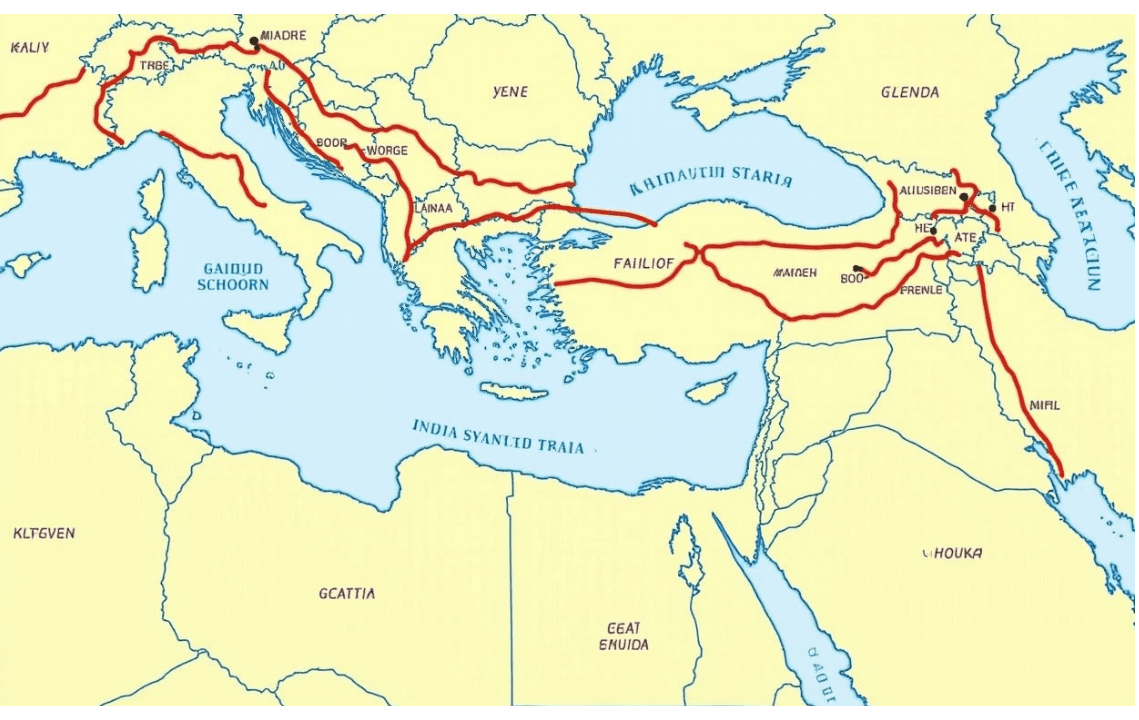
The cultivation of silk first started in China around 3600 BCE, with the earliest known examples from 2700 BCE. This silk was imported to various countries like India and Persia, and even to Greece and Rome during later times. The Silk Road was officially opened by the Han Dynasty of China in 130 BCE. It soon became under the control of the Parthians, who supervised the trades and assimilation occurring on the Central Asian Roads. Silk later became very popular in Rome around 100 BCE to 100 CE, when Rome bought silk, tea, and dyes from China and sold horses, saddles, grapevines, honey, dogs, etc. to them. The road later extended to Rome conquered. Under Emperor Julian, the Byzantine Empire developed a prosperous silk industry around 6th century CE, which contributed a major portion to the Byzantine economy. The road also had a very negative impact on the empire. It was the Silk Road that helped in spreading the Bubonic Plague, which decimated Constantinople in 542 CE. Silk Road was also used by India, Persia, and Arabia to trade with both the east and the west. Thus, the Silk Road became the thread that connected great civilizations, namely China, India, Persia, Arabia, Anatolia, Egypt, and Europe, where they traded not only goods but also exchanged religions like Manichaeism, Buddhism, Eastern Christianity, etc., knowledge like Chinese Engineering, Indian Mathematics and Spirituality, Greek Astronomy and Philosophy, etc., and many more.
Indian Ocean Trade: The Ocean of Cultural Exchange
The Indian Ocean was an important route that connected India, South-East Asia, Arabia, East Africa, and even Europe. The Europeans traded through the Indian Ocean mainly via the Red Sea Corridor and the Strait of Hormuz. The Romans traded spices, especially black pepper from India, for their gold. “The Periplus of the Erythraean Sea” was a text by a Greek-speaking unknown Egyptian author in the 1st century CE, which gives details about the Indian-Roman Trade. According to the text, important ports in India included Barbaricum in the Indus River, Maziris(Cranganur) in the southwestern Malabar Coast, the island of Sri Lanka, etc. The biggest trading partners were the kingdoms of Chola, Chera, and Pandya of southern India. The kingdoms of South East Asia traded through the Strait of Malacca, which is an important choke point till today. The Indian Ocean trade was heavily influenced by the Monsoon winds that helped travelers to distant lands much faster. This Monsoon was exploited by the merchants of South East Asia, India, East Africa, and Egypt. Important exports from India included spices like black pepper, cloves, nutmeg, and mace to the West, and the Hindu and Buddhist religions, and also the Sanskrit language to the East. The Swahili Coast was an important location in East Africa, which was famous for doing business with the rest of the world. Famous port cities included Mombasa, Gedi, Pate, Zanzibar, Kilwa, etc., which were always full of foreign merchants from Europe, Arabia, and India.
The Trans-Saharan Trade: The Dusty Roads to Gold
The Sahara Desert also saw merchants travelling through it in caravans connecting Northern & Western Africa with Europe. The camel caravans were controlled by the Berbers who acted as a medium between Africa & Mediterrenian. The Empires that took part in these trades included the Ghana Empire (6th to 13th century CE), Mali Empire(1240-1645), and Songhai Empire(1460-1591). The things exported from Africa included ivory and slaves, but most importantly, Gold Dust. The capital of the Mali Empire, Timbuktu, was known for having huge sources of gold dust, which the Europeans traded for salt, thus creating a gold and salt trading system. The emperor ofthe Mali empire, Mansa Musa, who is also considered the richest man of all time, also encouraged this trade. Thus, Africa and Europe shared an economic relationship involving items like gold, salt, ivory, copper, horses, glassware, and slaves through the vast desert of the Sahara.
European & Mediterranean trade: From Carthage to Venice
The earliest known European trading superpowers were the Phoenicians between 1500 and 322 BCE. Centred around Carthage. At their greatest extent, they occupied parts of Northern Africa, the Levant, the Iberian Peninsula, and even parts of Italy. They traded throughout the Mediterranean Sea with civilizations like Greece, Rome, and Egypt. They also traded with distant lands like Persia and Iran through the Levant and the Red Sea Corridor.
After the Punic Wars, the mercantile power was transferred to the Romans, who expanded their trading through the Silk Road and the Indian Ocean. Caesarea Maritima was an important port city located on the eastern coast of the Mediterranean Sea, established around 22-10 BCE by Rome’s client king Herod the Great. Rome traded China’s silk, India’s spices, Africa’s ivory and gold with its wine, olive oil, fine pottery, gold coins, bronze work, etc.
After the fall of Rome, the Venetians were the last Pre-Columbian European Merchants who maintained business with the rest of Afro-Eurasia.
Interconnections, Global Economy, and Impact
The global businesses duringthe early days were based on a barter system, which later developed into currency systems. China, India, Persia, the Levant, and Rome were the five important trading regions. Along with Goods & Services, indigenous thoughts and belief systems like Buddhism, Zoroastrianism, Manichaeism, Hinduism, Taoism, Confucianism, Stoicism, Skepticism, Eastern Orthodox Christianity, and even Sufism were exchanged. India and China became the world’s biggest economies for about a millennium.
But along with all the positives, it also gave rise to epidemics and pandemics like Antonine Plague (166 CE), Justinian’s Plague (541-542 CE), the Black Death (14th century CE), etc., and later, after the Columbian exchange, diseases like Syphilis, Malaria, and Yellow Fever also spread.
Conclusion
Thus, from this blog post, we get an idea of how various Pre-Columbian civilizations exchanged materials, services, knowledge, belief systems, and even diseases. The ancient society, like today, worked in coordination in economic and geopolitical interests.
Suggested Readings
- World History Encyclopedia
- The Silk Roads: A New History of The World by Peter Frankopan.
- The Golden Road: How Ancient India Transformed the World by William Dalrymple.
Disclosure: This post contains affiliate links. As an Amazon Associate, I earn from qualifying purchases. I only recommend books I truly value.