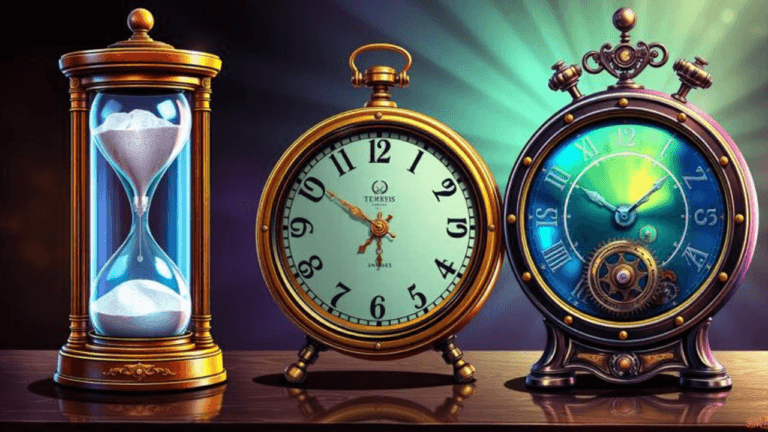
Tag: History of Science

  • Ancient Indian Astronomy: Time Keeping in the Vedic Age

    Ancient Indian Astronomy: Time Keeping in the Vedic Age

    Introduction: The Sky as a Laboratory

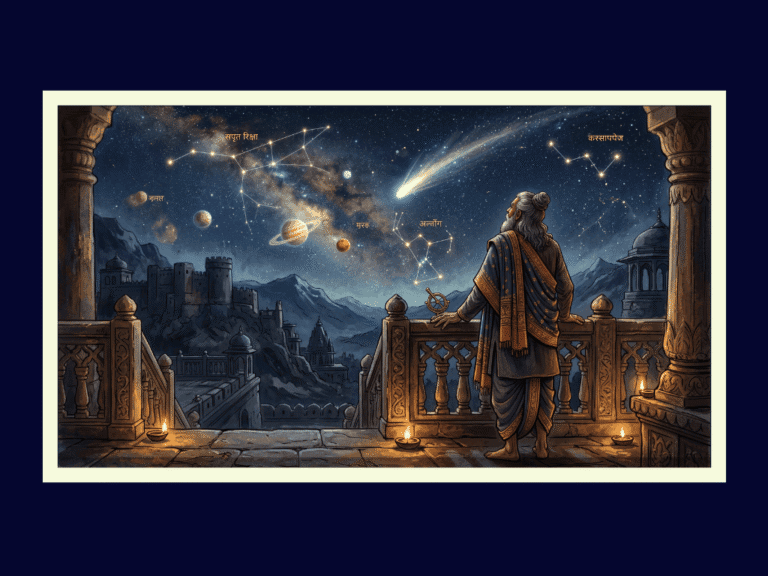
    Astronomy has been an integral part of Indian culture since the Vedic period (~1500 BCE). The Vedic astronomers studied the skies and celestial patterns to calculate directions, distances, seasons, and even agricultural cycles.  Astronomy or Jyotiṣa is even considered one of the six Vedāṇgas, which are the essential subjects for understanding the Vedas, the other being phonetics, ritual, etymology, grammar, and metrics. The Vedas themselves have numerous mentions of heavenly bodies, making ancient Indian astronomy very crucial.

    Time was also a very important aspect for the Vedic people, so much so that it was considered that the time (prajāpati) itself created the Vedas.

    In this blog post, we are going to discuss the most important aspects of Vedic astronomy. We will also discuss how timekeeping was crucial at that time, which slowly gave birth to the Indian scientific thinking, leading to numerous mathematical and scientific discoveries in the later period.

    Codifying the Stars: Astronomical Texts

    The works of Vedāṇga Jyotiṣa are generally attributed to the Vedic astronomer, Lagadha. Two of its most important textual editions are Ārcajyotiṣa (associated with the Ṛk Veda) and the Yājuṣajyotiṣa (associated with the Yajur Veda). The former contains 36 verses, and the latter contains 43 verses describing timekeeping units like months, seasons, days and nights, equinoxes, solstices, etc. They also mention terms specific to ancient Indian astronomy and cosmology, like yuga, tithi, etc.

    A yuga is a five-year cycle, which acts as a reconciliation between the solar year (~365 days) and the lunar cycle (12 lunar cycles approximate to about 354 days). Thus, in Vedic systems, the passing of a yuga denoted that the sun and moon had returned to almost the same initial positions.

    A tithi is 1/30th of a lunar synodic month. A synodic cycle is the time taken by the moon to return to the same phase, which is around 29.5 days. 

    The texts also mention 6 Indian seasons or ṛtus: spring, summer, monsoon, autumn, pre-winter, and winter.

    Apart from the longer time scales, the Vedāṇga Jyotiṣa also mentions shorter units like muhūrttas and kālas. The former is 1/30th of a day (48 minutes) while the latter is 1/603rd of a day.

    The Vedic people used these scales not only for their daily needs but also for detailed ceremonial activities, which required geometric precision. Altars for sacrificial pyres were designed with their geometry aligned to the time scales and positions of celestial objects, as mentioned in the mathematical and ritualistic texts called the Śulbasūtras.

    In the 10th chapter of the 3rd book of the Taittirīya Brāhmaṇa, a text within the Yajur Veda, a ritual called Sāvitrāgnicayana is mentioned. In it, 185 bricks need to be piled in concentric circles to form an altar. Each brick is named after a particular unit of time, like the 12 months, 24 fortnights, days and nights separately in each fortnight, muhūrttas, and even muhūrtta-muhūrttas (~3.2 minutes).

    Mapping the Lunar Path: The Nakṣatra System

    Nakṣatras were very important in ancient Indian astronomy. They are fixed divisions or coordinates that track the Moon’s position against the background of fixed stars. The moon takes around 27.31 days to return to the same position against the fixed stars. Thus, the entire cycle was divided into 27 nakṣatras, each spanning 13°20’ of the sky.

    Texts like the Taittirīya Saṃhitā and Śatapatha Brāhmaṇa mention these 27 nakṣatras, while some texts, like the Atharva Veda, also mention a 28th one (named Abhijit).

    They were also mentioned in the Vedāṇga Jyotiṣa texts, as a yuga begins and ends when the sun and the moon are within a particular nakṣatra coordinate.

    Beyond the astronomical role, each nakṣatra was associated with a presiding deity and formed the basis for ritual timing, guiding decisions related to sacrifice, travel, and other activities.

    They also acted as a natural seasonal calendar, as the position of the sun in a particular nakṣatra denoted a particular season or other yearly events, like the transition of the sun’s path northward or southward, called uttarāyana and dakṣināyana, corresponding to the solstices.

    Nakṣatras later became the foundation for the establishment of Indian astrology. After integrating with Greek astronomy, they helped in developing the Rāśis (Indian Zodiacs).

    Conclusion: The Dawn of Indian Science

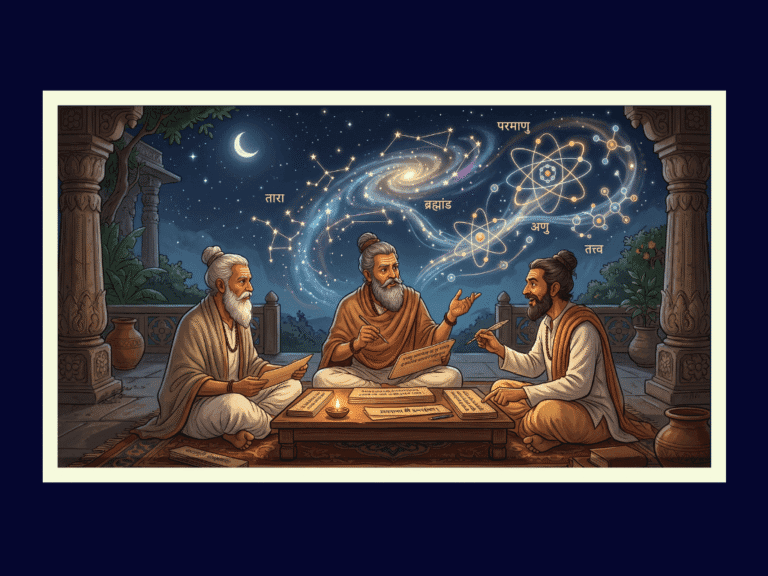
    Vedic astronomy was the first step toward the gigantic leap that was about to come in later Indian scientific history. In the later Vedic period, this knowledge helped scientists and philosophers of the time to argue and discuss various concepts like space (ākāśa), sound (śabda), and atoms (anu).

    During the golden age of India (300 to 700 CE), ancient indian astronomy was integrated with arithmetic and trigonometric functions by scientists such as Āryabhaṭa and Varāhamihira to take Indian science to a different level, which we will discuss in another blog in this history of Indian science series.

    That’s all from this blog. In the next blog, we will travel to the later Vedic age to see how physics in India was slowly being born, with the synthesis of philosophy, mathematics, and astronomy.

    If you find the blog interesting, please share it with your friends and family. Do comment below to discuss your thoughts. And please subscribe to the newsletter below if you want to be notified about the future blog posts in this series and beyond. Finally, a big thanks for reading.

    Suggested Readings

  • History of Indian Science: Space, Matter, and Time

    History of Indian Science: Space, Matter, and Time

    Introduction

    The history of Indian civilization is about six millennia old. The civilization has a rich cultural, societal, and intellectual history. In this blog series, we are going to dive deep into the evolution and history of Indian science, particularly in physics and astronomy. We begin from the Vedic period and journey through the classical age, medieval period, and finally to the modern era.

    The Timeline of the Evolution

    The journey of Indian physics began with Vedic astronomy and timekeeping, which conceptualized the early astronomical patterns like Nakṣatras, necessary for ritual calendars. In the later Vedic age, natural philosophy emerged along with an understanding of concepts like space (ākāṣa) and sound (ṣabda).

    India also developed its own school of atomism, Vaiśeśika, and introduced the concept of the atom (anu). Astronomy, combined with new mathematical inventions like zero and the decimal system, gave rise to scientific texts called siddhāntas. Later, the intellectual exchanges with the Greeks led to parallel developments in science and philosophy in both cultures.

    The history of Indian science was at its peak during the Gupta period, when scientists like Āryabhaṭa and Varāhamihira introduced new theories like trigonometric functions, calculation of eclipses, and the rotation of the Earth, leading to a golden age. Polymaths like Brahmagupta and Bhāskara II contributed to mathematics and astronomy, leading to early ideas of motion and gravity centuries before Newton.

    The Kerala School of Mathematics and Astronomy in medieval India introduced various infinite series and proto-calculus ideas, which evolved through generations into the modern era. Science, particularly physics, in India today, is thus a beautiful amalgamation of thousands of years of traditional research with the discoveries and inventions of modern science and technology.

    Conclusion

    This was a small introduction to the history of Indian science, and the successive blog posts will cover its various important phases. I hope you will appreciate the series and reflect on the evolving nature of the Indian scientific spirit. 

    That is all. Please comment, share, and subscribe to my newsletter below if you find this project interesting and want to be notified in the future. Thank you.

  • Evolution of Clocks: The Epic History of Time

    Evolution of Clocks: The Epic History of Time

    Introduction

    Human beings have been fascinated with time for tens of thousands of years. Early Homo sapiens used time to know when to hunt, rest, cultivate, etc. For measuring time accurately, Neolithic humans began to construct timekeeping devices, which later came to be known as clocks. These clocks added punctuality to the human mainframe and accelerated efficiency to a great extent. 

    In this blog, we discuss the evolution of clocks and nine such clock models that revolutionized the field of Horology (the field of measuring time and making timekeeping devices). We discuss their construction, working, and their impact on timekeeping. 

    Chapter 1: Sundial (~3500 BCE – 1600 CE)

    Sundials are the earliest known clocks or timekeeping devices, created by human beings. They consisted mainly of a platform with indicator markings and a rod-shaped figure above it, also known as a gnomon. During the day, the gnomon cast a shadow over the platform, whose length and angle were measured and calculated to find the exact hour. The device depended on human observation and calculation, and only worked when sunlight was available. Sundials were soon replaced by more efficient clocks in the future, especially the mechanical clock. They are still on display in various regions for decorative and educational purposes.

    Chapter 2: Water Clock / Clepsydra (~1500 BCE – 1600 CE)

    Water clocks (or Clepsydras) were one of the earliest known clocks made by man, which were independent of any external cause, like sunlight. They were famous in ancient Egypt, Greece, and China. They were built with various designs, especially the Chinese and Arabs devised many complicated mechanisms. 

    In simple terms, the device consisted of two containers connected through a simple pipe or a hole. Water was poured into one of the containers and allowed to drip into the other at a controlled and measured rate. The empty container had markings that could indicate the time passed based on the volume of water filled. In some models, markings were instead on the container filled with water, and time was calculated on the basis of the decrease in water levels of the container. In both models, the water clocks proved superior to sundials and were used mostly at night. Their use declined after the invention of the mechanical clock during the 15th-16th centuries.

    Chapter 3: Candle / Incense Clock / Hour Glass (~500 – 1800 CE)

    Around the middle of the first millennium CE, a new type of mechanism was created to make timekeeping portable, so it could be carried from one place to another. Thus, the candle clock and the hourglass were invented. 

    The candle clock was nothing but a candle with markings on it that indicated the time elapsed as the candle burned over the course of time. Hourglasses, on the other hand, were an improvisation on the water clocks, where sand and glass bulbs replaced water and containers. The amount of sand passed from one bulb to another indicated the time elapsed. After the entire sand had passed to the second bulb, the clock could be easily reset by just switching the second bulb on top, so that sand could then pass to the first bulb, and the clock worked in the opposite direction. 

    Hourglasses were mainly used in long voyages, while the candle clock was mainly used for domestic and ceremonial purposes. Their use declined around the 17th-18th century due to the invention of more advanced clocks.

    Chapter 4: Mechanical Clock (~1300 – 1800 CE)

    Mechanical Clocks were the earliest form of properly engineered clocks. They were much more accurate compared to their predecessors and slowly led to their decline in usage. 

    A typical mechanical clock consists of 5 parts: a power source, a gear train, an escapement, a regulator, and an indicator. In the earliest mechanical clocks, a falling weight was used as the power source. The falling weight interacting with gravity created a steady pull that drove the gear train. A gear train is a system of interconnected gears arranged so that the rotation of one of the gears leads to the rotation of all the gears. These gears drive something called an escapement, a disc with two tooth-like arms called pallets, mounted on a rotating shaft, that control the movement of the gears. 

    This escapement is guided by another object called the regulator. In the earliest clocks, a horizontal cross-bar with adjusted weights known as a foliot was used as the regulator. As the gear train moved the pallets, the escapement moved the bar back and forth. The weights on the foliot resisted sudden changes due to rotational inertia, thereby regulating the movement of the gear train. 

    The regulated motion of the gear train was finally transferred to an indicator, in the form of hands, which displayed it in the form of passage of time on the clock’s face. These types of clocks created a revolution in horology and were in continuous use till the 1800s.

    Chapter 5: Pendulum Clock (1656 – 1930 CE)

    The mechanical clocks, although far superior to their predecessors, had a major disadvantage. Their regulators worked on rotational inertia, depending on the movement of the gear train; thus, their accuracy reduced with time and needed to be readjusted. 

    In 1656, the Dutch mathematician and engineer Christiaan Huygens invented the pendulum clock. It had almost the same design and principle as that of the mechanical clock, except for the regulator part. Instead of the dependent foilot, a pendulum was used as the regulator. Unlike the foliot, the pendulum works on the principle of simple harmonic motion under gravity. The pendulum thus swings in a uniform motion independent of any external object. Thus, the pendulum clock worked as a far better-regulated and, in turn, more efficient clock than the mechanical clock. 

    Another innovation was that the power source was changed from a falling weight to a spring whose potential energy provided the power. The pendulum clocks were in common use till the late 1930s.

    Chapter 6: Marine Chronometer (1735 – 1970 CE)

    The Pendulum Clock, although very efficient and requiring very little calibration, had a major drawback. It was inefficient in sea voyages, as the motion of the pendulum was interfered with by the constant rocking and rolling of the waves. 

    In 1735, the English engineer John Harrison invented the marine chronometer, suitable for sea voyages. The marine chronometer had a balance wheel and a spring in place of a pendulum as the regulator. The wheel oscillated in a uniform harmonic oscillation, and the spring attached to it provided the elasticity, thereby maintaining a uniform regulation independent of both gear train motion and motions from sea waves. 

    The marine chronometer proved to be very efficient in naval expeditions and warfare, and continued to be used till the 1970s, when they were replaced by atomic clocks.

    Chapter 7: Quartz Clock (1927 – present)

    The Quartz Clocks are the first electrical clocks. Here, the power sources are batteries, in place of springs or weights. But the most important innovation is in the regulators. 

    Quartz is a crystal that possesses a unique property called piezoelectricity, the ability to generate electrical pulses when under mechanical stress. Thus, in quartz clocks, tuning forks made of quartz crystal are installed in vibrated conditions, thus creating electrical pulses which act as the regulator. 

    Electrical clocks are far superior in accuracy and efficiency compared to mechanical clocks, and thus, the former completely replaced the latter within decades. Also, quartz being extremely abundant on earth, made quartz clocks extremely cheap, and thus they are still in use in nearly every household.

    Chapter 8: Atomic Clock (1949 – present)

    Atomic Clocks are the champions of accuracy. In an atomic clock, the quartz crystal vibrates and sends electrical signals at a fixed frequency. These electrical signals are then converted to microwave signals. These microwave signals are sent to certain atoms: either Cesium-133, Rubidium-87, or Hydrogen (maser). The microwave signals excite the atoms. These atoms pass through a detector. Any change in the frequency of the electrical signal will change the level of excitation of the atom. The detector will detect the change and send a feedback signal to the quartz, thereby maintaining the regulating frequency. 

    These clocks are so accurate that time has been defined by them. Before the atomic clocks, time was defined by the Earth’s rotation and revolution, whose measurements were affected by tides, earthquakes, and other causes. But after the invention of the Atomic clocks, one second is defined as 9,192,632,770 oscillations of radiation corresponding to a specific energy in the Cesium-133 atom. 

    So, with the invention of atomic clocks, the calculation of time became finally independent of the Earth’s surface. Atomic clocks are now used in global navigation systems like GPS, telecommunication and internet facilities, stock markets, astronomical observations, and many more.

    Chapter 9: Smart Watch (2000 – present)

    Smart watches are direct descendants of Quartz clocks. The main body is the same except that the electrical signals are passed through a digital logical counter, which counts the oscillations. The software associated with it compares the oscillation with an external timeframe (GPS, phone, satellite, etc.) and sends feedback signals to the quartz crystal. Another thing that changed is that smart watches have a digital display frame with no clock hands as an indicator. Except for the regulator, almost all the mechanisms are the same for a smart watch and a quartz watch with a digital frame. They are today used both as timekeeping devices and for external features like measuring heart rate, weather reports, etc.

    Conclusion

    Clocks have evolved along with human civilizations over time. From calculating time to defining time, they have come a long way. The evolution of clocks can be classified into three different stages: pre-mechanical, mechanical, and electrical clocks. A proper electronic age for a clock is yet to come (if we don’t count mobile phones and personal computers as electronic clocks).

    That is all for this blog. Hope you enjoyed it. Please share, and subscribe if you want to get updates for my blogs. And thank you for reading the piece.