Tag: history-of-technology

  • The Evolution of Writing: From Voice to Cloud

    The Evolution of Writing: From Voice to Cloud

    Introduction

    Writing is an important aspect of human life. A typical day of a human’s life generally starts and ends with consuming some form of writing. Writing media has been with us for at least 5,000 years. Whether for business, religious, political, scientific, or literary purposes, writing has either been the proof, the memory, or the assistance for these activities. But the writing medium and instrument were not always the same for all these millennia. In this blog, we dive deep to discuss the evolution of writing across the world and its impact on the civilizations it developed alongside. So, let’s begin.

    Chapter 1: Oral Tradition (Prehistory to Present)

    The earliest form of documentation by humans was obviously the transfer of knowledge orally by recitation and remembrance. Humans have an oral tradition dating back to prehistory of around a hundred thousand years, before the Out of Africa Migration. They used to memorize information based on a certain rhythm, which assisted in remembrance. Oral tradition was generally performed either for storytelling or ritualistic reasons, which later gave birth to both the mythologies and the religious traditions around the world. Oral Tradition is still followed today for less serious information that is considered too vague or casual to be documented in written form.

    Chapter 2: Stone Inscriptions (~3000 BCE to Present)

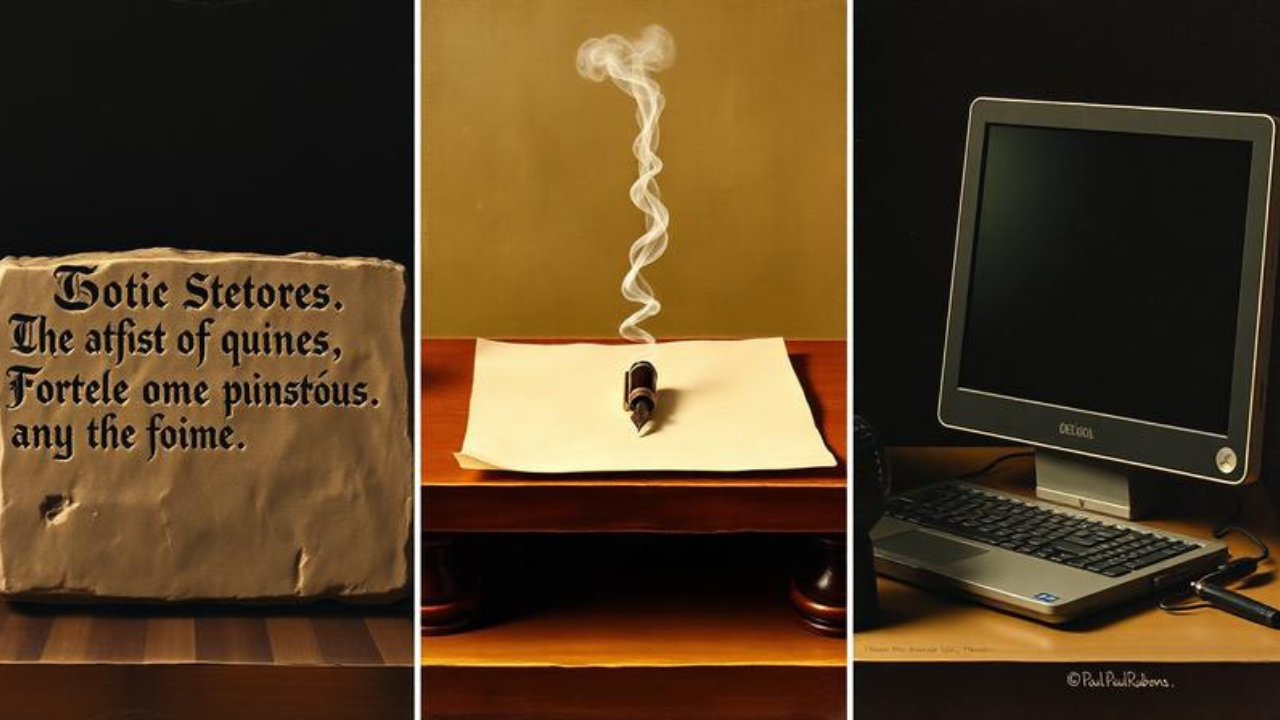
    Around the end of the fourth millennium BCE, humans began to document information in some form of writing. The writing media were large stones or rocks, while the instruments were hammers and chisels. People used to create stone inscriptions depicting information regarding law, statecraft, rituals, etc. Stone inscriptions were also used to depict mesmerizing architectures. The earliest stone inscriptions are found in Mesopotamia and Egypt, which soon spread to other regions like India and China. This invention resulted in the birth of permanent documentation, as the previous Oral Culture was prone to distortion. Although the use of stone for recording information slowly disappeared with time, stones are still used today for architectural decorations, depicting art and culture.

    Chapter 3: Clay Tablets (~3000 BCE to 300 BCE)

    Clay Tablets appeared in ancient Sumer around 3000 BCE. The scribes used a reed stylus, an instrument made of a reed or a bamboo stalk with a cut and split tip to hold ink. They used the stylus on clay tablets to document data about administration, accounting, bureaucracy, and contracts. The use of clay tablets slowly spread to the nearby regions of the whole of Mesopotamia and the Fertile Crescent, and still preserves some of the earliest known documents, including books of the world. The use of clay tablets declined during the Persian control of the region, and fully went extinct after the Greek campaign led by Alexander the Great.

    Chapter 4: Papyrus Scrolls (~2500 BCE to 800 CE)

    While the Mesopotamians were documenting on clay tablets, the Egyptians developed their own medium: Papyrus scrolls. They were an early form of paper made from the pith of the papyrus plant (Cyperus papyrus), and the Egyptians used a stylus with ink to store information on them. The scribes and priests used papyrus scrolls to store various information from commerce to literature to philosophy. Through trade and invasions, the use of papyrus scrolls reached the Mediterranean world and highly impacted the Greco-Roman culture. Their use slowly declined after the use of codices became more prevalent, and they were completely abandoned after the invention and popularity of paper.

    Chapter 5: Palm-Leaf Manuscripts (~700 BCE to 1700 CE)

    India has a rich history of oral traditions. When many civilizations began to document in a writing format, the Indians continued their oral culture through precise use of rhymes, syllables, and metres. But around the 10th to 5th century BCE, they began to shift into a form of writing system for the first time. They used a knife or a stylus with ink on palm leaves or bark. Thus, the tradition of palm-leaf manuscripts began. The scholars used the manuscripts to store various information, starting from religious rituals to philosophical and astronomical information. The palm-leaf tradition quickly spread to the rest of the subcontinent as well as to the South East Asia, including Sumatra and Java. It was in palm-leaf manuscripts that most of the documentation of the entire Indosphere was historically recorded. Their use declined after the spread of paper, but continued to be used within traditional lineages till the 17th-18th century.

    Chapter 6: Parchment Codices (~300 BCE to 1500 CE)

    The Greeks, around the Hellenistic period, developed another form of writing medium: parchment or animal skins. The Greek scholars and philosophers used a quill pen and ink on parchment to store information regarding law, metaphysics, philosophy, and science. The medium later spread to other parts of Europe after the Roman colonization of Greece. The use of Parchment Codices reached its peak during the Roman and early Byzantine Periods. They were adopted by early Christianized Europe and continued to be used till the 13th-15th century, but began to be replaced by paper, and were completely out of use by the late 16th century.

    Chapter 7: Paper Manuscripts (~100 CE to present)

    The Paper that we use today was first invented by China during the Han dynasty period, probably around 105 CE. Traditionally, the invention of paper is credited to the Chinese court official and inventor Cai Lun. Imperial China soon began using them with bamboo brushes (baboo handle with animal hair) and inks for literacy, bureaucracy, education, and even trades. Through trades via the Silk Road, the use of paper spread over the Islamic World, from which it reached other civilizations like Africa, Europe,  and India. The invention of paper led to the extinction of other forms of writing, including papyrus, palm-leaf, and parchment, because paper was very cheap, light, and a scalable writing surface. Paper is still used today as the primary form of documentation and records, although it is slowly replaced by digital media.

    Chapter 8: Printed Paper (700 / 1500 CE to present)

    The Earliest forms of printed paper were developed in Tang China around the 7th century CE. They used ink brushed on carved wooden blocks, which were later upgraded to movable parts by the Chinese engineer Bi Sheng in the 1040s. The printers had hundreds of character blocks with water-based inks. The printers soon reached Korea and Japan, creating a writing revolution in the entirety of East Asia.

    Around the 16th century, a German engineer named Johannes Gutenberg created a different type of printing machine, totally different from the Chinese counterpart. It used metal blocks instead of wooden blocks, used limited alphabets instead of hundreds of characters, was relatively faster, and had an oil-based ink instead of a water-based one. The invention of the printing machine helped accelerate the Renaissance in Europe.  It was used for commerce, state-patronage, science, reformation, and many more. Printing presses are still in use as books are mostly (if not always) printed nowadays, although the machine has undergone a tremendous amount of transformation over the centuries.

    Chapter 9: Fountain Pen Writing (1600 CE to 1980s)

    Around the late 16th century, the Middle East developed an early prototype of something which will soon develop into what is known as the fountain pen. The pen had a continuous ink flow, perfect for personal writing and authorship. The prototype reached Europe over the centuries and reached its presentform in the mid 1800s. The fountain pen replaced all other manual writing instruments all around the world and was very popular for more than one hundred years. The fountain pen soon began to lose its importance after the invention of the ballpoint and the gel pen in 1938 and 1984, respectively, and became completely out of use by the 1990s.

    Chapter 10: Typewritten Documents (1870s to 2000s)

    The typewriter, although it had many prototypes in the 1700s, was rarely used till the middle of the 19th century. In the 1860s, an American inventor named Christopher Latham Sholes invented the practical typewriter as we know it today. The instrument could be used for typing a document in a more precise way compared to writing, and soon became an essential part of the industrialized world. The mechanized uniform texts began to be used in governments, corporations, modern offices, and bureaucracies, which is still continued today via computers. Their use began to decline from the 1980s with the beginning of digitalization, and was completely replaced in most governments and corporations by digital documents in the 2000s.

    Chapter 11: Ballpoint & Gel Pen Writing (1938 to present)

    The Ballpoint pen was invented by the Argentine inventor László Bíró in 1938. The pen uses a small rotating ball at the tip of the pen, carrying ink from the reservoirs. The ink is oil-based, resulting in the drying of the writing very fast. The Ballpoint pen had many advantages over the fountain pen: it was low-cost, simpler to use, reliable, and many more. Another type of pen, called the Gel Pen, was invented in Japan in 1984. This pen uses a water-based ink, giving a smoother writing experience, although the drying time is a little longer than that of the ballpoint pen. Both the pens completely replaced the fountain pen and are predominantly in use today.

    Chapter 12: Digital Documents (1980s to present)

    With the development and commercialization of computers and the internet, typewriters faced an existential crisis in the 1980s, as they were soon getting replaced by digital documentation on computers. Further innovations like smartphones, algorithmic memory, AI text, and cloud storage completely ended the lives of typewriters. Today, digital documentation is becoming the dominant form of records and is aiming to completely end the use of paper in human lives.

    Conclusion

    Thus, the storage and documentation of information and data has evolved a long way, from mind to cloud. This blog shows how different civilizations designed their own form of documentation, whether in  Mesopotamia, Egypt, India, China, orthe  Greco-Roman World, before assimilating together to develop an evolved form of storage. The blog also shows the development of the writing instrument: from hammer and chisel to computers, and this journey has been truly wonderful.

    That is all for this blog. Hope you find it informative and educational. Please like, share, and subscribe to my newsletters if you want updates for my posts in the future. Finally, thank you for reading this.


  • From Shadows to Smartwatches: The Fascinating Evolution of Clocks Through History

    From Shadows to Smartwatches: The Fascinating Evolution of Clocks Through History

    Introduction

    Human beings have been fascinated with time for tens of thousands of years. Early Homo sapiens used time to know when to hunt, rest, cultivate, etc. For measuring time accurately, Neolithic humans began to construct timekeeping devices, which later came to be known as clocks. These clocks added punctuality to the human mainframe and accelerated efficiency to a great extent. In this blog, we discuss nine such clock models that revolutionized the field of Horology (the field of measuring time and making timekeeping devices). We discuss their construction, working, and their impact on timekeeping. So, let’s explore the evolution of clockmaking technology through the sands of time.

    Chapter 1: Sundial (~3500 BCE – 1600 CE)

    Sundials are the earliest known clocks or timekeeping devices, created by human beings. They consisted mainly of a platform with indicator markings and a rod-shaped figure above it, also known as a gnomon. During the day, the gnomon cast a shadow over the platform, whose length and angle were measured and calculated to find the exact hour. The device depended on human observation and calculation, and only worked when sunlight was available. Sundials were soon replaced by more efficient clocks in the future, especially the mechanical clock. They are still on display in various regions for decorative and educational purposes.

    Chapter 2: Water Clock / Clepsydra (~1500 BCE – 1600 CE)

    Water clocks (or Clepsydras) were one of the earliest known clocks made by man, which were independent of any external cause, like sunlight. They were famous in ancient Egypt, Greece, and China. They were built with various designs, especially the Chinese and Arabs devised many complicated mechanisms. In simple terms, the device consisted of two containers connected through a simple pipe or a hole. Water was poured into one of the containers and allowed to drip into the other at a controlled and measured rate. The empty container had markings that could indicate the time passed based on the volume of water filled. In some models, markings were instead on the container filled with water, and time was calculated on the basis of the decrease in water levels of the container. In both models, the water clocks proved superior to sundials and were used mostly at night. Their use declined after the invention of the mechanical clock during the 15th-16th centuries.

    Chapter 3: Candle / Incense Clock / Hour Glass (~500 – 1800 CE)

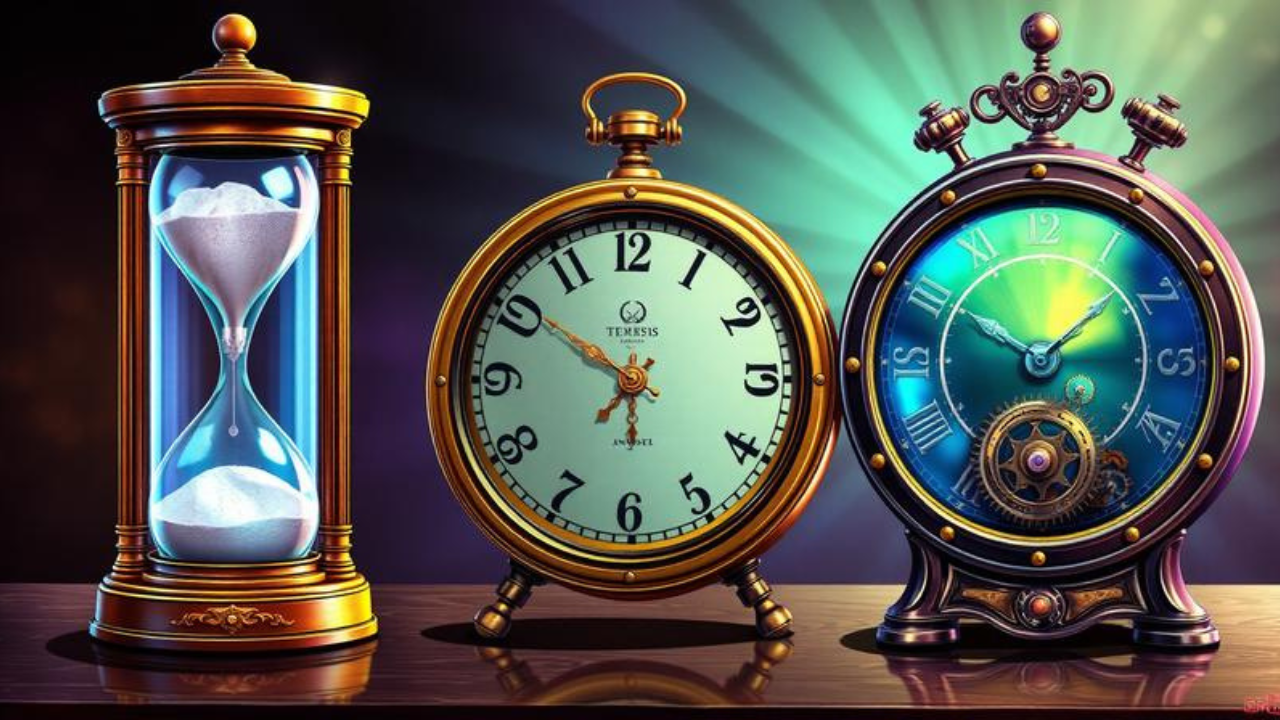
    Around the middle of the first millennium CE, a new type of mechanism was created to make timekeeping portable, so it could be carried from one place to another. Thus, the candle clock and the hourglass were invented. The candle clock was nothing but a candle with markings on it that indicated the time elapsed as the candle burned over the course of time. Hourglasses, on the other hand, were an improvisation on the water clocks, where sand and glass bulbs replaced water and containers. The amount of sand passed from one bulb to another indicated the time elapsed. After the entire sand had passed to the second bulb, the clock could be easily reset by just switching the second bulb on top, so that sand could then pass to the first bulb, and the clock worked in the opposite direction. Hourglasses were mainly used in long voyages, while the candle clock was mainly used for domestic and ceremonial purposes. Their use declined around the 17th-18th century due to the invention of more advanced clocks.

    Chapter 4: Mechanical Clock (~1300 – 1800 CE)

    Mechanical Clocks were the earliest form of properly engineered clocks. They were much more accurate compared to their predecessors and slowly led to their decline in usage. A typical mechanical clock consists of 5 parts: a power source, a gear train, an escapement, a regulator, and an indicator. In the earliest mechanical clocks, a falling weight was used as the power source. The falling weight interacting with gravity created a steady pull that drove the gear train. A gear train is a system of interconnected gears arranged so that the rotation of one of the gears leads to the rotation of all the gears. These gears drive something called an escapement, a disc with two tooth-like arms called pallets, mounted on a rotating shaft, that control the movement of the gears. This escapement is guided by another object called the regulator. In the earliest clocks, a horizontal cross-bar with adjusted weights known as a foliot was used as the regulator. As the gear train moved the pallets, the escapement moved the bar back and forth. The weights on the foliot resisted sudden changes due to rotational inertia, thereby regulating the movement of the gear train. The regulated motion of the gear train was finally transferred to an indicator, in the form of hands, which displayed it in the form of passage of time on the clock’s face. These types of clocks created a revolution in horology and were in continuous use till the 1800s.

    Chapter 5: Pendulum Clock (1656 – 1930 CE)

    The mechanical clocks, although far superior to their predecessors, had a major disadvantage. Their regulators worked on rotational inertia, depending on the movement of the gear train; thus, their accuracy reduced with time and needed to be readjusted. In 1656, the Dutch mathematician and engineer Christiaan Huygens invented the pendulum clock. It had almost the same design and principle as that of the mechanical clock, except for the regulator part. Instead of the dependent foilot, a pendulum was used as the regulator. Unlike the foliot, the pendulum works on the principle of simple harmonic motion under gravity. The pendulum thus swings in a uniform motion independent of any external object. Thus, the pendulum clock worked as a far better-regulated and, in turn, more efficient clock than the mechanical clock. Another innovation was that the power source was changed from a falling weight to a spring whose potential energy provided the power. The pendulum clocks were in common use till the late 1930s.

    Chapter 6: Marine Chronometer (1735 – 1970 CE)

    The Pendulum Clock, although very efficient and requiring very little calibration, had a major drawback. It was inefficient in sea voyages, as the motion of the pendulum was interfered with by the constant rocking and rolling of the waves. In 1735, the English engineer John Harrison invented the marine chronometer, suitable for sea voyages. The marine chronometer had a balance wheel and a spring in place of a pendulum as the regulator. The wheel oscillated in a uniform harmonic oscillation, and the spring attached to it provided the elasticity, thereby maintaining a uniform regulation independent of both gear train motion and motions from sea waves. The marine chronometer proved to be very efficient in naval expeditions and warfare, and continued to be used till the 1970s, when they were replaced by atomic clocks.

    Chapter 7: Quartz Clock (1927 – present)

    The Quartz Clocks are the first electrical clocks. Here, the power sources are batteries, in place of springs or weights. But the most important innovation is in the regulators. Quartz is a crystal that possesses a unique property called piezoelectricity, the ability to generate electrical pulses when under mechanical stress. Thus, in quartz clocks, tuning forks made of quartz crystal are installed in vibrated conditions, thus creating electrical pulses which act as the regulator. Electrical clocks are far superior in accuracy and efficiency compared to mechanical clocks, and thus, the former completely replaced the latter within decades. Also, quartz being extremely abundant on earth, made quartz clocks extremely cheap, and thus they are still in use in nearly every household.

    Chapter 8: Atomic Clock (1949 – present)

    Atomic Clocks are the champions of accuracy. In an atomic clock, the quartz crystal vibrates and sends electrical signals at a fixed frequency. These electrical signals are then converted to microwave signals. These microwave signals are sent to certain atoms: either Cesium-133, Rubidium-87, or Hydrogen (maser). The microwave signals excite the atoms. These atoms pass through a detector. Any change in the frequency of the electrical signal will change the level of excitation of the atom. The detector will detect the change and send a feedback signal to the quartz, thereby maintaining the regulating frequency. These clocks are so accurate that time has been defined by them. Before the atomic clocks, time was defined by the Earth’s rotation and revolution, whose measurements were affected by tides, earthquakes, and other causes. But after the invention of the Atomic clocks, one second is defined as 9,192,632,770 oscillations of radiation corresponding to a specific energy in the Cesium-133 atom. So, with the invention of atomic clocks, the calculation of time became finally independent of the Earth’s surface. Atomic clocks are now used in global navigation systems like GPS, telecommunication and internet facilities, stock markets, astronomical observations, and many more.

    Chapter 9: Smart Watch (2000 – present)

    Smart watches are direct descendants of Quartz clocks. The main body is the same except that the electrical signals are passed through a digital logical counter, which counts the oscillations. The software associated with it compares the oscillation with an external timeframe (GPS, phone, satellite, etc.) and sends feedback signals to the quartz crystal. Another thing that changed is that smart watches have a digital display frame with no clock hands as an indicator. Except for the regulator, almost all the mechanisms are the same for a smart watch and a quartz watch with a digital frame. They are today used both as timekeeping devices and for external features like measuring heart rate, weather reports, etc.

    Conclusion

    Clocks have evolved along with human civilizations over time. From calculating time to defining time, they have come a long way. The evolution can be classified into three different stages: pre-mechanical, mechanical, and electrical clocks. A proper electronic age for a clock is yet to come (if we don’t count mobile phones and personal computers as electronic clocks).

    That is all for this blog. Hope you enjoyed it. Finally wrote my first “technology” blog after 36 blogs. So, kindly forgive the technical jargon. I will try to minimize them in the future. Will be bringing more blogs on the history of science and technology like this. Please like, share, and subscribe if you want to get updates for my blogs. And thank you for reading the piece.