
Tag: intellectual-history

  • The Evolution of Brain Games: How Culture Shapes Strategy Through Chess, Go, and Beyond

    The Evolution of Brain Games: How Culture Shapes Strategy Through Chess, Go, and Beyond

    Introduction

    A game is a form of human interaction where one or more individuals compete to accomplish a specific task under certain conditions or to outperform other participants in that task, within a casual environment with no serious consequences. A game is generally played for entertainment during leisure time, but many individuals who excel in certain games often pursue the art of playing those games as a professional career. Games can be of various types: played by individuals or teams, requiring a toned physique or a sharpened mind, and completed in minutes or taking days to complete. Games that require more organized skill or training are known as sports. 

    In this blog, we are going to discuss some specific types of games and sports. Those that are played mostly through the mind, memory, and intellect. Most of them are played on a board. We are going to discuss the origins and evolution of seven such “brain games” that got embedded in the history and culture of those civilizations, if not the whole world. This blog won’t discuss the nitty-gritty of the gameplay, but will just discuss the relationships between the basic gameplay and the cultures it influenced, or was influenced by. So, let’s begin.

    Chapter 1: Oware / Mancala

    Mancala is one of the earliest known game families in human history. It originated in Sub-Saharan Africa around 3000 BCE, but slowly travelled to the Middle East and Caribbean during the medieval and colonial periods. The original gameplay consisted of a turn-based game which involved sowing of seeds in pits. The objective was to capture the seeds from the opponent’s pit. The seeds had no hierarchy, and thus, the one with more seeds won. The game slowly evolved with additions of multi-row boards, involvement of abstract game strategy, and formation of local variations, which grew into individual games. One such popular game is Oware, which is played mainly in Western African nations like Ghana. Oware is one of the most popular games within the Mancala family, with a fixed set of rules for gameplay and outcome. Mancala, in early African cultures, acted as a reference for resource distribution. The game influenced the culture by establishing virtues like communal balance, resource redistribution over domination, long-term strategy, and presenting a non-zero-sum worldview.  Manchala games are still very popular in Africa and are embedded in its culture.

    Chapter 2: Backgammon

    The earliest history of a game related to Backgammon can be found in Mesopotamia from 2600 BCE, in the form of the Royal Game of Ur. Originally, it was a dice-based game, which slowly spread to the Roman Empire, and later to the Islamic and Western worlds, via the Byzantine Empire. Both the Royal Game of Ur and Backgammon are types of racing games that depend on luck and probability for outcome. The objective is to remove all the pieces from the board faster than the opponent, depending on dice rolls. Backgammon, over time, gave rise to a basic understanding of probability, especially in the Middle Ages. The game shows how those cultures considered fate and luck as important conditions in determining outcomes, which is still present in many modern societies. This game also popularized the “dice” to the world, which in turn influenced different games across different cultures.

    Chapter 3: Chess

    Chess is perhaps the most popular board game. It is a two-player turn-based game whose objective is to capture or “Checkmate” the opponent’s king. The pieces are hierarchical, and each piece category has its own power and value. The game actually developed during the 5th-6th century CE in India, originally called “Chaturanga”. The original pieces were representatives of four types of armies: Infantry, Cavalry, Elephants, and Chariots. After the Islamic invasions in India, the game passed to Persia, where it got the name “Shatranj.” In Islamic Persia, the pieces became aniconic, as Islam forbids idols. The game soon went to Europe through both the Iberian Peninsula  (via Cordoba Sultanate) and the Kyivan Rus (via Byzantine Empire). In Europe, the Queen and the Bishops’ power increased due to the political and theological influences. The game continued to grow in Mediterranean Europe and the Russian Empire, with various evolutions like world-class tournaments (1850s), time controls (1860s-80s), tactical & positional plays, world chess championship(1886), chess engines (1980s), AI engines (2020s), etc. The game of chess reflects the warfare abstractions, the hierarchical chain of command, rational planning, intellectual prestige, and strategic thinking models, which were core to different environments through which it evolved: whether it’s India, Persia, Russia, or Western Europe. Today, chess is a professional sport played all over the world, with countries like Russia, India, China, and the USA dominating the top spots.

    Chapter 4: Pachisi / Ludo

    Pachisi was another Ancient Indian game from the 6th century CE, which slowly evolved into what is now called Ludo. While Chaturanga was mostly popular with the elite or intellectual class in Ancient India, Pachisi was more popular with the common households. The gameplay consisted of a cross-shaped board with around six cowrie shells as dice. The objective was to bring all the pieces off the board as fast as possible with respect to the outcome of the cowrie shells rolled. The gameplay also involved capturing opponent pieces, which resulted in the pieces restarting their journey from home. With the passage of time, the cross-shaped board became a square-shaped one, the multiple shells became a singular die, and Pachisi evolved into Ludo, with the influence of the West. The game clearly depicts the Indian acceptance of fate on outcomes, and also the use of strategy and tactics when encountering unfavourable circumstances. Ludo, today, is a highly popular casual game, played among the families of the Indian subcontinent, and is now going through a high digital emergence with a huge number of apps.

    Chapter 5: Go

    Go is an East Asian board game that dates back to around 3000 BCE. Although the origin is so old, the actual game was formalized around the early Tang period (7th century CE). The game also spread to Japan and Korea, with a huge influence on the latter’s culture. The objective of the game is to control a larger portion of the board than the opponent, through black and white stones across the grid. It is a turn-based game where stones can only be placed on a grid if there is at least one adjacent empty grid. If a stone or a group of stones is surrounded by enemy stones from all sides, that group is considered captured and is removed from the board. The game has undergone several changes over the course of time, including tactical evolution, some innovation in set rules, and even the involvement of AI through AlphaGo. The game upholds the Chinese philosophy of positional strategies combined with disciplined rigor. Go also visualizes the art of controlling a territory with brains instead of brawn. Today, the game is very popular in China, Taiwan, and Korea, with strong professional circuits.

    Chapter 6: Shogi

    Shogi is a Japanese strategy board game that evolved from the Indian Chaturanga in the 10th-11th century CE. The pieces are the same shape and color, with their ownership indicated by the direction they point, i.e., towards the opponent. One major difference from regular chess is that the captured pieces can be used by the opponent as their own piece under certain conditions. This game emphasizes recycling pieces. The game saw tactical evolution during the Edo period with many minor rule changes. The game requires players to be flexible without sacrificing discipline, which symbolizes Japanese flexibility. Presently, the game is very popular in Japan and has a professional ranking system.

    Chapter 7: Dominoes

    Dominoes is a popular game in the West, which finds its origin in medieval China, around the 11th century CE. The gameplay involves matching tiles called dominoes by the number of dots. And arranging them in a chain until one player is out. The number of matching dominoes remaining with the opponent became their score. In this way, the person to score a set number first wins. The game has a huge factor of probability and critical thinking. The game evolved across the last millennium, with respect to scoring systems, until it reached Europe in the 18th century CE. The game gives importance to Chinese logic and pattern matching. Today, the game is very popular as a casual game and is embedded in many Western regional cultures.

    Conclusion

    Games have influenced humans as much as humans have influenced games. Games, especially these “brain games,” beautifully depict how humans gather information, process it inside their brains, and respond accordingly. Playing such games from a very early age also helps in cognitive evolution, pattern recognition, and memory development of a child. These games can also help in binding together friends, families, and other relationships, despite daily human struggles. Games and sports help us in many more ways than we actually realize.

    That is all for this blog. I know, this blog was a bit technical. I tried to write the gameplay details as little as possible.  Hope you found it helpful. If so, please like, share, and subscribe to my newsletters for updates on my future blogs. Thank you for reading this blog.

  • East Meets West: The Six Philosophical Parallels Linking India and Greece

    East Meets West: The Six Philosophical Parallels Linking India and Greece

    Introduction

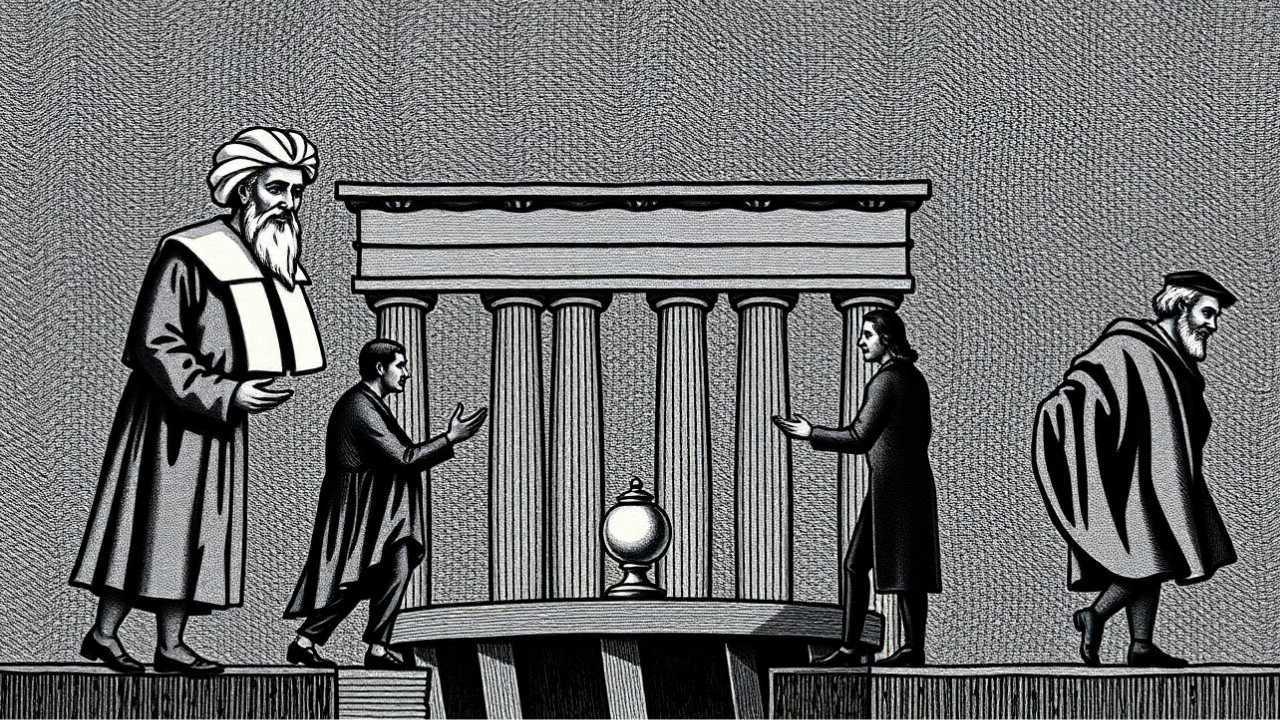
    Ancient India and Greece were two of the hubs of the world’s greatest philosophical thought. Both being great contributors to the Axial Age, the civilizations produced distinct philosophical schools and ideas, each with its own ethics, epistemology, and metaphysics. Interestingly, some of the bigger schools from both cultures shared interesting similarities and parallels across the continents. One of the reasons for this similarity is attributed to the invasion of Alexander the Great in the East. The schools from both cultures might have exchanged some ideas after that, although most schools have their core principles defined centuries before the invasion. In this blog, we discuss six such interesting parallels between the schools of Greek and Indian Philosophy. So, let’s begin.

    Chapter 1: Sāṃkhya and Greek Pluralism

    The schools of Sāṃkhya and Greek Pluralism are two of the oldest in world philosophy, both dating much before the pre-Socratic era. Both traditions reject simplistic monism in favour of multiple fundamental principles for explaining the universe.

    Sāṃkhya defines a dualistic ontology consisting of Puruṣa (consciousness) and Prakṛti (primordial matter). The universe emerges as Prakṛti unfolds into twenty-four additional principles, including intellect (buddhi), ego (ahaṅkāra), mind (manas), the five subtle elements (tanmātras), and the five gross elements (mahabhutas). Liberation occurs when Puruṣa realises its separation from Prakṛti.

    Greek Pluralism, on the other hand, explained the diversity of phenomena in terms of small sets of fundamental elements, namely, earth, air, fire, and water. Philosophers such as Empedocles postulated that the elements interact through cosmic forces of Love(attraction) and strife(separation). Another philosopher, Anaxigoras, introduced the concept of seeds (spermata) – minute, eternal particles which are ordered by Nous (intellect), an immaterial principle to provide structure. They explained observable phenomena without invoking a creator God.

    Both schools show striking parallels – they both believe in a pluralistic universe, consisting of multiple irreducible principles; for Sāṃkhya, these are the 25 categories, while for Greek Pluralism, these are the five elemental roots. Both schools are also extremely naturalistic and reject any form of divine intervention.

    Along with many similarities, there are some core differences, which include that Puruṣa, in the case of Sāṃkhya, is a passive witness to the evolution of Prakṛti, while Greek Pluralists rarely invoke consciousness, and if it appears in the form of Nous, it is an ordering principle and not a passive witness. Another important difference is in the goal or aim of the schools. While Sāṃkhya is deeply tied to the object of liberation, the Greek Pluralists use their principles for cosmological, ethical, and societal purposes.

    Chapter 2: Nyāya and Aristotelianism

    The schools of Nyāya and Aristotelianism form two of the most rigorous and systematic traditions of logical reasoning in world philosophy. Both emphasize logical thought over everything else and promote structured analysis for understanding the universe.

    Nyāya’s central epistemology is based on four means of knowledge-

    1. Pratyakṣa (perception) – direct sensory experience.
    2. Anumāna (inference) – logical reasoning from the beginning to the end.
    3. Upamāna (analogy) -knowledge via comparison.
    4. Śabda (verbal testimony) – knowledge obtained from reliable sources, like the Vedas.

    Casualty, inference patterns, and methods of refuting fallacies are central, making Nyāya a rigorous science of reasoning and debate.

    Aristotle, in his works, the Organon and natural philosophy, provided a comprehensive approach to logic, ontology, and causation. His central contributions include – 

    1. Syllogistic Logic – deductive reasoning from the beginning to the end.
    2. Categories of being – based on substance, quantity, quality, relation, place, time, etc.
    3. Four Causes (aitia) – material, formal, efficient, and final causes explaining existence.
    4. Empirical Observation – Aristotle integrated logic with systematic observation and generalization.

    Aristotle emphasized teleology, where natural phenomena are oriented towards ends, and logical structure underpins both science and metaphysics.

    Both schools thus have many parallels. They treat logic as the ultimate foundation of philosophy, and both embrace realism over metaphysics. Both of them also prioritize methodological rigor, whether it’s Nyāya’s structural debates or Aristotle’s careful logical demonstration.

    Like other schools, they have some dissimilarities, which include Nyāya’s primary focus on knowledge, inference, and metaphysics, while Aristotle’s integration of biology and teleology. Another important difference is that Nyāya sometimes integrates theism as a metaphysical postulate, while Aristotelianism’s Prime Mover is impersonal and non-interfering.

    Chapter 3: Vaiśeṣika and Greek Atomism

    The Vaiśeṣika school, attributed to Kaṇāda, deals primarily with metaphysical and logical understanding and organizes reality into discrete categories (padārthas). The classical system categorizes the world into seven or nine categories, depending on sub-branches, including-

    1. Substance (dravya) – the enduring substratum (earth, water, fire, air, void, time, space, and self)
    2. Quality (guṇa) – attributes to substances (color, taste, number, etc.)
    3. Action (karma) – any type of motion or change to substance.
    4. Universal (sāmānya), Particularity (viśeṣa), Inherence (samavāya) – relations connecting substance and qualities.
    5. Non-existence (abhāva) – absence.

    Vaiśeṣika also develops an atomic theory, proposing that substances are composed of paramāṇus (atoms) – eternal, indivisible units of matter. These atoms combine in pairs, triads, and higher structures to form the macroscopic objects we see.

    Greek Atomism emerged under Leucippus and Democritus, and was further developed by the Epicureans. Its core principles include-

    1. Indivisible atoms – the fundamental units of all matter, energy, and unchangeable.
    2. Void (kenon) – space in which atoms move freely.
    3. Mechanical Causation – macroscopic properties emerge from shape, size, motion, and the arrangements of atoms.
    4. Naturalistic explanation – phenomena, including celestial motion, are reducible to atomic interactions.

    Epicureans later added an ethical dimension – atoms interact naturally, and understanding these interactions reduces fear and enables ataraxia (peace of mind).

    The structural parallels between Vaiśeṣika and Greek Atomism include that both schools’ foundations are based on fundamental constituents of reality (paramāṇus and atoms). Combining the fundamental constituents, both the school explained the natural macroscopic world. Both gave naturalistic explanations such that every complex matter has some underlying simple entities, which are in turn divisible until the fundamental constituents.

    These schools have a few differences; some of them are that Vaiśeṣika goes beyond atoms, includes quality, action, universals, and inherence, while Greek Atomism is linear, focusing just on atoms and voids. The former treats atoms as a part of a broader, structured ontology, including time, space, and substance, while Greek Atomism operates within a simpler, mechanical universe of atoms in a void.

    Chapter 4: Vedānta and Neoplatonism

    Vedānta, particularly Advaita Vedānta, and Neoplatonism represent two of the greatest sophisticated metaphysical traditions that explore the relationship between the ultimate unity and the multiplicity of the world. Both schools grapple with one-many problem, offer accounts to the ultimate reality, and propose pathways for the soul or consciousness to realize its true nature.

    Advaita vedānta, systemized by Śaṅkara, proposes Brahman as the absolute, non-dual reality. The phenomenal world (jagat) is understood as māyā, a manifestation of Brahman’s apparent multiplicity. The individual self (ātman) is ultimately identical to Brahman, and ignorance (avidyā) creates an illusion. Liberation (mokṣa) occurs when the self realizes the non-duality, ending the cycle of birth and death (saṃsāra). It emphasizes knowledge (jñāna) as the primary means to liberation, often supplemented by ethical conduct and devotion (karma and bhakti).

    Neoplatonism, articulated by Plotinus, posits the One as the ineffable source of all reality. From the One emanates the Nous (intellect), followed by the Soul (psyche), which ultimately manifests the material world. The world is real but derivative, and multiplicity emerges from the absolute unity of the One.

    Both traditions share many similarities. They describe reality as emerging from an ultimate, unitary principle – Brahman or the One. Both prescribe a transformative journey for the self. Both recognize that the ultimate principle of reality cannot be fully captured in words or concepts, and it is beyond dualities, qualities, and ordinary experience.

    Differences between the schools mainly include the nature of the phenomenal world, which Vedānta treats as māyā or temporary illusion, while Neoplatonism treats it as real but independent. Vedanta emphasizes karma and bhakti alongside jñāna as pathways to liberation, while Neoplatonism focuses on intellectual and contemplative purification, giving lesser importance to ethical guidance.

    Chapter 5: Jainism and Pythagoreanism

    The tradition of Jainism was systematized by Mahāvira, which emphasizes-

    1. Ahimsa (non-violence) – ethical foundation, strict avoidance of harm to all living beings.
    2. Anekāntavada (non-one-sidedness) – A philosophical principle recognizing that the same truth can be perceived by different beings through different perspectives.
    3. Karma theory – Every action produces subtle karmic particles that bind the soul (jivā), continuing rebirth (saṃsāra).
    4. Ascetic practice – Liberation (mokṣa) is achieved through rigorous ethical conduct, renunciation, meditation, and detachment from material desires.

    Jainism’s ontology distinguishes jivā (soul) from ajivā (non-soul), with ethical and spiritual practice directly affecting the soul’s purification.

    Pythagoreanism, founded by Pythagoras, is a metaphysical-religious tradition combining mathematics, ethics, and metaphysics. Its core principles include –

    1. Numerical harmony – Numbers and their ratios underlie cosmic order, and understanding these relationships can lead to understanding reality.
    2. Ascetic lifestyle – Pythagoreans adopted dietary restrictions, communal living, and self-discipline to purify the body and mind,
    3. Belief in metapsychosis – Reincarnation or transmigration of the soul, based on moral consequences of actions.
    4. Ethical and spiritual cultivation – Living in harmony with cosmic order and virtue promotes purification and aligns the soul with universal principles.

    The Pythagorean approach is simultaneously mathematical, ethical, and spiritual, reflecting a worldview where they are inseparable.

    The parallels between the two traditions include that they both emphasize an ascetic and ethical lifestyle (they promoted ascetism the most among other schools in their respective civilizations). They also believe in the transmigration of the soul and the need for purification to escape the continuing cycle. They also heavily emphasize ethics and believe in a universal ethical order, whether tied to karmic law or numerical and cosmic harmony.

    Key differences between the schools include their metaphysical understanding, where Jains give importance to the Karmic particles, while Pythagoreans promote Numerical harmony. Another difference is the goal of the tradition, where the former’s aim is to achieve liberation (mokṣa) while the latter aims to achieve cosmic harmony through mathematics and ethics.

    Chapter 6: Buddhism and Stoicism

    Buddhism centers around the Four Noble Truths-

    1. Dukkha – Life involves suffering and dissatisfaction
    2. Samudaya –  Suffering arises from craving (taṇhā) and attachment.
    3. Nirodha – Liberation (Nirvāṇa) is possible through cessation of craving.
    4. Magga – The path to liberation is the Noble Eightfold Path, encompassing right view, intention, speech, action, livelihood, effort, mindfulness, and concentration.

    The tradition emphasizes impermanence (anicca), non-self (anatta), and the importance of mindful awareness (sati) in achieving liberation. Tools for controlling desires include ethical conduct (sīla) and meditation (samādhi). Buddhism is a very practical and experiential philosophy, seeking liberation not through speculative metaphysics, but via disciplined transformation of the mind and behavior.

    Stoicism, particularly in the Roman period (Seneca, Epictetus, Marcus Aurelius), teaches that virtue is the highest good and that happiness depends on aligning with Nature or Logos, the rational order of the cosmos. Major doctrines include – 

    1. Control and indifference – Recognize what is within one’s control (virtue, thoughts) and what is not (external events).
    2. Acceptance of fate (amor fati) – Embrace the natural order and life’s inevitable difficulties.
    3. Emotional regulation – Cultivate apatheia – freedom from destructive passions.
    4. Ethical practice – Live according to reason, maintain honesty, justice, courage, and self-discipline.

    It is thus a practical philosophy aimed at inner tranquility, promoting self-mastery and resilience in the face of uncertainties.

    Buddhism and Stoicism have many parallels. Some include focusing on mental discipline (through meditation and mindfulness for Buddhism, and through reflection and journaling for Stoicism), detachment from external outcomes, and priority towards experiential knowledge rather than speculative ones.

    Key differences include Buddhism’s denial of a permanent self (anatta) compared to Stoicism’s rational agent. Also, the spiritual techniques are different; for Buddhism, they are meditation, mindfulness, and renunciation, while for Stoicism, they are reflection, rational examination, journaling, and habituation.

    Comparison Table

    Indian SchoolGreek SchoolCore Focus / ParallelKey Distinction
    SāṃkhyaGreek PluralismMultiple fundamental principles explaining realitySāṃkhya is dualist (Prakṛti &Puruṣa); Greek pluralism is often materialist and non-dual
    NyāyaAristotelianismLogic, epistemology, structured reasoningNyāya integrates epistemic pramāṇas; Aristotle emphasizes deductive syllogism
    VaiśeṣikaGreek AtomismAtoms/ indivisible units as fundamental constituentsVaiśeṣika adds categories like quality, inherence; Greek atomists focus on void and motion.
    VedāntaNeoplatonismUltimate unity -> multiplicity, spiritual ascentVedānta emphasizes non-dual Btahman; Neoplatonism uses One -> Nous -> Soul hierarchy
    JainismPythagoreanismEthical ascetism, soul purificationJainism emphasizes karma, ahimsa, and mokṣa; Pythagoreans focus on numerical harmony and cosmic alignment
    BuddhismStoicismMental discipline, detachment, practical ethicsBuddhism emphasizes impermanence and non-self; Stoicism emphasizes rationality, Logos, and virtue


    Conclusion and Reflection

    Thus, from the above discussions, we see that various Indian and Greek philosophical schools share surprising similarities, whether it is Vedānta and Neoplatonism, or Buddhism and Stoicism. But the blog never intends to suggest that one tradition copied from the other. The two civilizations developed independently and may have shared a few ideas through cultural exchanges during campaigns and invasions, from which the parallels may have arisen. Infact, many important Indian schools like Yoga, Mīmāṃsā, and Cārvāka, and Greek schools like Epicureanism, Cynicism, and Stoicism, are avoided in this blog as they didn’t share any parallel ideas across the continents. This blog intends to show how different cultures can basically derive the same result independently of each other. This blog also intends to bridge the gap between those who are accustomed to Western Philosophy and Indian Philosophy, and hopes to open a wormhole between them.

    Anyway, that is all for this blog. Do like, comment, and share if you find this piece interesting and informational. Also, please subscribe to my newsletters through email below, if you want to get notified for future blogs and updates. Also, your subscription will motivate me to write future blogs on more interesting topics in philosophy, science, history, and mythology. Finally, thank you for reading the blog.

    Suggested Readings

    Disclosure: This post contains affiliate links. As an Amazon Associate, I earn from qualifying purchases. I only recommend books I truly value.


  • 7 Intellectual Rivalries: How Great Idea Battles Shaped Human History

    7 Intellectual Rivalries: How Great Idea Battles Shaped Human History

    Introduction

    Homo sapiens is considered an intellectual species. For over 60,000 years, human beings have slowly evolved through time with the help of cognitive, agricultural, and scientific revolutions. Through logic, reason, trial and error, the primitive humans have evolved to their modern selves. During the course of this intellectual evolution, although agreement by the general public played an important role, disagreement and even rivalries played an important role in enquiry and further evolution. In this blog, we talk about seven such famous rivalries that shaped the course of human history to a certain degree. From classical Greece to modern science, these rivalries played an important role in how human beings began to understand the universe.

    1. Platonism vs Aristotelianism

    The school of Platonism believed that the world around us is a shadow of a higher one. Plato argued that true knowledge comes from pure reason and turning inward. He suggested not to trust our imperfect senses. For the Platonists, the real world was abstract and eternal, which cannot be perceived or understood by our five senses.

    Then came the Aristotelians. They suggest that the real world can only be seen by studying everything around us through our senses, including various substances, causes, and observable patterns. According to Aristotle, true knowledge can be achieved through practical experiences, and not from theories and inner contemplations.

    This rivalry became the foundation of modern Western thought, specifically between idealism and empirical realism.

    2. Nyaya vs Buddhism

    The Nyaya Philosophers of ancient India believed in a realistic world that can be known through perception, inference, comparison, and testimony. They gave importance to logic above all else. They believed in a permanent self (atman) and an objective world that works alone on pure logic and reasoning.

    Buddhists, on the other hand, believed everything is temporary, including the self, which is just a collection of experiences. They were skeptical of Nyaya’s claim of objectivity and propagated relativism.

    This rivalry shaped India’s intellectual debate over objective vs subjective truth for centuries.

    3. Confucianism vs Legalism

    Confucius and his followers saw society as something that flourishes through virtue, morals, and proper relationships. They believed humans could evolve through proper guidance, education, and ethics. They proposed an ethical world that would be ruled by virtuous rulers for inspiration.

    Legalism argued the opposite – a society could function properly only through strict laws and firm punishments. They believed the world could be in perfect order through proper law enforcement, and not through morals and virtues.

    Both the schools influenced China in different periods (Legalism during the Qin Dynasty and Confucianism during the Han Dynasty), before finally merging with the societies of the Chinese Civilization forever.

    4. Advaita vs Dvaita

    Adi Shankara and his school of Advaita Vedanta taught that reality is ultimately the nondual Brahman. They claimed that liberation from illusion occurs when the self realizes that God, the self, and the universe are all one.

    Dvaita Vedanta, founded by Madhva, debated that God, the self, and the universe are distinct forever. The world is fully real and not an illusion. According to them, liberation will occur not through any realization, but through complete devotion to God (Vishnu).

    This debate shaped Indian Philosophy and continues to thrive in Hindu philosophical discussions.

    5. Rationalism vs Empiricism

    Rationalists like René Descartes and Baruch Spinoza believed that the mind contains innate ideas, and reason is the strongest path to truth. Mathematics and Logic come from proper reasoning and critical thinking, and are independent of the senses.

    Empiricists like John Locke, David Hume, and George Berkeley argued the reverse: the mind begins as a blank slate, and is filled by knowledge from experience. According to them, sense organs are the ultimate tools of understanding, and even complex ideas evolve from simpler impressions.

    This debate laid the foundation of modern science and shaped the Enlightenment Period.

    6. Lamarckism vs Darwinism

    Jean-Baptiste Lamarck proposed that species evolve because organisms adapt during their lifetimes and pass these traits to their offspring. Giraffes stretch their neck to eat leaves from tall trees, and their children inherit longer necks. According to him, evolution was driven by need and effort.

    Charles Robert Darwin showed that evolution works through natural selection – random mutation occurs, and those better suited for their surroundings survive and reproduce. Traits don’t arise because they are needed; they remain because they work.

    Darwin’s model replaced Lamarck’s theory, completely changing the direction of the study of genetics and evolution.

    7. Relativity vs Quantum Mechanics

    Albert Einstein’s Relativity described the universe as smooth, continuous, and governed by precise laws. According to his theory, space and time curve around mass, resulting in deterministic patterns. It works beautifully on celestial objects like galaxies, stars, and planets.

    Quantum Mechanics, led by the likes of Max Planck and Niels Bohr, challenged the picture. At the smallest scales, reality becomes probabilistic, discontinuous, and uncertain. Particles behave like waves, and both position and momentum cannot be determined simultaneously.

    Both the theories still work – but they don’t agree with each other, leading to Physics’ greatest rivalry.

    Conclusion and Reflection

    These seven rivalries showed that contradicting ideas can survive in the same world and often lead to some kinds of revolutions. Debates, discussions, and disagreements are some of the strongest tools that humans possess and should always be encouraged, cherished, and promoted. If everyone agreed to the same idea, humans would still be hunters and gatherers in the 21st century CE.

    That’s all for this blog. Please like, comment, and share if you find this interesting. Thank you for reading this blog.

    Suggested Readings

    Disclosure: This post contains affiliate links. As an Amazon Associate, I earn from qualifying purchases. I only recommend books I truly value.