Tag: mythology

  • The Encyclopedia of World Trees: From Vedic Aśvattha to Norse Yggdrasill

    The Encyclopedia of World Trees: From Vedic Aśvattha to Norse Yggdrasill

    Introduction

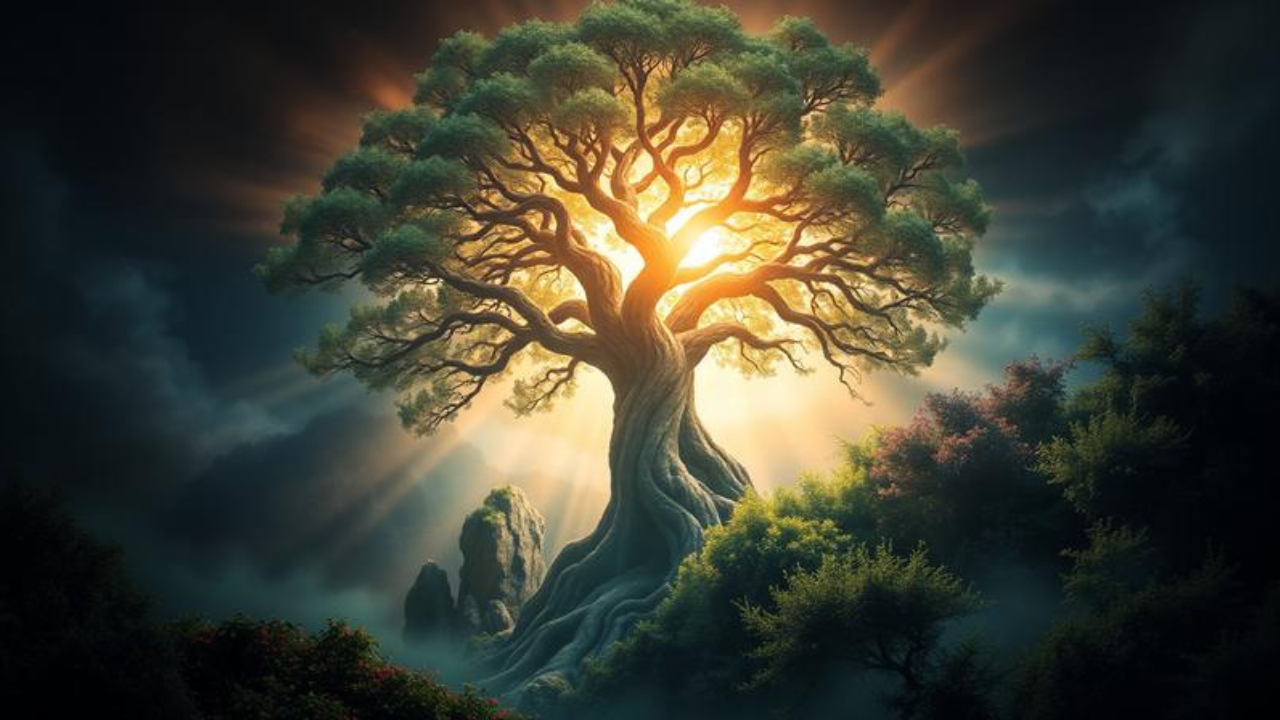
    Plants and trees have played crucial roles in human society since the beginning. From agriculture to medicinal use to botanical gardens, the plant kingdom has always been integral to human lives. Humans, thus, with respect and celebration, have created numerous stories, myths, legends, and folklores involving plants and trees across various cultures and civilizations. One such example is the concept of different “World Trees,” which connect the different realms, including the Earth, heaven, and the underworld. These World Trees have been systematically embedded in various cultural metaphysics and cosmologies. In this blog, we discuss seven world trees starting from the Siberian Turks to the Chinese to the Norse. The list is not exhaustive, and many sacred trees have been omitted to keep the blog concise and suitable for completing in a single reading. So, let’s begin.

    1. Bay Térék (Turkic-Siberian)

    The Bay Térék is the foundational world tree in Siberian and Turkic Shamanic cosmology, which can be traced back to the Paleolithic Age. The tree is seen as a spiritual ladder connecting the underworld, the earth, and the sky. The trunk represents the earthly plain, the roots penetrate the ground to the home of the ancestors in the underworld, while the branches reach the heavens, where the Gods and other celestial beings dwell. 

    Shamans invoke the tree in healing, divination, and initiation ceremonies, often using drums and chants. Birds and snakes are said to be living within the tree, acting as the messengers to the sky and the underground. The Bay Térék is perhaps the earliest example of a sacred world tree among all the cultures of the world.

    2. Aśvattha (Vedic-Indian)

    The Aśvattha is one of the most philosophically profound trees in Vedic-Hindu mythology, appearing in both the Rig Veda and later the Bhagavad Gita. It is described as an inverted cosmic tree whose roots are said to extend to heaven, while its branches reach the Earth. This inversion symbolizes the illusory nature of the world (Maya) and the primacy of the spiritual realm.

    The tree is depicted as evergreen, a visual metaphor for continuity and persistence, resonating with the concepts of dharma and cosmic order. In the 15th chapter of the Bhagavad Gita, the tree is used as a metaphor for the human body and the soul: “ The unreal has no roots, the real has no branches.” Here, the Aśvattha functions as a philosophical device, guiding seekers to understand the transient nature of worldly existence and the eternal essence of the self.

    The tree is culturally associated with the Banyan Tree, used as a meeting place, traditional schools, and shrines.

    3. Jianmu (Chinese)

    The Jianmu Tree occupies a central place in Chinese mythology as a cosmic axis connecting Heaven and Earth. It is mentioned in texts like the Shan Hai Jing (Classic of Mountains and Seas) and various shamanic stories. Its trunk is said to extend from the earthly plane into the heavens, while its branches stretch across the sky, supporting celestial bodies and divine realms. Jianmu also acts as a support for the Sun and Moon, sometimes depicted with birds perched in its branches, representing the passage of time and the regulation of celestial movements. It also serves as a bridge for humans and deities, facilitating divine interventions, spiritual journeys, and communication between realms.

    Symbolically, the tree represents stability, continuity, and moral order, echoing the Confucian and Daoist emphasis on harmony with nature. In essence, Jianmu is more than a tree; it is a cosmic scaffold, embodying heavenly order, moral harmony, and the bridges between the human and the divine worlds.

    4. Gaokerena (Zoroastrian)

    The Gaokerena is the central sacred tree in Zoroastrian cosmology, embodying immortality, divine blessing, and the regeneration of life. According to Bundahishn (Zoroastrian Creation Texts), Gaokerena sprang from the seed of all seeds, planted by Ahura Mazda, the supreme God, to sustain life and provide divine nourishment to humanity and all living beings. Its fruits and trees possess healing properties, ensuring health, longevity, and the continuation of life.

    Gaokerena is also the origin of all plants and seeds, linking it directly to agriculture, human survival, and the ethical responsibility to care for creation. It also represents the Zoroastrian dual idea of asha (truth, order) and druj (chaos, falsehood). In some traditions, the seeds of Gaokerena were guarded by divine beings until they could spread life across the world, further emphasizing the tree’s role in creation and universal generation.

    5. Yax Che’ (Maya)

    The Yax Che’, or “First Tree”, is a foundational sacred tree in Maya cosmology, representing the axis mundi that connects the underworld, earth, and heavens. Central to the Maya creation myth, Yax Che’ serves as the cosmic pillar around which the universe is organized, linking the terrestrial world of humans with the divine realms above and the Xibalban underworld below. Its roots, trunk, and branches symbolize the flow of life, energy, and spiritual communication across planes of existence.

    Symbolically, the Yax Che’ embodies life, fertility, and continuity, reflecting the Maya emphasis on cycles of creation, death, and rebirth. It also serves as a guide for shamans, enabling spiritual journeys and communication with ancestors or Gods, reinforcing its function as a conduit of sacred knowledge.

    6. Ceiba Tree (Aztec)

    In Aztec cosmology, the Ceiba Tree symbolizes the structural and spiritual backbone of the universe, anchoring sacred sites, cities, and ceremonial centers in alignment with Cosmic order.

    The tree acts as a bridge between realms, with roots extending into Mictlan, the underworld, the trunk representing the human and earthly realm, and branches reaching into the celestial domain of the Gods and stars.

    7. Yggdrasil (Norse)

    Also known as the “World Tree,” the Yggdrasil is the central tree in Norse mythology, connecting the Nine worlds and serving as the axis of existence. It is often depicted as an immense ash tree, its branches stretching into the heavens and its roots extending into various realms, including Asgard, Midgard, and Niflheim, embodying the interconnectedness of the Gods, humans, and the underworld.

    In myth, the tree is a home to a variety of mythical beings, including the dragon Niðhöggr, the eagle Hræsvelgr, and the squirrel Rataoskr. The tree’s three main roots are situated in Urðanbrunnr (Well of Fate), Mímisbrunnr (Well of Wisdom), and Hvergelmir (the source of rivers), highlighting Yggdrasil’s role as a source of knowledge, destiny, and life.

    Culturally, the tree influenced Norse rituals, poetry, and cosmological storytelling, appearing in the Poetic Edda and Prose Edda. Its enduring imagery emphasizes the Norse worldview that nature, divinity, and human life are inseparable, with the World Tree serving as a symbol for cosmic harmony, spiritual guidance, and moral order.

    Conclusion

    The World Trees can be said to be one of the peaks of human imagination, where they combine botany with metaphysics, using a living organism as a bridge between separate worlds. Some sacred and mythological trees, like the Huluppu Tree,  the Perkūnas Oak, the Celtic Oak, and the Baobab Tree, have been intentionally excluded as they function primarily as symbols for certain Gods or ancestors, and not as a cosmic pillar. Anyhow, if any important “World Tree” has been accidentally omitted by me, do write in the comments.

    That’s all for this blog. Do like, comment, and share if you find this blog interesting. Also, subscribe to my newsletters through your email if you want notifications for future blogs. I will be heavily motivated by your reactions and come up with future blogs, whether in Science or Philosophy, History or Mythology. Finally, thank you for reading the blog.

    Suggested Ideas

    Disclosure: This post contains affiliate links. As an Amazon Associate, I earn from qualifying purchases. I only recommend books I truly value.


  • From Shesha to Xiuhcoatl: Myths of Creation, Preservation & Destruction by the World’s Serpents

    From Shesha to Xiuhcoatl: Myths of Creation, Preservation & Destruction by the World’s Serpents

    Introduction

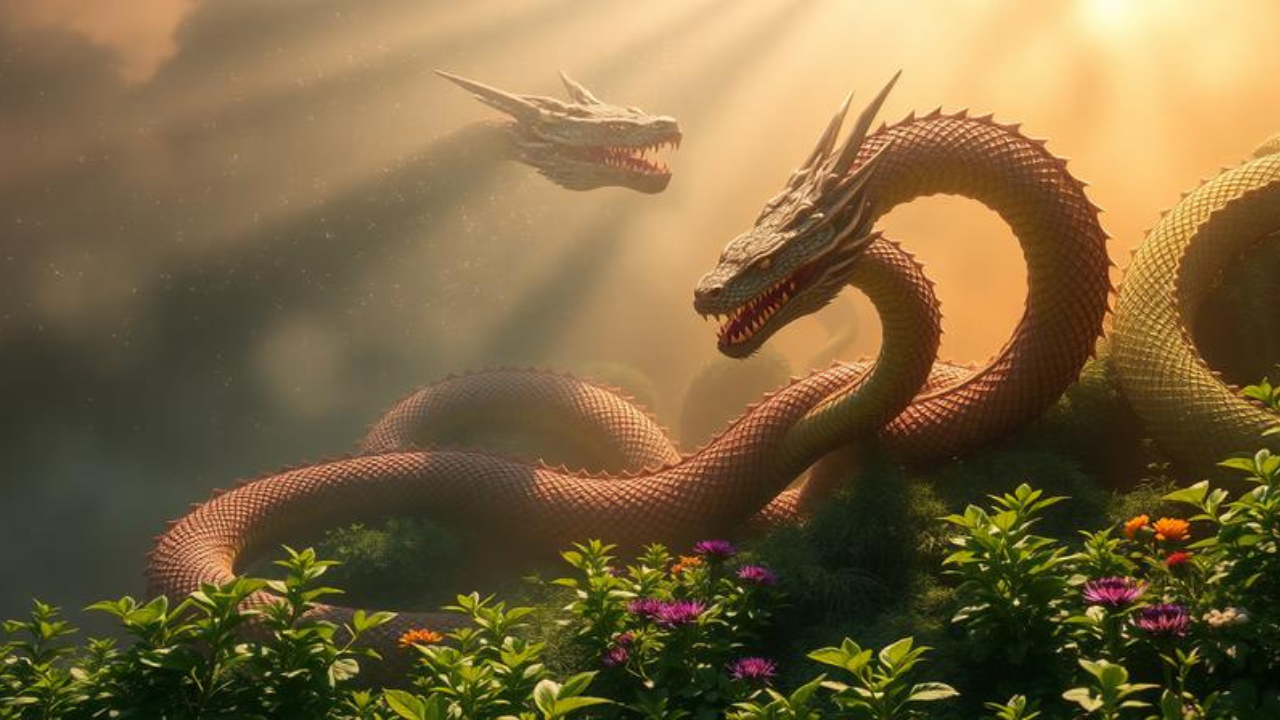
    Since the start of human civilizations around 6000 – 8000 years ago, societies have developed myths, folklores, and legends, complementing their arts and cultures. Over the course of evolution, some of those developed into structured, well-defined stories that revolved around their geography, political structures, and metaphysics. One such development was the introduction of mythical serpents, which played important roles in their mythological world-building. Some of those serpents played a role in creation, some in preservation, while some played a role in destruction. In this blog, we discuss 15 such mythical serpents that play important roles concerning creation, preservation, and destruction in mythologies around the world. The list is non-exhaustive, as naturally, there must be hundreds more examples in myths and lore, but they are beyond the scope of a single blog. So, let’s begin.

    Chapter 1: Serpents Associated With Creation

    1. Shesha / Ananta – Ananta, meaning the Endless, acts as the cosmic serpent in Hindu mythology, upon which the entire creation rests. Shesha is described as a colossal, thousand-headed serpent floating upon the Kshira Sagara, or the Ocean of Milk. In Puranic traditions, Shesha remains at the border between cycles of creation, acting as a bridge between the two universes. After each cycle, creation begins from the creator God Brahma, who, in turn, takes birth from a lotus, which emerges from the navel of Lord Vishnu, the God of Preservation, who, in turn, rests upon Shesha, thus making Shesha the ultimate foundation for creation. Shesha embodies order, infinity, and cosmic support to Lord Vishnu, taking birth alongside Vishnu’s avatars several times, whether as Lakshmana with Rama or Balarama with Krishna.
    2. Aido-Hwedo – In the folklore and myths of various Western African cultures, especially the Fon and Ewe people in Benin, Togo, and Ghana, Aido-Hwedo acts as the serpent of creation, working alongside the supreme deity Mawu-Lisa, the twin-aspect creator god representing both the sun and the moon. While the latter conceptualizes the universe, the former shapes it physically. In the creation story, Mawu-Lisa rides upon Aido-Hwedo across the primordial waters, directing the serpent to carve out mountains, plateaus, rivers, and valleys, while the serpent’s excretions form the metals, minerals, and precious stones, enriching the earth. After the creation is complete, Aido-Hwedo descends into the primordial waters, holding the whole world in his back.
    3. The Rainbow Serpent – Among the Aboriginal cultures in Australia, the Rainbow Serpent acts as the living force of creation, fertility, and law. In many Dreamtime stories, the earth was flat, barren, and dry at the beginning. The Rainbow Serpent emerged from under the ground through primordial waterholes and began to make the Earth rich in fertility and prosperity. She created holes in the Earth’s surface, leading to primordial waters coming through the holes and forming the sources of water on the planet. The Rainbow Serpent also acts as a law-giver and protector of sacred lands, especially water. Those who respect nature are blessed by her, but those who exploit nature beyond limits face her wrath and many times punished. Thus, the serpent has a dual nature – nurturing as well as authoritative.
    4. Jörmungandr– The Midgard Serpent of Norse mythology, is one of the awe-inspiring serpents in world traditions. Born from the trickster God Loki and the giantess Angrboda, Jörmungandr is one of their three children, the other being Fenrir the wolf, and Hel, the queen of the dead. As per tradition, Odin, the king of the Gods, banished the serpent to the oceans encircling Midgard (the world of humans). The serpent grew and soon encircled the entire world, and finally bit its own tail. Unlike other creator-serpents, Jörmungandr doesn’t shape the world, but defines its boundary. His circular coils stabilize the oceans, creating a cosmic barrier between the known and the unknown. He will also play a destructive role in Ragnarök, the destruction of the world, where he will release his tail and unleash havoc and calamity, and ultimately will be slain by Thor, the thunder God.
    5. Antaboga – In the Javanese and Balinese mythology, Antaboga is a cosmic serpent associated with the creation of the world. He is neither a destructive nor a guardian spirit, but a quiet, contemplative creator whose actions give rise to Gods, worlds, and the cosmic order. Unlike other creator Gods, he doesn’t create the world by force or command, but by meditation and contemplation. As he coils around the formless chaos, his mind gives birth to the cosmic turtle Bedawang Nala, who supports the entire world on its back. While Bedawang Nala supports the earth, the various gods guard and nurture it, Antaboga keeps creating through deep meditation. According to one tale, his tears gave rise to Dewa Sri, the goddess of rice and fertility, who is responsible for feeding humanity.

    Chapter 2: Serpents Associated With Preservation

    1. Vasuki – He is the king of snakes in Hindu mythology. Unlike destructive serpents, who represent chaos, and primordial serpents, who form the universe’s foundation, Vasuki is the serpent of coordination, endurance, and preservation. His most famous role appears in the Samudra Manthan, the churning of the ocean of milk by the Devas(Gods) and the Asuras(Demons), to obtain amrita, the nectar of immortality. To churn the entire ocean, Mount Mandara was used as the churning rod, but they needed a rope powerful enough to rotate the mountain. Vasuki volunteered and acted as the rope, and thus played a crucial role in obtaining amrita. Vasuki is immortalized in Hindu iconography as he is depicted coiled around the neck of Lord Shiva, the God of destruction.
    2. Ladon – Ladon is a multiple-headed dragon-serpent in Greek Mythology. Traditionally, the Hesperides were nymphs who tended a magical orchard at the western end of the world. The golden apples in this grove granted immortality and divine power. The queen of the Gods, Hera, appointed Ladon as the orchard’s eternal sentinel, preventing minor Gods, heroes, and monsters from attaining immortality. His most famous appearance occurs in the eleventh labor of Heracles, where, according to some versions, he is killed by Heracles with poison arrows, not because he was an evil monster, but because he was preserving order by preventing immortality from mortals.
    3. Python – In Greek Mythology, Python occupies a fascinating space between chaos and order. It is described as a colossal primordial earth serpent born from Gaia, the Earth herself. Its primary role was to guard the  Oracle of Delphi, then known as the sanctuary of Gaia. At that time, Delphi was not the Apollonian shrine it would become much later. After the rise of the Olympian Gods, its fate was sealed as it was killed by Apollo, with his divine arrows, as the solar deity wanted Delphi for himself. The priestess of Apollo, thus, retained the title of “Pythia”, derived from the serpent’s name. The death of Python is not complete destruction, but a transition, the old Gods getting replaced by the new Gods, thus evolving to a new era.
    4. Ba She – In Chinese mythology, Ba She is a powerful, enigmatic serpent associated with droughts, devouring waters, and a balance between danger and protection. It is typically described as an enormous serpent capable of swallowing elephants. Ba’s divine role is to cause drought on the surface by swallowing bodies of water whenever there is an excess of fiery energy (yang). In several stories, Ba She is killed and cut open by several heroes to release the water that it galloped. Ba She is not necessarily evil, but acts as a punishment against those who threaten nature. It also represents the cyclic nature of water, the necessity of balance in preserving life, the relationship between humans and natural forces, and the idea that even destructive beings can be a part of cosmic harmony.
    5. Phaya Naga – Revered across Thailand, Laos, Cambodia, and Myanmar, these are some of the enduring serpent beings of Southeast Asia. Phaya, meaning “King” or “Great”, while Naga, meaning “snake”, Phaya Naga exist as the most powerful snakes in the Mekong River Basin. In their Buddhist traditions, they act as guardians of rivers, lakes, wetlands, etc. Their home is said to be beneath the Mekong, where they maintain the balance between the human world and the mystical underwater kingdom known as Muang Badan. One of the most famous stories is how one of them protected the Buddha from the rain. As the Buddha meditated, the serpent coiled around him seven times and spread its hood to shield him from the rain. In regional folklore, many Lao and Thai chronicles often claim descent from Naga ancestors, symbolizing legitimacy, continuity, and divine favor.

    Chapter 3: Serpents Associated With Destruction

    1. Vṛtra – He is one of the earliest and most powerful serpents in Vedic Hinduism. Appearing prominently in the Rig Veda, Vṛtra is a metaphysical force that holds the world’s water, freezes cosmic motion, and traps creation in a state of unproductive stillness. His myth represents the eternal battle between dynamic order and oppressive inertia. He is described as stealing water from the divine rivers of the world, thereby destroying the essence of life force. Vṛtra is finally slain by the storm God Indra with his thunderbolt Vajra, in the same way, the other Indo-European thunder Gods, Zeus and Thor, slay the mythical serpents, Typhon and Jörmungandr.
    2. Apep / Apophis – Apep, in Egyptian mythology, is a primordial embodiment of chaos (Isfet), forever opposing truth, harmony, and cosmic order (Ma’at). If Ra, the Sun God, represents the steady, eternal renewal of life, then Apep represents the abyss that tries to swallow that very light every single night. Apep is imagined as a large serpent lurking in the deepest darkness of the Duat (the underworld), coiled beneath the horizon where the sun must pass during its night journey. Each night, Ra is attacked by Apep to devour the sun, but Ra battles with valor and skill, thereby forming a daily cosmic event. Unlike other serpents mentioned in the blog, Apep is absolutely evil, not a force of necessary destruction, not a cleanser, not a balancer, but a pure negation.
    3. Typhon – Typhon is a monstrous offspring of Gaia (the Earth) and Tartarus (raw destructive force and chaos). In Greek mythology, it is a fierce dragon-serpent that exists to represent apocalyptic destruction. According to myth, when the Olympian Gods defeated the Titans, Gaia, enraged at her triumph and the imprisonment of her children, birthed Typhon as the final instrument of vengeance. The serpent posed a serious challenge to the Olympians. But Zeus, like Indra and Thor, used his thunderbolt to finally defeat the serpent and bury him beneath Mount Etna or Tartarus. Typhon represents the spirit of vengeance, channelled by the Earth herself, when anyone tries to mess with her offspring.
    4. Azhi Dahaka – Also called Zahhak, he is a legendary serpent-demon in Zoroastrian cosmology. He represents chaos, in opposition to Asha, who represents order and truth. Unlike other destructive serpents, Azhi Dahaka represents the moral decay that destabilizes societies. He is a serpent with three heads, with uncontrollable hunger for human blood. The three heads symbolize uncontrolled desire, greed, and violence. He spreads immorality in human societies. According to the Avesta,  Azhi Dahaka represents a demonic strength whose very existence threatens the cosmic order. In one of the most vivid narratives, he is beaten and captured by the Persian Hero-God Thraetaona (Fereydun), and is chained atop Mount Damavand, although not killed, representing that desire, greed, and violence cannot be eliminated, but can be controlled.
    5. Xiuhcoatl – Also called the “Turquoise Serpent” or “Fire Serpent”, Xiuhcoatl is one of the most terrifying serpents in the Mesoamerican mythology, particularly in the Aztec mythology. Xiuhcoatl is closely associated with the Aztec God of fire and war, Huitzilopochtli, the patron deity of the people of Mexico. According to legend, the serpent serves as Huitzilopochtli’s weapon, a living extension of his divine power. As a destructive force, Xiuhcoatl is not chaotic in the sense of mindless evil; he operates within the cosmic logic of Mesoamerican cosmology. Destruction is necessary for renewal. The Aztecs themselves believed that the sun required conflict and sacrifice to rise each day. In this context, Xiuhcoatl becomes an instrument for cosmic maintenance: he destroys so that life and order can persist.

    Conclusion

    Thus, we see how serpents were represented in cultures all over the world in their mythologies and legends to explain cosmological and metaphysical phenomena. They also played an important role in enriching the classical literature all over the world, from Theogony in Greece, to the Mahabharata in India, to the Avesta in Iran. These limbless reptiles inspired various Bronze and early Iron Age cultures to develop their entire theology and metaphysics around them.

    That is all for this blog. Hope you enjoyed the reading. Please like, comment, share, and subscribe if you find this interesting. Your encouragement will inspire me to create more such blogs, whether in science or philosophy, mythology or history. Finally, thank you all for reading the whole piece.

    Suggested Readings

    Disclosure: This post contains affiliate links. As an Amazon Associate, I earn from qualifying purchases. I only recommend books I truly value.