Tag: science-history

  • 7 Intellectual Rivalries: How Great Idea Battles Shaped Human History

    7 Intellectual Rivalries: How Great Idea Battles Shaped Human History

    Introduction

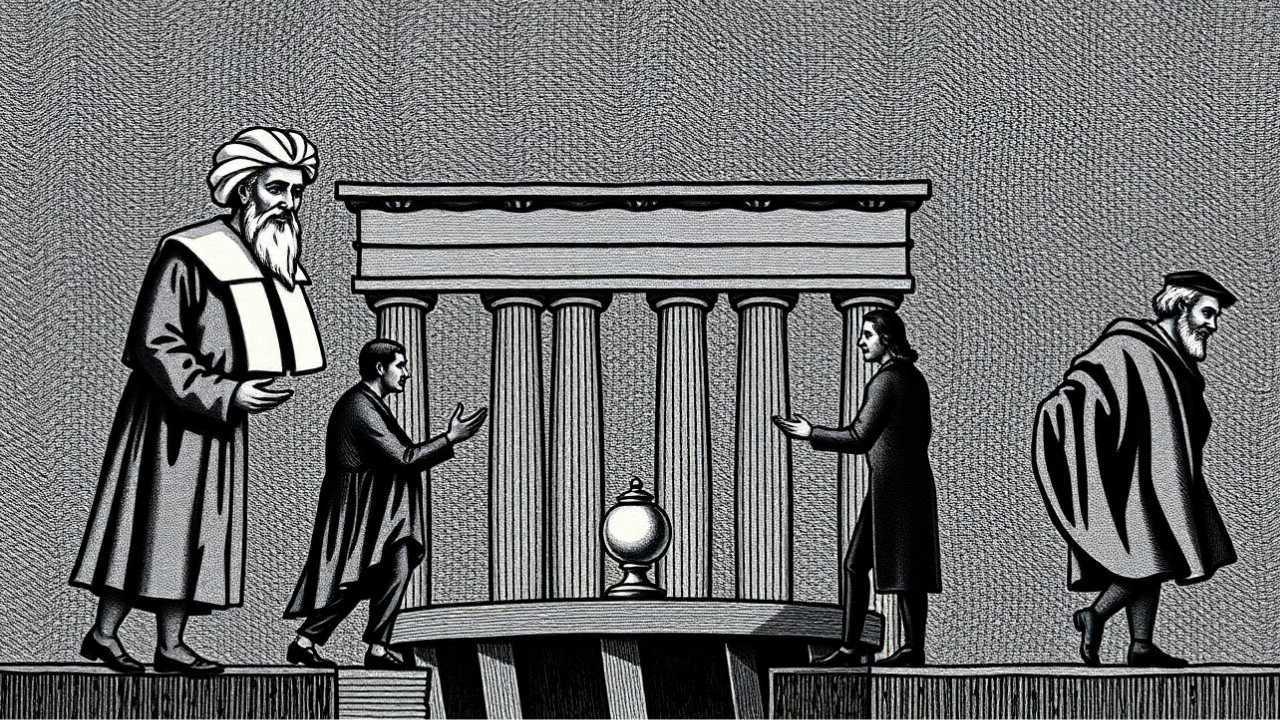
    Homo sapiens is considered an intellectual species. For over 60,000 years, human beings have slowly evolved through time with the help of cognitive, agricultural, and scientific revolutions. Through logic, reason, trial and error, the primitive humans have evolved to their modern selves. During the course of this intellectual evolution, although agreement by the general public played an important role, disagreement and even rivalries played an important role in enquiry and further evolution. In this blog, we talk about seven such famous rivalries that shaped the course of human history to a certain degree. From classical Greece to modern science, these rivalries played an important role in how human beings began to understand the universe.

    1. Platonism vs Aristotelianism

    The school of Platonism believed that the world around us is a shadow of a higher one. Plato argued that true knowledge comes from pure reason and turning inward. He suggested not to trust our imperfect senses. For the Platonists, the real world was abstract and eternal, which cannot be perceived or understood by our five senses.

    Then came the Aristotelians. They suggest that the real world can only be seen by studying everything around us through our senses, including various substances, causes, and observable patterns. According to Aristotle, true knowledge can be achieved through practical experiences, and not from theories and inner contemplations.

    This rivalry became the foundation of modern Western thought, specifically between idealism and empirical realism.

    2. Nyaya vs Buddhism

    The Nyaya Philosophers of ancient India believed in a realistic world that can be known through perception, inference, comparison, and testimony. They gave importance to logic above all else. They believed in a permanent self (atman) and an objective world that works alone on pure logic and reasoning.

    Buddhists, on the other hand, believed everything is temporary, including the self, which is just a collection of experiences. They were skeptical of Nyaya’s claim of objectivity and propagated relativism.

    This rivalry shaped India’s intellectual debate over objective vs subjective truth for centuries.

    3. Confucianism vs Legalism

    Confucius and his followers saw society as something that flourishes through virtue, morals, and proper relationships. They believed humans could evolve through proper guidance, education, and ethics. They proposed an ethical world that would be ruled by virtuous rulers for inspiration.

    Legalism argued the opposite – a society could function properly only through strict laws and firm punishments. They believed the world could be in perfect order through proper law enforcement, and not through morals and virtues.

    Both the schools influenced China in different periods (Legalism during the Qin Dynasty and Confucianism during the Han Dynasty), before finally merging with the societies of the Chinese Civilization forever.

    4. Advaita vs Dvaita

    Adi Shankara and his school of Advaita Vedanta taught that reality is ultimately the nondual Brahman. They claimed that liberation from illusion occurs when the self realizes that God, the self, and the universe are all one.

    Dvaita Vedanta, founded by Madhva, debated that God, the self, and the universe are distinct forever. The world is fully real and not an illusion. According to them, liberation will occur not through any realization, but through complete devotion to God (Vishnu).

    This debate shaped Indian Philosophy and continues to thrive in Hindu philosophical discussions.

    5. Rationalism vs Empiricism

    Rationalists like René Descartes and Baruch Spinoza believed that the mind contains innate ideas, and reason is the strongest path to truth. Mathematics and Logic come from proper reasoning and critical thinking, and are independent of the senses.

    Empiricists like John Locke, David Hume, and George Berkeley argued the reverse: the mind begins as a blank slate, and is filled by knowledge from experience. According to them, sense organs are the ultimate tools of understanding, and even complex ideas evolve from simpler impressions.

    This debate laid the foundation of modern science and shaped the Enlightenment Period.

    6. Lamarckism vs Darwinism

    Jean-Baptiste Lamarck proposed that species evolve because organisms adapt during their lifetimes and pass these traits to their offspring. Giraffes stretch their neck to eat leaves from tall trees, and their children inherit longer necks. According to him, evolution was driven by need and effort.

    Charles Robert Darwin showed that evolution works through natural selection – random mutation occurs, and those better suited for their surroundings survive and reproduce. Traits don’t arise because they are needed; they remain because they work.

    Darwin’s model replaced Lamarck’s theory, completely changing the direction of the study of genetics and evolution.

    7. Relativity vs Quantum Mechanics

    Albert Einstein’s Relativity described the universe as smooth, continuous, and governed by precise laws. According to his theory, space and time curve around mass, resulting in deterministic patterns. It works beautifully on celestial objects like galaxies, stars, and planets.

    Quantum Mechanics, led by the likes of Max Planck and Niels Bohr, challenged the picture. At the smallest scales, reality becomes probabilistic, discontinuous, and uncertain. Particles behave like waves, and both position and momentum cannot be determined simultaneously.

    Both the theories still work – but they don’t agree with each other, leading to Physics’ greatest rivalry.

    Conclusion and Reflection

    These seven rivalries showed that contradicting ideas can survive in the same world and often lead to some kinds of revolutions. Debates, discussions, and disagreements are some of the strongest tools that humans possess and should always be encouraged, cherished, and promoted. If everyone agreed to the same idea, humans would still be hunters and gatherers in the 21st century CE.

    That’s all for this blog. Please like, comment, and share if you find this interesting. Thank you for reading this blog.

    Suggested Readings

    Disclosure: This post contains affiliate links. As an Amazon Associate, I earn from qualifying purchases. I only recommend books I truly value.



  • The Evolution of Thought: From Ancient Metaphysics to Quantum Physics

    The Evolution of Thought: From Ancient Metaphysics to Quantum Physics

    Introduction – When Wonder Was a Science

    Before the universe became a machine, it was a question. Long before laboratories, men and women watched stars and fires, asking what lay beneath their glow. They called it being, truth, Tao, Brahman – different words for the same ache: to understand why the world exists at all.

    From the Greek search for order to India’s exploration of consciousness and China’s quest for harmony, early philosophers didn’t divide knowing from living. The thinker, the seer, and the scientist were one.

    But over time, questions gave way to methods, and symbols gave rise to equations. The cosmos that once reflected the mind became an object of study. Yet even as the instruments sharpened, the longing beneath them remained the same – to find unity in the infinite.

    This is the story: how metaphysics became physics – and how, in doing so, it may have rediscovered its soul.

    Chapter 1: The Metaphysical Era – When the World Was Thought Before It Was Measured

    1. The Greek Vision – Before physics measured, philosophy imagined. In the Mediterranean mind, Greek thinkers replaced myth with mind. The Milesians sought a single arch – water, air, or boundless substance – turning Gods into elements. ThePythagoreans found in number and proportion the rhythm of cosmos; the world became harmony made visible. The Heracliteans declared flux with only constant, fire, the symbol of eternal change. In answer, the Eleatics claimed that change itself is an illusion – being is one and motion impossible – forcing logic to question the senses. The Atomists reconciled both: eternal, indivisible particles moving in a void, giving plurality to an underlying sameness. From Plato’s transcendental Forms to Aristotle’s synthesis of form and matter, Greek thought became a summary of reality – essence, potentiality, substance. The later schools humanised this search. Epicureans married atomism to tranquility; Stoics made reason the pulse of the cosmos. Skeptics withheld judgment, preferring humility to certainty; Cynics scorned convention as falsehood. Finally, Neoplatonism re-spiritualised philosophy, seeing all multiplicity as emanations from a single radiant One. Each school stretched the same impulse: to explain the order of being before measuring its motion.
    2.  The Indian Vision – Across the subcontinent, Indian thinkers mapped existence not as substance, but as experience. Samkhya divided the world into Purusha (pure awareness) and Prakriti (matter), whose dance created the manifold universe. Yoga transformed that insight into practice – meditation, restraint, and discipline as technology for disentangling consciousness from nature’s web. Where Nyaya built rigorous logic to define valid knowledge, Vaisheshika described an atomism of the cosmos of categories and causes, remarkably close to natural philosophy. Mimamsa grounded metaphysics in language and ritual, where words and actions themselves maintained cosmic order. Vedanta, especially Advaita, moved the other way – collapsing the world into Maya, a shimmering illusion upon the only reality, Brahman. Beyond the Vedic fold, Jainism taught pluralism and nonviolence – many truths coexisting through Anekantavada – while Buddhism rejected essence altogether: to exist is to arise dependently and vanish moment to moment. Charvaka, the lone materialist, discarded heaven and rebirth, trusting only perception and the tangible. Together, they built a kaleidoscope of metaphysics –  from dualism to monism, from ritual realism to radical empiricism – all bound by one question: What is truly real, and who perceives it?
    3. The Chinese Vision – In ancient China, metaphysics wore the face of ethics. Daoism spoke of the Dao – the nameless way that flows through all things. To act without forcing, to yield rather than struggle, was to align with the cosmos itself. Confucianism, by contrast, rooted cosmic order in social virtue: filial piety, justice, and ritual propriety mirrored the balance between heaven and earth. The rational Mohists protested ritual excess, calling for impartial love and practical good – an early ethics of measurable consequence. Legalists, skeptical of virtue, trusted systems over sages: only law could sustain order amid human frailty. Together, these schools saw metaphysics not as abstraction but as a living order – harmony between heaven’s rhythm and human conduct.

    Thus, before the telescope or the equation, there was thought. The Greeks asked what reality is; the Indians asked what knows; the Chinese asked how to live within it.

    Chapter 2: The Transition Era – When Thought Turned into Method

    1. Nicolaus Copernicus – The Revolving Cosmos: In a world where Earth was the immovable center, he proposed a quieter, audacious symmetry – the Sun, not Earth, stood still. His heliocentric model restored simplicity to the heavens: circles, not chaos. Though cautious and cloaked in geometry, his revolution was philosophical at heart – dethroning humanity from the cosmic center and placing order itself as the true subject of worship. It marked the first fracture in the metaphysical comfort of a man-centered universe.
    2. Galileo  Galilei- The Eye That Measured: He turned observation into rebellion. His telescope revealed moons around Jupiter, phases of Venus, and imperfections on the Sun – the celestial bodies that disobeyed perfection. With his experiments on motion, he found law beneath change: acceleration, inertia, proportion. But Galileo’s real heresy was epistemic – the belief that truth must be seen, tested, and repeated. He brought heaven into the laboratory and made nature speak mathematics. Thought was no longer divine speculation but disciplined vision.
    3. Johannes Kepler – The Music of the Spheres Rewritten: To him, the cosmos still sang, but in ellipses instead of circles. Merging Pythagorean harmony with Tycho Brahe’s data, he found that planetary motion obeyed precise mathematical laws. For Kepler, numbers weren’t abstractions – they were the mind of God written in orbit. He preserved the metaphysical yearning for harmony while translating it into geometry. His orbits were not symbols but structure: philosophy set to motion, music turned to mathematics.
    4. Francis Bacon – The Architect of Method: Where the ancients built metaphysical towers, he laid foundations. He urged thinkers to abandon deduction from principle and instead ascend by induction from experience. Knowledge, he said, should not contemplate but conquer nature, not for vanity, but for utility and light. His Novum Organum replaced Aristotle’s logic with a new instrument: experiment and data. Bacon’s spirit was half monk, half engineer – a visionary of disciplined curiosity, transforming philosophy into organized inquiry.
    5. Rene Descartes – The Doubt That Built Certainty: He began with a void – doubting all until only the act of doubting itself remained undeniable. Cogito, ergo sum. From the flicker of certainty, he rebuilt the world in clear and distinct ideas. His dualism split mind from matter, spirit from mechanism, birthing both modern subjectivity and mechanical physics. The cosmos, for Descartes, was a machine built by a rational God – measurable, predictable, but separate from the self that knows it.
    6. Baruch Spinoza – The God of Geometry: To him, Descartes’ dualism was an illusion. There was only one substance – God or Nature – infinite, self-caused, unfolding through necessary laws. Mind and matter were merely two aspects of this single reality. His Ethics read like a proof, each proposition following from the last with Euclidean grace. In his quiet radicalism, he united metaphysics and physics again –  divinity as immanence, casualty as sacred order. He built a cosmos of serene determinism, both rational and divine.
    7. Isaac Newton – The Lawgiver of Motion: Where others imagined, Isaac Newton calculated. Gravity, inertia, and motion became universal grammar; apples and planets obeyed the same equations. His Principia Mathematica fused mathematics and experiment into an empire of predictability. Yet he was still a metaphysician at heart – alchemist, theologian, seeker of divine architecture behind law. In his cosmos, space was absolute, time uniform, and God the clockmaker who set it in motion. The age of measurement had begun, but the dream of meaning remained.
    8. Gottfried Wilhelm Leibniz – The Logic of Creation: A philosopher of infinite optimism, Leibniz saw the universe as a harmony of monads – indivisible, self-contained centers of perception. Each mirrored the cosmos from its own point of view, synchronized by divine pre-established order. His vision turned metaphysics into proto-information theory: reality as structured perception, not substance. While he co-invented calculus alongside Newton, his deeper gift was conceptual – a logic of worlds, both possible and actual, where reason itself became metaphysical law.

    Thus ended philosophy’s long adolescence. The heavens were no longer symbols but systems; motion no longer mystery but mathematics. Yet, beneath the equations, the old longing endured – to find unity, purpose, and pattern in the infinite.

    Chapter 3: The Modern Scientific Era – When Physics Remembered Its Soul

    1. Albert Einstein – The Clockwork and the Curvature: To Einstein, the world was still rational but not rigid. Space and time, once absolute, are now curved with mass and motion, forming a seamless fabric of causality. His relativity restored unity to nature: gravity became geometry, and the cosmos a continuous dance of light and law. Yet beneath his equations lingered metaphysical elegance – the conviction that “God does not play dice.” For Einstein, physics was a revelation of order, not accident: a rational music still guided by harmony.
    2. Niels Bohr – The Paradox of the Observer: Bohr shattered the comfort of classical certainty. In the strange theatre of the atom, he saw light behave as both particle and wave – complementary, not contradiction, was the key. Observation itself became participation; reality answered only when questioned. For Bohr, truth lived in paradox – not as confusion but completeness. The quantum world, he said, demanded humility: nature would not fit into human categories. Knowledge had become dialogue, and the scientist a philosopher of uncertainty.
    3. Werner Heisenberg – The Limits of Knowing: He gave that uncertainty a formula. His principle declared that position and momentum could never be precisely known together, not due to error, but because reality itself was indeterminate until observed. The more we measure, the less we know. Beneath mathematics, he saw echoes of Plato: particles as potential, half-real until realized. Physics had turned inward, confronting the very limits of knowledge it once glorified. The observer was no longer outside nature – he was entangled within it.
    4. Erwin Schrodinger – The Dreamer of Unity: For Schrodinger, the quantum world was not chaos, but consciousness misunderstood. His wave equation described how possibilities ripple through time, collapsing into one reality upon observation. But behind the math, he saw metaphysical unity – the same truth theUpanishads whispered: Atman and Brahman are one. In his essays, he spoke of the mind as singular, the universe as thought. The cat in his thought experiment was never just about physics; it was a question about being itself.

    And so physics came full circle. After centuries of purging myth and meaning, it found mystery again – not in temples, but in laboratories. The equations grew stranger, but the questions older: what is reality, who observes, and why does anything exist at all?

    Conclusion – When Physics Became Philosophy Again

    We often imagine science as the opposite of philosophy – one measures, the other dreams. But history whispers otherwise. Every law began as a wonder; every formula as a metaphor of meaning.

    From Thales’ water to Schrodinger’s wave. Have we circled the same question: is reality matter, mind, or both?

    The telescope and the mantra, the experiment and the meditation – each sought truth through a different instrument.

    In the end, the arc of thought bends towards unity. Einstein’s curvature, Bohr’s paradox, Heisenberg’s limits, Schrodinger’s consciousness – all hint that reality is relational, not separate.

    Perhaps the ancients were not wrong, only premature: the cosmos still breathes through mystery.

    That’s all in this blog. Please like, comment, and share if you find this interesting. Thank you.

    Suggested Readings

    Disclosure: This post contains affiliate links. As an Amazon Associate, I earn from qualifying purchases. I only recommend books I truly value.