Introduction
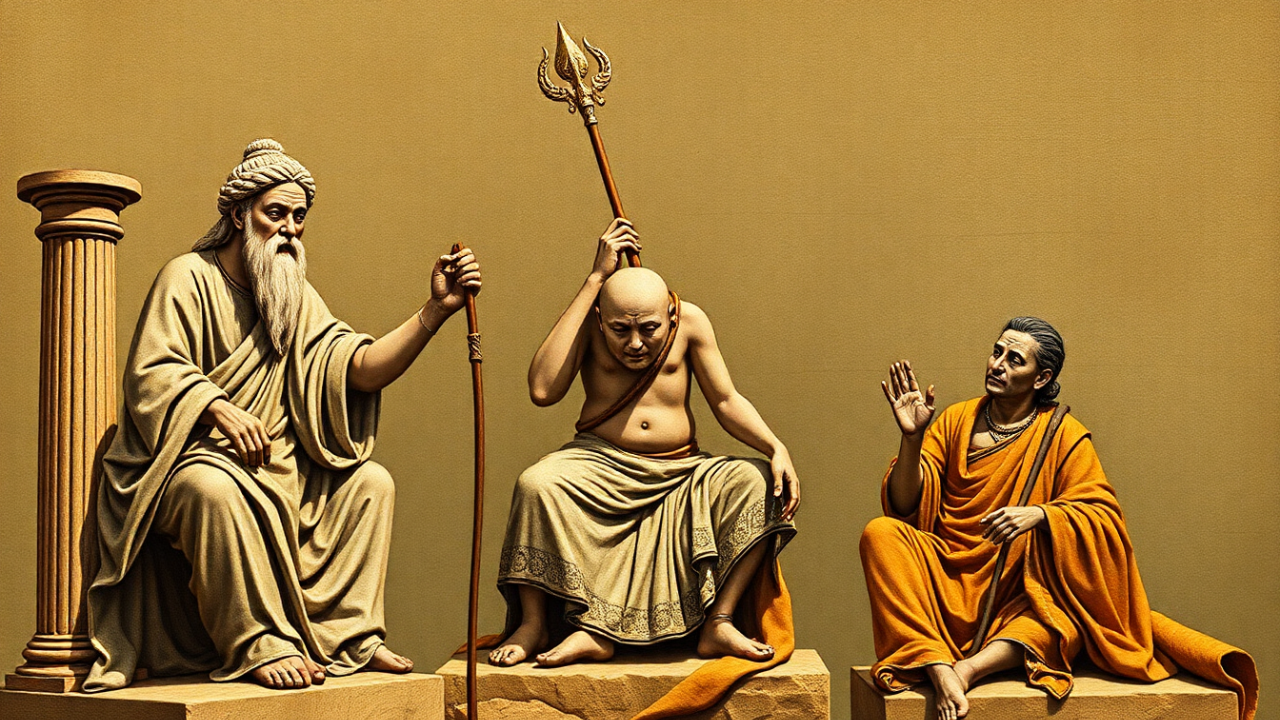
Ancient India and Greece were two of the hubs of the world’s greatest philosophical thought. Both being great contributors to the Axial Age, the civilizations produced distinct philosophical schools and ideas, each with its own ethics, epistemology, and metaphysics. Interestingly, some of the bigger schools from both cultures shared interesting similarities and parallels across the continents. One of the reasons for this similarity is attributed to the invasion of Alexander the Great in the East. The schools from both cultures might have exchanged some ideas after that, although most schools have their core principles defined centuries before the invasion. In this blog, we discuss six such interesting parallels between the schools of Greek and Indian Philosophy. So, let’s begin.
Chapter 1: Sāṃkhya and Greek Pluralism
The schools of Sāṃkhya and Greek Pluralism are two of the oldest in world philosophy, both dating much before the pre-Socratic era. Both traditions reject simplistic monism in favour of multiple fundamental principles for explaining the universe.
Sāṃkhya defines a dualistic ontology consisting of Puruṣa (consciousness) and Prakṛti (primordial matter). The universe emerges as Prakṛti unfolds into twenty-four additional principles, including intellect (buddhi), ego (ahaṅkāra), mind (manas), the five subtle elements (tanmātras), and the five gross elements (mahabhutas). Liberation occurs when Puruṣa realises its separation from Prakṛti.
Greek Pluralism, on the other hand, explained the diversity of phenomena in terms of small sets of fundamental elements, namely, earth, air, fire, and water. Philosophers such as Empedocles postulated that the elements interact through cosmic forces of Love(attraction) and strife(separation). Another philosopher, Anaxigoras, introduced the concept of seeds (spermata) – minute, eternal particles which are ordered by Nous (intellect), an immaterial principle to provide structure. They explained observable phenomena without invoking a creator God.
Both schools show striking parallels – they both believe in a pluralistic universe, consisting of multiple irreducible principles; for Sāṃkhya, these are the 25 categories, while for Greek Pluralism, these are the five elemental roots. Both schools are also extremely naturalistic and reject any form of divine intervention.
Along with many similarities, there are some core differences, which include that Puruṣa, in the case of Sāṃkhya, is a passive witness to the evolution of Prakṛti, while Greek Pluralists rarely invoke consciousness, and if it appears in the form of Nous, it is an ordering principle and not a passive witness. Another important difference is in the goal or aim of the schools. While Sāṃkhya is deeply tied to the object of liberation, the Greek Pluralists use their principles for cosmological, ethical, and societal purposes.
Chapter 2: Nyāya and Aristotelianism
The schools of Nyāya and Aristotelianism form two of the most rigorous and systematic traditions of logical reasoning in world philosophy. Both emphasize logical thought over everything else and promote structured analysis for understanding the universe.
Nyāya’s central epistemology is based on four means of knowledge-
- Pratyakṣa (perception) – direct sensory experience.
- Anumāna (inference) – logical reasoning from the beginning to the end.
- Upamāna (analogy) -knowledge via comparison.
- Śabda (verbal testimony) – knowledge obtained from reliable sources, like the Vedas.
Casualty, inference patterns, and methods of refuting fallacies are central, making Nyāya a rigorous science of reasoning and debate.
Aristotle, in his works, the Organon and natural philosophy, provided a comprehensive approach to logic, ontology, and causation. His central contributions include –
- Syllogistic Logic – deductive reasoning from the beginning to the end.
- Categories of being – based on substance, quantity, quality, relation, place, time, etc.
- Four Causes (aitia) – material, formal, efficient, and final causes explaining existence.
- Empirical Observation – Aristotle integrated logic with systematic observation and generalization.
Aristotle emphasized teleology, where natural phenomena are oriented towards ends, and logical structure underpins both science and metaphysics.
Both schools thus have many parallels. They treat logic as the ultimate foundation of philosophy, and both embrace realism over metaphysics. Both of them also prioritize methodological rigor, whether it’s Nyāya’s structural debates or Aristotle’s careful logical demonstration.
Like other schools, they have some dissimilarities, which include Nyāya’s primary focus on knowledge, inference, and metaphysics, while Aristotle’s integration of biology and teleology. Another important difference is that Nyāya sometimes integrates theism as a metaphysical postulate, while Aristotelianism’s Prime Mover is impersonal and non-interfering.
Chapter 3: Vaiśeṣika and Greek Atomism
The Vaiśeṣika school, attributed to Kaṇāda, deals primarily with metaphysical and logical understanding and organizes reality into discrete categories (padārthas). The classical system categorizes the world into seven or nine categories, depending on sub-branches, including-
- Substance (dravya) – the enduring substratum (earth, water, fire, air, void, time, space, and self)
- Quality (guṇa) – attributes to substances (color, taste, number, etc.)
- Action (karma) – any type of motion or change to substance.
- Universal (sāmānya), Particularity (viśeṣa), Inherence (samavāya) – relations connecting substance and qualities.
- Non-existence (abhāva) – absence.
Vaiśeṣika also develops an atomic theory, proposing that substances are composed of paramāṇus (atoms) – eternal, indivisible units of matter. These atoms combine in pairs, triads, and higher structures to form the macroscopic objects we see.
Greek Atomism emerged under Leucippus and Democritus, and was further developed by the Epicureans. Its core principles include-
- Indivisible atoms – the fundamental units of all matter, energy, and unchangeable.
- Void (kenon) – space in which atoms move freely.
- Mechanical Causation – macroscopic properties emerge from shape, size, motion, and the arrangements of atoms.
- Naturalistic explanation – phenomena, including celestial motion, are reducible to atomic interactions.
Epicureans later added an ethical dimension – atoms interact naturally, and understanding these interactions reduces fear and enables ataraxia (peace of mind).
The structural parallels between Vaiśeṣika and Greek Atomism include that both schools’ foundations are based on fundamental constituents of reality (paramāṇus and atoms). Combining the fundamental constituents, both the school explained the natural macroscopic world. Both gave naturalistic explanations such that every complex matter has some underlying simple entities, which are in turn divisible until the fundamental constituents.
These schools have a few differences; some of them are that Vaiśeṣika goes beyond atoms, includes quality, action, universals, and inherence, while Greek Atomism is linear, focusing just on atoms and voids. The former treats atoms as a part of a broader, structured ontology, including time, space, and substance, while Greek Atomism operates within a simpler, mechanical universe of atoms in a void.
Chapter 4: Vedānta and Neoplatonism
Vedānta, particularly Advaita Vedānta, and Neoplatonism represent two of the greatest sophisticated metaphysical traditions that explore the relationship between the ultimate unity and the multiplicity of the world. Both schools grapple with one-many problem, offer accounts to the ultimate reality, and propose pathways for the soul or consciousness to realize its true nature.
Advaita vedānta, systemized by Śaṅkara, proposes Brahman as the absolute, non-dual reality. The phenomenal world (jagat) is understood as māyā, a manifestation of Brahman’s apparent multiplicity. The individual self (ātman) is ultimately identical to Brahman, and ignorance (avidyā) creates an illusion. Liberation (mokṣa) occurs when the self realizes the non-duality, ending the cycle of birth and death (saṃsāra). It emphasizes knowledge (jñāna) as the primary means to liberation, often supplemented by ethical conduct and devotion (karma and bhakti).
Neoplatonism, articulated by Plotinus, posits the One as the ineffable source of all reality. From the One emanates the Nous (intellect), followed by the Soul (psyche), which ultimately manifests the material world. The world is real but derivative, and multiplicity emerges from the absolute unity of the One.
Both traditions share many similarities. They describe reality as emerging from an ultimate, unitary principle – Brahman or the One. Both prescribe a transformative journey for the self. Both recognize that the ultimate principle of reality cannot be fully captured in words or concepts, and it is beyond dualities, qualities, and ordinary experience.
Differences between the schools mainly include the nature of the phenomenal world, which Vedānta treats as māyā or temporary illusion, while Neoplatonism treats it as real but independent. Vedanta emphasizes karma and bhakti alongside jñāna as pathways to liberation, while Neoplatonism focuses on intellectual and contemplative purification, giving lesser importance to ethical guidance.
Chapter 5: Jainism and Pythagoreanism
The tradition of Jainism was systematized by Mahāvira, which emphasizes-
- Ahimsa (non-violence) – ethical foundation, strict avoidance of harm to all living beings.
- Anekāntavada (non-one-sidedness) – A philosophical principle recognizing that the same truth can be perceived by different beings through different perspectives.
- Karma theory – Every action produces subtle karmic particles that bind the soul (jivā), continuing rebirth (saṃsāra).
- Ascetic practice – Liberation (mokṣa) is achieved through rigorous ethical conduct, renunciation, meditation, and detachment from material desires.
Jainism’s ontology distinguishes jivā (soul) from ajivā (non-soul), with ethical and spiritual practice directly affecting the soul’s purification.
Pythagoreanism, founded by Pythagoras, is a metaphysical-religious tradition combining mathematics, ethics, and metaphysics. Its core principles include –
- Numerical harmony – Numbers and their ratios underlie cosmic order, and understanding these relationships can lead to understanding reality.
- Ascetic lifestyle – Pythagoreans adopted dietary restrictions, communal living, and self-discipline to purify the body and mind,
- Belief in metapsychosis – Reincarnation or transmigration of the soul, based on moral consequences of actions.
- Ethical and spiritual cultivation – Living in harmony with cosmic order and virtue promotes purification and aligns the soul with universal principles.
The Pythagorean approach is simultaneously mathematical, ethical, and spiritual, reflecting a worldview where they are inseparable.
The parallels between the two traditions include that they both emphasize an ascetic and ethical lifestyle (they promoted ascetism the most among other schools in their respective civilizations). They also believe in the transmigration of the soul and the need for purification to escape the continuing cycle. They also heavily emphasize ethics and believe in a universal ethical order, whether tied to karmic law or numerical and cosmic harmony.
Key differences between the schools include their metaphysical understanding, where Jains give importance to the Karmic particles, while Pythagoreans promote Numerical harmony. Another difference is the goal of the tradition, where the former’s aim is to achieve liberation (mokṣa) while the latter aims to achieve cosmic harmony through mathematics and ethics.
Chapter 6: Buddhism and Stoicism
Buddhism centers around the Four Noble Truths-
- Dukkha – Life involves suffering and dissatisfaction
- Samudaya – Suffering arises from craving (taṇhā) and attachment.
- Nirodha – Liberation (Nirvāṇa) is possible through cessation of craving.
- Magga – The path to liberation is the Noble Eightfold Path, encompassing right view, intention, speech, action, livelihood, effort, mindfulness, and concentration.
The tradition emphasizes impermanence (anicca), non-self (anatta), and the importance of mindful awareness (sati) in achieving liberation. Tools for controlling desires include ethical conduct (sīla) and meditation (samādhi). Buddhism is a very practical and experiential philosophy, seeking liberation not through speculative metaphysics, but via disciplined transformation of the mind and behavior.
Stoicism, particularly in the Roman period (Seneca, Epictetus, Marcus Aurelius), teaches that virtue is the highest good and that happiness depends on aligning with Nature or Logos, the rational order of the cosmos. Major doctrines include –
- Control and indifference – Recognize what is within one’s control (virtue, thoughts) and what is not (external events).
- Acceptance of fate (amor fati) – Embrace the natural order and life’s inevitable difficulties.
- Emotional regulation – Cultivate apatheia – freedom from destructive passions.
- Ethical practice – Live according to reason, maintain honesty, justice, courage, and self-discipline.
It is thus a practical philosophy aimed at inner tranquility, promoting self-mastery and resilience in the face of uncertainties.
Buddhism and Stoicism have many parallels. Some include focusing on mental discipline (through meditation and mindfulness for Buddhism, and through reflection and journaling for Stoicism), detachment from external outcomes, and priority towards experiential knowledge rather than speculative ones.
Key differences include Buddhism’s denial of a permanent self (anatta) compared to Stoicism’s rational agent. Also, the spiritual techniques are different; for Buddhism, they are meditation, mindfulness, and renunciation, while for Stoicism, they are reflection, rational examination, journaling, and habituation.
Comparison Table
| Indian School | Greek School | Core Focus / Parallel | Key Distinction |
| Sāṃkhya | Greek Pluralism | Multiple fundamental principles explaining reality | Sāṃkhya is dualist (Prakṛti &Puruṣa); Greek pluralism is often materialist and non-dual |
| Nyāya | Aristotelianism | Logic, epistemology, structured reasoning | Nyāya integrates epistemic pramāṇas; Aristotle emphasizes deductive syllogism |
| Vaiśeṣika | Greek Atomism | Atoms/ indivisible units as fundamental constituents | Vaiśeṣika adds categories like quality, inherence; Greek atomists focus on void and motion. |
| Vedānta | Neoplatonism | Ultimate unity -> multiplicity, spiritual ascent | Vedānta emphasizes non-dual Btahman; Neoplatonism uses One -> Nous -> Soul hierarchy |
| Jainism | Pythagoreanism | Ethical ascetism, soul purification | Jainism emphasizes karma, ahimsa, and mokṣa; Pythagoreans focus on numerical harmony and cosmic alignment |
| Buddhism | Stoicism | Mental discipline, detachment, practical ethics | Buddhism emphasizes impermanence and non-self; Stoicism emphasizes rationality, Logos, and virtue |
Conclusion and Reflection
Thus, from the above discussions, we see that various Indian and Greek philosophical schools share surprising similarities, whether it is Vedānta and Neoplatonism, or Buddhism and Stoicism. But the blog never intends to suggest that one tradition copied from the other. The two civilizations developed independently and may have shared a few ideas through cultural exchanges during campaigns and invasions, from which the parallels may have arisen. Infact, many important Indian schools like Yoga, Mīmāṃsā, and Cārvāka, and Greek schools like Epicureanism, Cynicism, and Stoicism, are avoided in this blog as they didn’t share any parallel ideas across the continents. This blog intends to show how different cultures can basically derive the same result independently of each other. This blog also intends to bridge the gap between those who are accustomed to Western Philosophy and Indian Philosophy, and hopes to open a wormhole between them.
Anyway, that is all for this blog. Do like, comment, and share if you find this piece interesting and informational. Also, please subscribe to my newsletters through email below, if you want to get notified for future blogs and updates. Also, your subscription will motivate me to write future blogs on more interesting topics in philosophy, science, history, and mythology. Finally, thank you for reading the blog.
Suggested Readings
- A History of Indian Philosophy Vol. I: An Introduction to the Eight Major Philosophies of Ancient India by Prof. SN Dasgupta
- A Critical History of Greek Philosophy by W. T. Stace
Disclosure: This post contains affiliate links. As an Amazon Associate, I earn from qualifying purchases. I only recommend books I truly value.