Tag: thought experiments

  • 7 Intellectual Rivalries: How Great Idea Battles Shaped Human History

    7 Intellectual Rivalries: How Great Idea Battles Shaped Human History

    Introduction

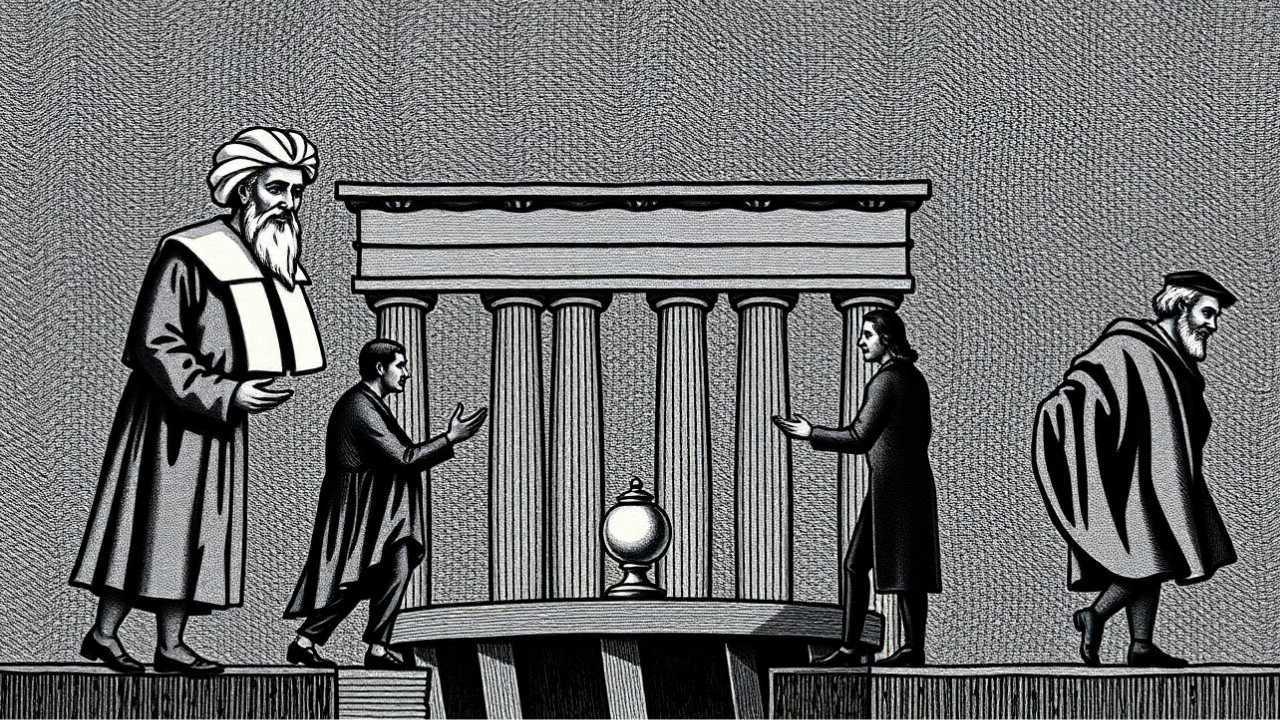
    Homo sapiens is considered an intellectual species. For over 60,000 years, human beings have slowly evolved through time with the help of cognitive, agricultural, and scientific revolutions. Through logic, reason, trial and error, the primitive humans have evolved to their modern selves. During the course of this intellectual evolution, although agreement by the general public played an important role, disagreement and even rivalries played an important role in enquiry and further evolution. In this blog, we talk about seven such famous rivalries that shaped the course of human history to a certain degree. From classical Greece to modern science, these rivalries played an important role in how human beings began to understand the universe.

    1. Platonism vs Aristotelianism

    The school of Platonism believed that the world around us is a shadow of a higher one. Plato argued that true knowledge comes from pure reason and turning inward. He suggested not to trust our imperfect senses. For the Platonists, the real world was abstract and eternal, which cannot be perceived or understood by our five senses.

    Then came the Aristotelians. They suggest that the real world can only be seen by studying everything around us through our senses, including various substances, causes, and observable patterns. According to Aristotle, true knowledge can be achieved through practical experiences, and not from theories and inner contemplations.

    This rivalry became the foundation of modern Western thought, specifically between idealism and empirical realism.

    2. Nyaya vs Buddhism

    The Nyaya Philosophers of ancient India believed in a realistic world that can be known through perception, inference, comparison, and testimony. They gave importance to logic above all else. They believed in a permanent self (atman) and an objective world that works alone on pure logic and reasoning.

    Buddhists, on the other hand, believed everything is temporary, including the self, which is just a collection of experiences. They were skeptical of Nyaya’s claim of objectivity and propagated relativism.

    This rivalry shaped India’s intellectual debate over objective vs subjective truth for centuries.

    3. Confucianism vs Legalism

    Confucius and his followers saw society as something that flourishes through virtue, morals, and proper relationships. They believed humans could evolve through proper guidance, education, and ethics. They proposed an ethical world that would be ruled by virtuous rulers for inspiration.

    Legalism argued the opposite – a society could function properly only through strict laws and firm punishments. They believed the world could be in perfect order through proper law enforcement, and not through morals and virtues.

    Both the schools influenced China in different periods (Legalism during the Qin Dynasty and Confucianism during the Han Dynasty), before finally merging with the societies of the Chinese Civilization forever.

    4. Advaita vs Dvaita

    Adi Shankara and his school of Advaita Vedanta taught that reality is ultimately the nondual Brahman. They claimed that liberation from illusion occurs when the self realizes that God, the self, and the universe are all one.

    Dvaita Vedanta, founded by Madhva, debated that God, the self, and the universe are distinct forever. The world is fully real and not an illusion. According to them, liberation will occur not through any realization, but through complete devotion to God (Vishnu).

    This debate shaped Indian Philosophy and continues to thrive in Hindu philosophical discussions.

    5. Rationalism vs Empiricism

    Rationalists like René Descartes and Baruch Spinoza believed that the mind contains innate ideas, and reason is the strongest path to truth. Mathematics and Logic come from proper reasoning and critical thinking, and are independent of the senses.

    Empiricists like John Locke, David Hume, and George Berkeley argued the reverse: the mind begins as a blank slate, and is filled by knowledge from experience. According to them, sense organs are the ultimate tools of understanding, and even complex ideas evolve from simpler impressions.

    This debate laid the foundation of modern science and shaped the Enlightenment Period.

    6. Lamarckism vs Darwinism

    Jean-Baptiste Lamarck proposed that species evolve because organisms adapt during their lifetimes and pass these traits to their offspring. Giraffes stretch their neck to eat leaves from tall trees, and their children inherit longer necks. According to him, evolution was driven by need and effort.

    Charles Robert Darwin showed that evolution works through natural selection – random mutation occurs, and those better suited for their surroundings survive and reproduce. Traits don’t arise because they are needed; they remain because they work.

    Darwin’s model replaced Lamarck’s theory, completely changing the direction of the study of genetics and evolution.

    7. Relativity vs Quantum Mechanics

    Albert Einstein’s Relativity described the universe as smooth, continuous, and governed by precise laws. According to his theory, space and time curve around mass, resulting in deterministic patterns. It works beautifully on celestial objects like galaxies, stars, and planets.

    Quantum Mechanics, led by the likes of Max Planck and Niels Bohr, challenged the picture. At the smallest scales, reality becomes probabilistic, discontinuous, and uncertain. Particles behave like waves, and both position and momentum cannot be determined simultaneously.

    Both the theories still work – but they don’t agree with each other, leading to Physics’ greatest rivalry.

    Conclusion and Reflection

    These seven rivalries showed that contradicting ideas can survive in the same world and often lead to some kinds of revolutions. Debates, discussions, and disagreements are some of the strongest tools that humans possess and should always be encouraged, cherished, and promoted. If everyone agreed to the same idea, humans would still be hunters and gatherers in the 21st century CE.

    That’s all for this blog. Please like, comment, and share if you find this interesting. Thank you for reading this blog.

    Suggested Readings

    Disclosure: This post contains affiliate links. As an Amazon Associate, I earn from qualifying purchases. I only recommend books I truly value.


  • The Logic Breakers: 10 Paradoxes That Defy Common Sense and Science

    The Logic Breakers: 10 Paradoxes That Defy Common Sense and Science

    Introduction

    Have you ever stumbled upon a puzzle that makes your brain do somersaults? A problem so strange that it feels like the universe is messing with you? Welcome to the world of paradoxes, where logic twists, science shivers, and common sense takes a back seat. From time-travel conundrums to quantum quirks, these ten paradoxes challenge everything we think we know about reality. Strap in, because your mind is about to be stretched in ways you didn’t think possible.

    The Ship of Theseus

    The Ship of Theseus is an Ancient Paradox regarding the change of identity across time. Plutarch first mentioned it in the 1st century BCE. In Greek Mythology, the legendary hero Theseus rescued the Athenians from King Minos by slaying the monster Minotaur and escaping on a ship to Delos. The Athenians celebrated it by taking the ship to Delos. Over time, the damaged and rotten parts of the ships were replaced by new parts. Later, Athenians raised a question that, if every part of the ship were replaced, it would still be the original ship. Also, if it was not the original ship anymore, when did it cease to exist? In Contemporary Philosophy and Cognitive Science, the thought experiment is used to study identity across time and has been applied by various philosophers to study various cases.

    The Grandfather Paradox

    It is a type of temporal paradox that arises along with the concept of time-travel in theoretical physics and philosophy. The paradox arises hypothetically if a man travels through time to his past and kills his grandfather because he gave birth to the time traveler’s parent. As a result, the time traveler won’t be born, which will further result in his grandfather not being killed, which will further lead to his birth, creating a cyclical loop without any definitive result. The Grandfather paradox has been studied by theoretical physicists over time and is also used by many Science Fiction authors and directors in their novels and films.

    The Bootstrap Paradox

    It is another temporal paradox associated with time travel and an unending loop. Suppose a time traveler travels through time hundreds of years into the past and gives a copy of “The Time Machine” to a young H. G. Wells, who later publishes it under his name. Centuries later, the same book inspires the scientists to build an actual time machine, which results in time travel, thereby creating a loop with no starting point. The paradox happens when a person from the past uses a technology or idea of the future, which in turn becomes the cause of its existence in the future. This is another interesting trope used in various fictions by authors and directors in the last century.

    The Sorites Paradox

    Also known as the Paradox of the Heap (Sorites is the Greek word for Heap), it is an ancient problem that states that if removing one grain of sand doesn’t stop it from being a heap, when exactly does it stop being one? It is a paradox related to the identity of an object and questions about the time when it will lose its identity. Some resolutions had been proposed, including denying the existence of the heap and setting a fixed boundary to be called a heap.

    The Twin Paradox

    This paradox arises from the treatment of time in Special Relativity. It arrived due to the concept of Time Dilation, according to which, if a person or a thing travels at a speed significantly closer to the speed of light, their relative time from a different frame of reference slows down. So if one of two identical twin sisters travels to space at a speed near the speed of light and returns to earth after one year, she will find that she has aged significantly less than her twin who stayed on earth. But in relativity, what one observer sees for the second observer, the second observer sees the same for the first one, as time is relative. So, the space-going sister must see the time on Earth moving more slowly, resulting in a contradiction or paradox. The solution to this paradox can be found in general relativity through acceleration. The situation is not symmetrical because the traveling twin changes frame of reference – first while accelerating to space and second while decelerating to Earth. During the turnaround, the traveling twin experiences a shift in simultaneity, which counts as the “present time” on Earth suddenly jumps forward from her point of view. Thus, when they reunite, the sister who stayed on Earth is older. So, this paradox is theoretically solved and thus technically no longer a true “paradox”.

    The Observer Effect

    This paradox arises in quantum mechanics, where observing something sometimes changes its state, suggesting that reality itself depends on perception. In the quantum world, particles like electrons don’t have definite positions or velocities until they are measured, i.e., they act as probability clouds or waves of probabilities. When we observe or measure one, the wave collapses into a single state, meaning our act of observation determines which version of reality becomes real. For example, in the Double-Slit Experiment, when electrons aren’t observed, they behave like waves and interfere, creating a pattern. But when we set up detectors to watch which slit they go through, they act like particles instead, and the interference disappears. Thus, the observer effect shows us that in the quantum world, knowledge and reality are deeply entangled; we cannot study something without becoming part of its story.

    The Fermi Paradox

    It is the contradiction between the high likelihood of the emergence of extraterrestrial lifeforms and the lack of evidence for it. It is named after the physicist Enrico Fermi, who informally asked the question, “Where is everybody?” during a conversation at Los Alamos in 1950 with colleagues Emil Konopinsky, Edward Teller, and Herbert York. It was later popularized by the superstar physicist Carl Sagan in the 1960s. There have been various attempts to resolve the Fermi Paradox by searching for any sign of intelligence in outer space, with no positive results to date.

    The Paradox of Tolerance

    It is a philosophical problem in decision-making, which suggests that a society that tolerates everything, including tolerance, eventually destroys its own tolerance. It was proposed by philosopher Karl Popper in “ The Open Society and Its Enemies” in 1945. In this work, he proposed that a tolerant society should be intolerant of people who promote intolerance. This is a social paradox that raises the question of true tolerance. It has been questioned and debated by many philosophers, sociologists, and anthropologists since its coinage without achieving a true solution.

    The Barber Paradox

    It is a classic logical paradox that says if a barber is a person who shaves all men who don’t shave themselves, then who shaves the barber? Any answer to it is a contradiction, as a barber cannot shave himself, as he shaves those who don’t shave themselves. Thus, if he shaves himself, he ceases to be a barber. Also, if a barber ceases to shave himself, he will fall in the category of people who don’t shave themselves, and he ceases to be a barber.

    The Omnipotence Paradox

    This paradox goes like this: “Can an all-powerful being create a rock so heavy that even it cannot lift it?” If the being can’t create it, then it’s not all-powerful, and if it can, but then can’t lift it, it’s also not all-powerful. Either way, absolute powers seem self-contradictory. The paradox exposes a limit to language and logic, not necessarily in divinity. It shows that some statements, like a “square circle,” are logically meaningless, not things that can exist even in principle. So the more precise form of the argument is: Omnipotence does not mean the ability to do the logically impossible. Some philosophers reinterpret omnipotence as coherence-based, meaning a being is omnipotent within the boundary of consistent logic. Others (especially in theology and metaphysics) say the paradox simply shows limits to human logic when applied to infinite concepts.

    Conclusion

    Thus, we see that paradoxes are puzzles without a clearcut solutions. They appear in Logic, Philosophy, Physics, Psychology, and Theology, resulting in unending struggles and discussions that sometimes result in the discovery of new ideas and theories, which help in the progression of human civilization. That is all for this blog. Please like, comment, share, and subscribe if you enjoyed it. Thank You.

    Suggested Readings


    Disclosure: This post contains affiliate links. As an Amazon Associate, I earn from qualifying purchases. I only recommend books I truly value.