Tag: timekeeping

  • From Shadows to Smartwatches: The Fascinating Evolution of Clocks Through History

    From Shadows to Smartwatches: The Fascinating Evolution of Clocks Through History

    Introduction

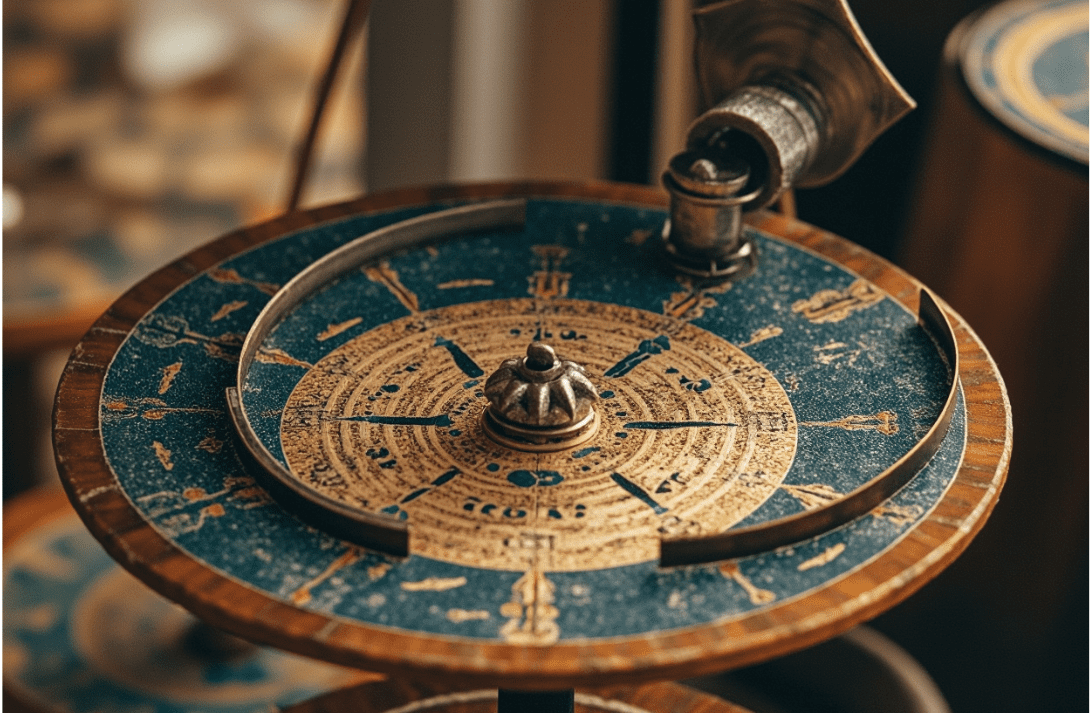
    Human beings have been fascinated with time for tens of thousands of years. Early Homo sapiens used time to know when to hunt, rest, cultivate, etc. For measuring time accurately, Neolithic humans began to construct timekeeping devices, which later came to be known as clocks. These clocks added punctuality to the human mainframe and accelerated efficiency to a great extent. In this blog, we discuss nine such clock models that revolutionized the field of Horology (the field of measuring time and making timekeeping devices). We discuss their construction, working, and their impact on timekeeping. So, let’s explore the evolution of clockmaking technology through the sands of time.

    Chapter 1: Sundial (~3500 BCE – 1600 CE)

    Sundials are the earliest known clocks or timekeeping devices, created by human beings. They consisted mainly of a platform with indicator markings and a rod-shaped figure above it, also known as a gnomon. During the day, the gnomon cast a shadow over the platform, whose length and angle were measured and calculated to find the exact hour. The device depended on human observation and calculation, and only worked when sunlight was available. Sundials were soon replaced by more efficient clocks in the future, especially the mechanical clock. They are still on display in various regions for decorative and educational purposes.

    Chapter 2: Water Clock / Clepsydra (~1500 BCE – 1600 CE)

    Water clocks (or Clepsydras) were one of the earliest known clocks made by man, which were independent of any external cause, like sunlight. They were famous in ancient Egypt, Greece, and China. They were built with various designs, especially the Chinese and Arabs devised many complicated mechanisms. In simple terms, the device consisted of two containers connected through a simple pipe or a hole. Water was poured into one of the containers and allowed to drip into the other at a controlled and measured rate. The empty container had markings that could indicate the time passed based on the volume of water filled. In some models, markings were instead on the container filled with water, and time was calculated on the basis of the decrease in water levels of the container. In both models, the water clocks proved superior to sundials and were used mostly at night. Their use declined after the invention of the mechanical clock during the 15th-16th centuries.

    Chapter 3: Candle / Incense Clock / Hour Glass (~500 – 1800 CE)

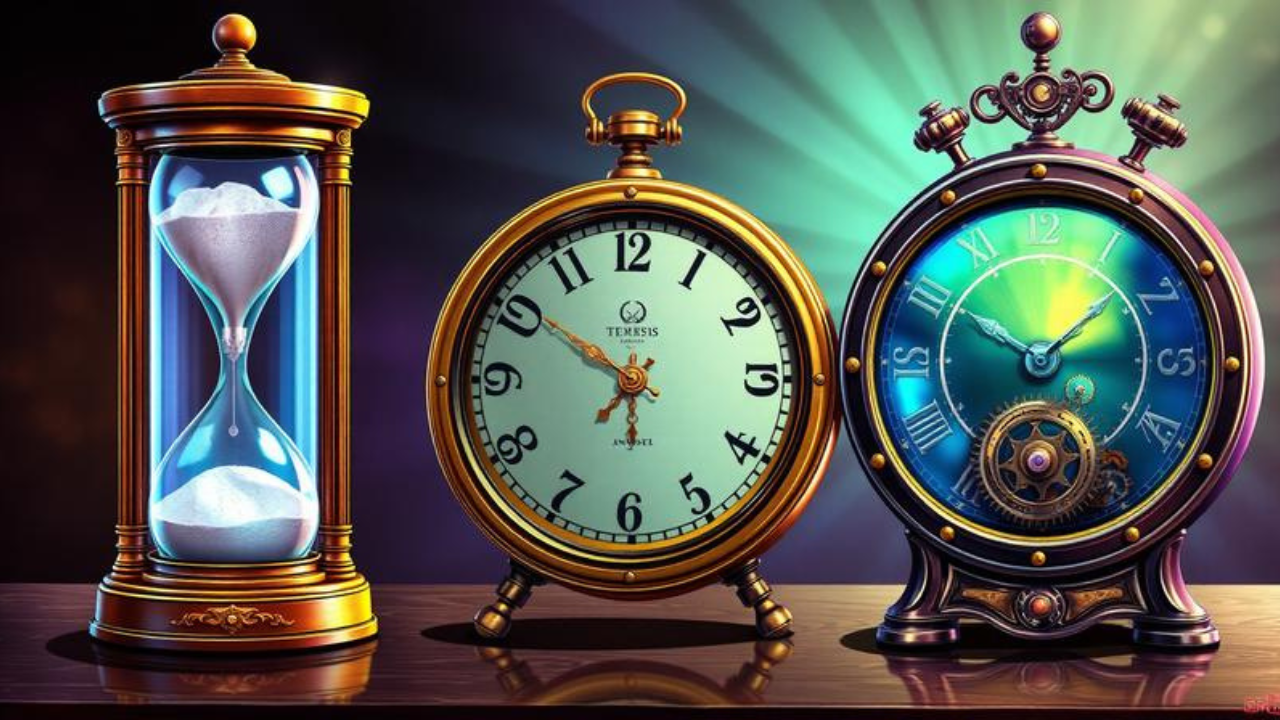
    Around the middle of the first millennium CE, a new type of mechanism was created to make timekeeping portable, so it could be carried from one place to another. Thus, the candle clock and the hourglass were invented. The candle clock was nothing but a candle with markings on it that indicated the time elapsed as the candle burned over the course of time. Hourglasses, on the other hand, were an improvisation on the water clocks, where sand and glass bulbs replaced water and containers. The amount of sand passed from one bulb to another indicated the time elapsed. After the entire sand had passed to the second bulb, the clock could be easily reset by just switching the second bulb on top, so that sand could then pass to the first bulb, and the clock worked in the opposite direction. Hourglasses were mainly used in long voyages, while the candle clock was mainly used for domestic and ceremonial purposes. Their use declined around the 17th-18th century due to the invention of more advanced clocks.

    Chapter 4: Mechanical Clock (~1300 – 1800 CE)

    Mechanical Clocks were the earliest form of properly engineered clocks. They were much more accurate compared to their predecessors and slowly led to their decline in usage. A typical mechanical clock consists of 5 parts: a power source, a gear train, an escapement, a regulator, and an indicator. In the earliest mechanical clocks, a falling weight was used as the power source. The falling weight interacting with gravity created a steady pull that drove the gear train. A gear train is a system of interconnected gears arranged so that the rotation of one of the gears leads to the rotation of all the gears. These gears drive something called an escapement, a disc with two tooth-like arms called pallets, mounted on a rotating shaft, that control the movement of the gears. This escapement is guided by another object called the regulator. In the earliest clocks, a horizontal cross-bar with adjusted weights known as a foliot was used as the regulator. As the gear train moved the pallets, the escapement moved the bar back and forth. The weights on the foliot resisted sudden changes due to rotational inertia, thereby regulating the movement of the gear train. The regulated motion of the gear train was finally transferred to an indicator, in the form of hands, which displayed it in the form of passage of time on the clock’s face. These types of clocks created a revolution in horology and were in continuous use till the 1800s.

    Chapter 5: Pendulum Clock (1656 – 1930 CE)

    The mechanical clocks, although far superior to their predecessors, had a major disadvantage. Their regulators worked on rotational inertia, depending on the movement of the gear train; thus, their accuracy reduced with time and needed to be readjusted. In 1656, the Dutch mathematician and engineer Christiaan Huygens invented the pendulum clock. It had almost the same design and principle as that of the mechanical clock, except for the regulator part. Instead of the dependent foilot, a pendulum was used as the regulator. Unlike the foliot, the pendulum works on the principle of simple harmonic motion under gravity. The pendulum thus swings in a uniform motion independent of any external object. Thus, the pendulum clock worked as a far better-regulated and, in turn, more efficient clock than the mechanical clock. Another innovation was that the power source was changed from a falling weight to a spring whose potential energy provided the power. The pendulum clocks were in common use till the late 1930s.

    Chapter 6: Marine Chronometer (1735 – 1970 CE)

    The Pendulum Clock, although very efficient and requiring very little calibration, had a major drawback. It was inefficient in sea voyages, as the motion of the pendulum was interfered with by the constant rocking and rolling of the waves. In 1735, the English engineer John Harrison invented the marine chronometer, suitable for sea voyages. The marine chronometer had a balance wheel and a spring in place of a pendulum as the regulator. The wheel oscillated in a uniform harmonic oscillation, and the spring attached to it provided the elasticity, thereby maintaining a uniform regulation independent of both gear train motion and motions from sea waves. The marine chronometer proved to be very efficient in naval expeditions and warfare, and continued to be used till the 1970s, when they were replaced by atomic clocks.

    Chapter 7: Quartz Clock (1927 – present)

    The Quartz Clocks are the first electrical clocks. Here, the power sources are batteries, in place of springs or weights. But the most important innovation is in the regulators. Quartz is a crystal that possesses a unique property called piezoelectricity, the ability to generate electrical pulses when under mechanical stress. Thus, in quartz clocks, tuning forks made of quartz crystal are installed in vibrated conditions, thus creating electrical pulses which act as the regulator. Electrical clocks are far superior in accuracy and efficiency compared to mechanical clocks, and thus, the former completely replaced the latter within decades. Also, quartz being extremely abundant on earth, made quartz clocks extremely cheap, and thus they are still in use in nearly every household.

    Chapter 8: Atomic Clock (1949 – present)

    Atomic Clocks are the champions of accuracy. In an atomic clock, the quartz crystal vibrates and sends electrical signals at a fixed frequency. These electrical signals are then converted to microwave signals. These microwave signals are sent to certain atoms: either Cesium-133, Rubidium-87, or Hydrogen (maser). The microwave signals excite the atoms. These atoms pass through a detector. Any change in the frequency of the electrical signal will change the level of excitation of the atom. The detector will detect the change and send a feedback signal to the quartz, thereby maintaining the regulating frequency. These clocks are so accurate that time has been defined by them. Before the atomic clocks, time was defined by the Earth’s rotation and revolution, whose measurements were affected by tides, earthquakes, and other causes. But after the invention of the Atomic clocks, one second is defined as 9,192,632,770 oscillations of radiation corresponding to a specific energy in the Cesium-133 atom. So, with the invention of atomic clocks, the calculation of time became finally independent of the Earth’s surface. Atomic clocks are now used in global navigation systems like GPS, telecommunication and internet facilities, stock markets, astronomical observations, and many more.

    Chapter 9: Smart Watch (2000 – present)

    Smart watches are direct descendants of Quartz clocks. The main body is the same except that the electrical signals are passed through a digital logical counter, which counts the oscillations. The software associated with it compares the oscillation with an external timeframe (GPS, phone, satellite, etc.) and sends feedback signals to the quartz crystal. Another thing that changed is that smart watches have a digital display frame with no clock hands as an indicator. Except for the regulator, almost all the mechanisms are the same for a smart watch and a quartz watch with a digital frame. They are today used both as timekeeping devices and for external features like measuring heart rate, weather reports, etc.

    Conclusion

    Clocks have evolved along with human civilizations over time. From calculating time to defining time, they have come a long way. The evolution can be classified into three different stages: pre-mechanical, mechanical, and electrical clocks. A proper electronic age for a clock is yet to come (if we don’t count mobile phones and personal computers as electronic clocks).

    That is all for this blog. Hope you enjoyed it. Finally wrote my first “technology” blog after 36 blogs. So, kindly forgive the technical jargon. I will try to minimize them in the future. Will be bringing more blogs on the history of science and technology like this. Please like, share, and subscribe if you want to get updates for my blogs. And thank you for reading the piece.
  • How Ancient Civilizations Measured Time: Archaeoasteonomy and Early Calendars

    How Ancient Civilizations Measured Time: Archaeoasteonomy and Early Calendars

    Time is one of the fundamental quantities of physics and perhaps the most mysterious of them all. I was reading the late Dr. Stephen Hawking’s A Brief History of Time, which inspired me to look into the depths of archaeoastronomy and ancient timekeeping all over the world. I am dedicating this blog to him.

    Introduction

    Archaeoastronomy is the study of how the universe, space, and time were viewed in the past. Timekeeping is the art of recording time using a device or calculations. In this blog, I am writing about the way eight ancient cultures, namely India, China, Egypt, Mesopotamia, Mesoamerica, Greco-Roman World, Celtic/Northern Europe & Islamic World viewed space & time, their cosmology, and their methods of time keeping before the invention of the telescope and the modern clock. How different worlds got inspiration from each other and also their evolution.

    India

    Indian Mandala

    Ancient India was very much inclined to cosmology and timekeeping. According to Hindu Cosmology, time is circular with no beginning or end, but has huge cycles known as Kalpa. A Kalpa is a day of Brahma, the God of Creation, which measures about 4.32 billion earthly years. Brahma’s life spans 100 years, which approximates to 311 trillion earthly years. Each Kalpa is divided into 14 Manvantaras, each lasting 306.72 million years, and each Manvantara is divided into 4 Yugas or ages, which are Satya Yuga, Treta Yuga, Dvapara Yuga, and Kali Yuga. According to Hindu Cosmology, the current Yuga is the Kali Yuga. In Buddhist Tantric Systems, time is also considered cyclical, like Hindu cosmology. The cyclical nature is called Kalachakra, or the Wheel of Time.

    The calendars followed in Ancient India were lunisolar, i.e. combination of lunar cycles and solar years of 365 days. The most common calendars were the Vikram Samvat Calendar from 57 BCE and the Saka Calendar from 78 CE.

    India also had texts on Astronomy & Astrology. The earliest known text on Astronomy & Astrology is the Vedanga Jyotisha from around 1350 BCE. It also includes Geometry and basic Trigonometry. Another later text, which was heavily influenced by the Greeks, is Yavanajataka (Ancient Indians called the Greeks as Yavanas), which was written after the Greeks came into contact with India during  Alexander’s campaign. Another great astronomical text was the Surya Siddhanta, written around 600 CE. In this text, Surya, the Sun God, gives wisdom about astronomy to Maya, the father-in-law of Ravana, the main antagonist of the epic Ramayana. Surya Siddhanta describes gravity a millennium before Sir Isaac Newton and also describes the size and positions of nearby planets quite accurately. It also describes how time passes at different rates under different circumstances and through different perceptions, which can be considered an earlier concept of relativity.

    India also had sites aligned to celestial movements. For example, Junapani stone circles (1500-500 BCE), which were primarily burial sites but also positioned in alignment with the winter solstice sunrise. The Ancient Indians also had their own Prime Meridian passing through Ujjain in modern Madhya Pradesh.

    In early modern India, there were five big observatories built by King Jai Singh II of Amber around the 18th century, called Jantar Mantar. The largest Jantar Mantar is in Jaipur, Rajasthan, which contains the world’s largest sundial.

    China

    Chinese Palace

    Ancient Chinese Cosmology was highly influenced by Daoism. According to it, the world is composed of Yin and Yang, two opposite but complementary forces. Yin, being passive, dark, and feminine, and Yang, being active, bright, and masculine, represent every duality of nature. Together they represent continuous cycles of creation, balance & transformation. The proper symbolization of Yin and Yang was first introduced by the Chinese philosopher Zou Yan in the 3rd Century BCE.

    The Chinese followed  Lunisolar calendars, combining lunar cycles and solar years of 365 days.  They designed their calendars using Sundials & Water clocks, both of which were very much popular in Ancient China. They also developed astronomical charts that depicted stars & constellations. They used lines called skeleton lines, which were used by the government to convey political & cultural values. These star charts were also popular in their sphere of influence, namely Japan, Korea & Vietnam.

    They used Oracle Bones, which were made from Ox shoulder blades or Turtle Shells. The cracks in them were used during the Shang Dynasty (1600-1046 BCE) for divination and to predict Astronomical events.

    China, in later years,s also had a huge number of observatories to study the sky after the influence of post-medieval missionaries. Emperor Kublai Khan also ordered the construction of observatories throughout China.

    Egypt

    Egyptian Pyramids

    The Ancient Egyptians’ cosmology consists of Ra, the Sun Go,d who was also linked to creation by creating the universe and life, and also destruction by destroying chaos. Ra was said to travel through the sky in his Solar Barques: The Mandjet during the day and Mesektet during the night. This journey of Ra in his vessels represented life, birth, and rebirth, thus creating a cosmic order.

    They used mainly a Solar Calendar of 365 days (12 months * 30 days + 5 extra days) for general purposes and also had a lunar calendar for religious and temple contexts.

    The Egyptians relied on the helical rising of  Sirius or Sothis (after 70 days ) to align their civil calendar with astronomical and agricultural cycles. This coincided with the annual flooding of the Nile during mid-July. This also marked the Egyptian New Year. The star was ultimately linked to rebirth & fertility.

    The Egyptians were known for the use of Obelisks for timekeeping. Obelisks were used as sundials and were designed to follow the sun from east to west throughout the day.

    Mesopotamia

    Mesopotamian image

    The Mesopotamians had a Lunisolar Calendar of 354 days; they used metonic systems to adjust the months to 29 or 30 days. The Sumerians also had a Lunar Calendar with 12 months with an average of 29.53 days. They periodically inserted a 13th month to align with the solar year.

    The Mesopotamians had an old history of astronomical observation dating back to 2000 BCE. In star catalogues like the Three Stars Each and also MUL.APIN divided the fixed stars into 3 groups: Anu, Enlil, and Ea, based on where they rose in the Eastern Hemisphere. The stars in the Northern Hemisphere were linked with Anu, the stars in the Equatorial  Region linked with Enlil, and the stars in the Southern Hemisphere with Ea. Anu, Enlil, and Ea were also the three supreme gods of the Mesopotamian Pantheon. Anu was the sky god with the highest importance, Enlil was the god of winds and storms and considered the most powerful of the three, and Ea was the god of water, wisdom, and creation. In a series of 68 to 70 Mesopotamian cuneiform tablets named Enuma Anu Enlil, astronomical and atmospheric events were precisely described, including solar and lunar eclipses, star positions, etc.

    The Mesopotamians also built massive high structures to study astronomy and religious omens, named Ziggurats, which in Akkadian meant “Mountain Peak”.

    Mesoamerica

    Aztec Sun

    The Olmecs were the earliest known Mesoamerican culture that lived between 1500 and 200 BCE. They contributed a lot to astronomy and even mathematics. One such example is the creation of the ritualistic Tzolkin calendar of 260 days (13 months * 20 days).

    The Maya developed a Long Count Calendar to record days from a mythological starting point of August 11, 3114 BCE. It consisted of 5 units: Bak’tun(144000 days), K’atun (7200 days), Tun (360 days), Winal( 20 days) & K’in(1 day), combining numbers 1 to 19 in a positional system to represent dates which would reset after every Bak’tun cycle. For example, December 21, 2012 CE marked the end of one Bak’tun cycle and the beginning of another without a cataclysm.

    They also built pyramids, which were aligned to cardinal directions and celestial events reflecting sacred cosmology comprising both human and divine realms.

    The Mayas used books called codices to record history, pictograms, and celestial representations. About 3-4 codices survive today-

                                  Dresden Codex- deals with astronomy, calendars, and prophecies. The most important codex.

                                  Paris Codex- deals with religious ceremonies, astronomy, constellations & history.

                                  Madrid Codex- tells about Maya gods and rituals associated with them.

                                  The Maya Codex of Mexico, formerly called the Grolier Codex, deals with astrology and predictions.

    The Aztecs used a solar calendar of 365 days named Xiuhpohualli of 18 months of 20 days plus 5 extra days. There also existed a parallel ritual calendar called the Tonalpohualli of 260 days. The two calendars ran simultaneously and together formed a 52-year century known as the calendar round or “xiuhmolpilli’. This marked the renewal of the sun.

    The Aztecs also created a massive basalt structure commonly known as the Aztec Sun Stone around 1427 CE. Also known as the Calendar Stone. It depicted five eras or five suns of the Aztec cosmology. The central figure consisted of a face often identified with the sun god Tonatiuh. Some scholars also argued that the face is of an earth monster named Tlaltecuhtli or a hybrid deity, Yohualtecuhtli, or the Lord of the Night.

    The Greco-Roman World

    Roman Coliseum

    The Greco-Roman world had one of the most advanced systems of astronomy and timekeeping. They primarily followed a lunisolar calendar but were later reformed by Julius Caesar in 46 BCE to a solar calendar, also called the Julian Calendar. Later, under  Emperor Constantine in 336 CE, the Christian Calendar was influenced by the Julian Calendar, like the establishment of Christmas on December 25, coinciding with the solstice and Roman Festivals.

    Ancient Greeks devised an analog computer called the Antikythera Mechanism in order to observe and calculate astronomical positions and events, including the sun, moon, planets, lunar eclipse,s etc. It used intricate gears reflecting advanced knowledge of trigonometry and astronomy.

    Greeks were also early proponents of Heliocentrism. Astronomer Aristarchus of Samos challenged Aristotle’s Geocentric model. Though his ideas were rejected and later totally dismissed by Hipparchus of Nicaea. Hipparchus of Nicaea was a Greek astronomer aroundthe 2nd century BCE who is well known for the discovery of the equinoxes and the gradual shift of the orientation of Earth’s axis, affecting the equinox over time. He estimated the precision rate of about one degree per century, implying a full cycle of approximately 36000 years. He also recorded specific dates of autumnal and vernal equinoxes between 162 and 135 BCE in Egyptian calendar terms.

    Another important astronomer was Claudius Ptolemy of the 2nd Century CE. He preferred the geocentric model and also introduced the concepts of epicircles whose centre moves around larger circles around earth. His system allowed the prediction of celestial motions and eclipses until it was superseded by the heliocentric model. He was also the first cartographer to use latitudes and longitudes.

    The Romans were known to build sundials of various shapes and sizes- even horizontal and vertical. They also developed portable sundials, which can be seen as the ancient wrist watches.

    Celtic/Northern Europe

    Druid Symbol

    The Druids and the Ancient Northern Europeans were known to build huge observatories like the Clava Cairns in Scotland, the Stonehenge in Wiltshire, Southern England, and Ireland’s Boyne Valley. They were used for both as sundials and as observatories. The Stonehenge, a circular ‘henge’ earthwork of about 360 feet in diameter, was built around 3100 BCE. It was primarily a burial pi,t but also acted as a sundial. The Clava Cairns is a Neolithic site where passage graves align with the winter solstice at sunset, illuminating inner chambers at mid-winter.

    The Celtic festivals are closely tied to the seasonal cycles. Main festivals include Samhain (around 31st October/ 1st November) signaling the Celtic New Year and the end of harvest, Imbolc (1st/2nd February) marking the start of spring, Beltane(30th April/ 1st March) celebrating the beginning of summer, Lughnasa(1st August) marking the start of autumn and harvest, Yule during Winter Solstice, Ostara during Spring Equinox, Litha during Summer Solstice and Mabon during Autumn Equinox, completing the annual cycle of the Wheel of the Year.

    They also have the Celtic Cross, featuring a Christian cross and a circle intersecting its arms, representing the sun’s illuminating shining rays behind the cross, blending Christian and Celtic traditions. The design reflects the Celtic reverence for nature and the sun, symbolizing light, life, and spiritual illumination.

    The Islamic World

    Islamic Stars and Moon

    The Islamic world follows a lunar calendar called Hijri of about 354 days with 12 lunar months.

    In medieval times, they were known to use Astrolobe, an ancient astronomical instrument developed aroundthe 6th century CE, used to measure time and the position of celestial bodies by determining their altitude. Though first developed by Europeans, it was refined by the Islamic world.

    During the Islamic Golden Age, most mosques engaged a full-time astronomer called Muqqawil. They were used to find Qibla or the direction towards the Kaaba in Mecca. They were also used to keep the lunar calendar accurate and for studying eclipses, comets, and stellar positions.

    Inthe 10th-11th century CE, a sophisticated method was developed by the Khwarazmian polymath Al-Biruni to measure time using shadows, particularly to develop solar hours and muslim prayer times. His work ‘Shadow’ in 1021 CE details techniques involving gnomonic measurements, the calculation of solar hour angles through the sine of the sun’s altitude, and the use of shadows for various astronomical problems. His shadow-based time measurements integrated trigonometry and astronomical observations with precision and greatly influenced Islamic cartography.

    Short Summary For Each Civilization

    India- saw time as eternal & cosmic- woven through Yugas and Kalpas, a sacred rhythm between the stars and the soul.

    China- measured time in cycles and harmony between Yin and Yang, using calendars for dynastic & administrative purposes.

    Egypt- viewed time as a divine order, ruled by Ra’s daily journey,  anchored in temples through the worship of the sun.

    Mesopotamia- calculated time through mathematics & predictions, recorded through Cuneiform tablets.

    Mesoamerica- honored time as sacred & cyclical, counting not just days but destinies, etched into codices & stones.

    The Greco-Roman World- understood time as rational & observable, through analog computers, geocentric spheres & sundials.

    Celtic/Northern Europe- senses time through seasons- where solstice danced through megalith gates.

    The Islamic World- embraced time with devotion, refining Astrolabes and studying shadows.

    Conclusion

    The concept of time has always kept human beings thinking throughout millennia. Before the invention of telescopes and analog clocks, time and space were viewed entirely differently from what is being considered now. Those views, though only partially accurate, give an understanding of how different ancient cultures perceive time and its structure.

    Suggested Reading

    Explore General Articles on:

    -1. Archaeoastronomy (World History Encyclopedia)

    -2. Ancient Indian Astronomy (World History Encyclopedia)

    -3. Maya Astronomy (World History Encyclopedia)

    -4. Stonehenge (World History Encyclopedia)

    -5. Ancient Calendars and Astronomy (Ancient Origins)

    Recommended Books: A Brief History of Time by Dr. Stephen Hawking, Astrophysics for People in a Hurry by Neil deGrass Tyson.

    Disclosure: This post contains affiliate links. As an Amazon Associate, I earn from qualifying purchases. I only recommend books I truly value.