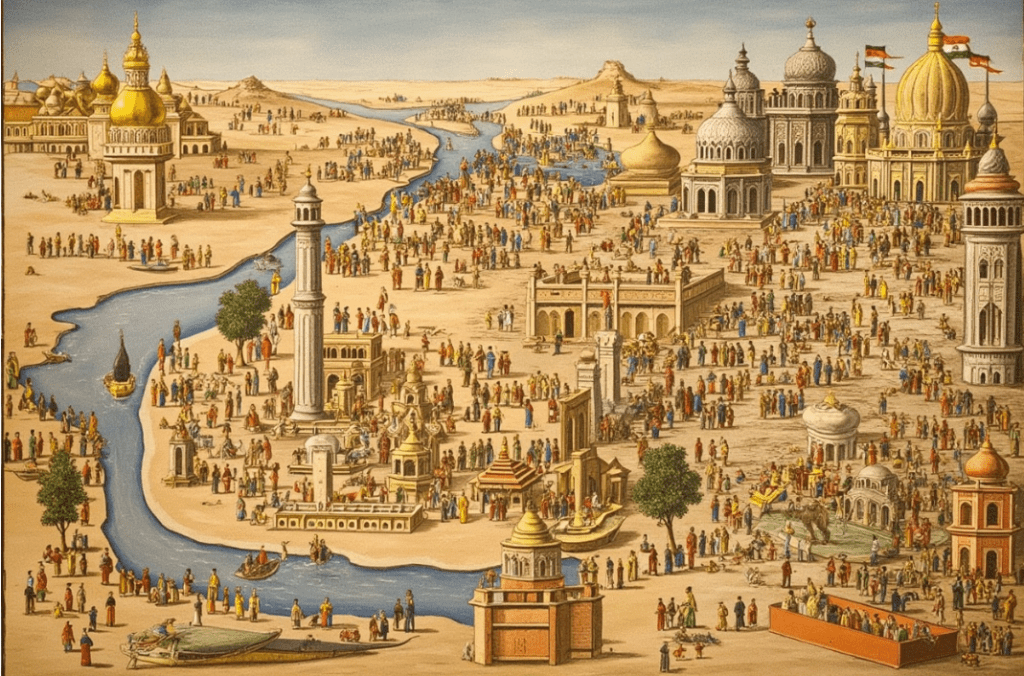
A brief comparative study of the relationship between two great cousin civilizations.
Introduction
Ancient India and Persia(Iran) were two of the world’s earliest civilizations. From the Indus Valley Civilization to the Maurya & the Gupta Empires and from the Elamite Civilization to the Achaemenid and Sassanian Empires, India and Iran were giants when it came to economy, power & wisdom for about 3000 years.They also shared many similarities between themselves with respect to religion, language and culture. This blog gives a brief comparative study between the two nations and tries to understand the similarities between the two ancient neighbours and their legacies.
Linguistic Relationships: A Journey through Vedic Sanskrit and Avestan
The earliest texts found in the two nations are the Vedas and the Avesta. The language through which they are written i.e., Vedic Sanskrit and Avestan interestingly shares a good amount of similarities between them. Some of the similarities in their vocabularies are given as follows-
| English Word | Vedic Sanskrit | Avestan |
| Sacrificial Ritual | Yajna | Yasna |
| Sacrificial Drink | Soma | Haoma |
| Gold | Hiranya | Zaranya |
| Honorable Man | Aryaman | Airyaman |
| Army | Sena | Haena |
| Horse | Asva | Aspa |
| Man | Nara | Nar |
| Cow | Go | Gav |
| Earth | Bhumi | Bumi |
| Animal | Pasu | Pasu |
| Mind | Manas | Manah |
| Is | As | Asti |
| River | Sindhu | Hendu/Hindu |
From these words we can predict that both Vedic Sanskrit and Avestan were perhaps sister languages that may be both descending from a Proto Indo-Iranian Language. Even the people living in both ancient India and Iran referred to their land as Aryavarta and Airyanem Vaejah, both meaning the land of the Aryas or Aryans in Sanskrit and Avestan. The word Arya means honorable in both the languages and has nothing to do with race unlike that which was adopted and abused by the Nazis. Even the hymns of Vedic Samhitas and the Avestan Gathas sound quite similar when listened carefully during Hindu and Zoroastrian rituals.
Today the heirs to these languages i.e., Modern Indo Aryan Languages like Hindustani, Bengali, Punjabi, Marathi, Gujarati etc. and Modern Iranian languages like Persian, Pashto, Kurdish, Balochi etc. are spoken in large numbers in countries like India, Pakistan, Bangladesh, Nepal, Sri Lanka, Iran, Afghanistan, Tajikistan and Iraq covering a population of roughly 1,700,000,000 people.

Religious Relationships: Hinduism & Zoroastrianism- The Parallels & The Antiparallels
The Ancient Vedic Religion, the precursor to the Hinduism that we know today was a nature worshipping polytheistic religion. The Rig Veda– The oldest Indian literature starts with denoting fire or Agni as the priest of Gods as he is considered the purifier of all negatives. He is described as the one leading the Yajna or the sacrificing ritual. A sacrificial drink called Soma was involved with Yajna consumed during rituals. The Ancient Iranian Religion before the prophet Zarathustra was also a polytheistic religion with their own set of pantheons. Fire was and is always interlinked with Iranian religions and is known by Atar or Atash and is revered as a symbol of purity and truth. Atar represents the divine presence of Ahura Mazda, the chief deity and is also required for rituals called Yasna and a sacrificing drink called Haoma.
The deities in the Vedic religion were called the Devas and the demonic beings were called Asuras. Chief Vedic Gods include Indra (God of rain, thunder and king of Gods), Agni(God of fire, priest of gods), Varuna(an Asura and God of balance & order, in later stages became God of seas), Vayu(God of wind), Savitr( also called Surya the sun god), Mitra(God of morning sun, friendship & association, often paired with Varuna), Yama (the God of underworld & justice) etc.
The deities in the Ancient Iranian religion were called Ahuras and the demonic beings were called Daevas. Chief deities include Ahura Mazda(the king of Gods), Mithra(God of rising sun, agreements and contracts), Atar(God of fire and divine purity), Vayu(God of wind), Anahita(Goddess of water & fertility), Rashnu(God of wisdom & justice), Verethragna (God of war & victory).
Thus we can see that Ancient Hinduism and Zoroastrianism can be thought as antiparallel religions in some ways as the deities in one religion were considered the demons in other and vice versa ( Deva/Daiva and Asura/Ahura). There is also a similarity in the naming and duties of the deities (Mitra-Mithra, Vayu-Vayu, Indra-Verethragna(both killed a cosmic demonic serpent by the same name Vritra)).
The later trajectories of the two religions are completely different. Hinduism evolved from a nature worshiping theology to having Gods related to more philosophical concepts gaining more significance ( Vishnu– the protector of life & embodiment of space itself, Shiva– the destroyer of the worlds & the one who controls time, Shakti– representation of cosmic feminine & a source of infinite energy) and even a concept of god with no qualities or attributes (Nirguna Brahman). Zoroastrianism on the other hand took a different path- it transformed from polytheism( many gods of equal importance) to heinotheism( Ahura Mazda main god, all other subordinate gods), to finally monotheism( Ahura Mazda only god with a negative counterpart Angra Mainyu, making the philosophy dualistic). In later stages Persia was conquered by the Muslims of Arabia around 700-800 CE and thus the religion declined, although many fled to India and are now known as Parsis. India was also conquered by Turkic Muslims around 1300s and European Colonizers around 1750s which affected Hinduism a lot- both in philosophy and theology.
Today about 1,200,000,000 Hindus live in countries like India, Nepal, Mauritius, Fiji, Guyana etc. and about 120,000 Zoroastrian live in countries primarily India, Iran,USA,Canada etc.
Geographic & Political Relationships: The sacred lands of Indo-Iranians
The Indian Subcontinent and the Iranian Plateau were the heartlands of two civilizations. The two nations were separated by buffer zones like Bactria(north of Hinukush Mountains, modern day Northern Afghanistan,Tajikistan & South-Eastern Uzbekistan), Gandhara (Modern day Kandahar region of Afghanistan and Northwest Pakistan including parts of Punjab) and the Indus River(Parts of Sindh and Balochistan).
The earliest contact between the two states was around 1000 BCE through businesses and trades in the region of Kabul and Sistan (modern Afghanistan and Balochistan). During the reign of the Achaemenid Emperor Kurush(Cyrus the Great in Greek) around 550-530 BCE, some parts of India came under Persian rule including Gandhara and Northwest Punjab. Later Emperor Darayavaus (Darius the Great in Greek) sent an expedition to India. Three of his inscriptions refer to his relations with India, including the Behistun rock inscription (also called Bagastana of place of Gods) dating around 518 BCE stating Gandhara as one of his subject countries. The Persepolis Inscription includes Punjab under the Persian Empire. The epigraph of Nagsh-i-Rustam shows India as the 24th state of his empire. Nearly one third of the gold of the Persian Empire was tribute from India. The Achaemenids also bought rice from India to be planted in the Near-East. It is believed that the Greek Mathematician and Philosopher Pythagoras got his doctrine of metapsychosis from India mediated by a Persian. Emperor Khshayarsha(Xerxes I in Greek) took Indians as some of his military units when he invaded and defeated the Greeks.
Later after Alexander the Great’s invasion of Persia and India, Persia came under the rule of Seleucus Nicator, one of his generals thus forming the Seleucid Empire. Emperor Chandragupta Maurya of the Maurya Empire defeated Seleucus and took some territories of Persia under his domain.
Towards 100 BCE, a group of Indianized Persians called Indo-Parthians or Pahlavas ruled parts of North West India. Both the civilizations benefited from the rise of the Kushan Empire during which arts like the Gandhara Art and various knowledge systems flourished in Takshashila in India and Jundishapur in Iran, two of the greatest centres of ancient wisdom.
The Sassanian Empire of Iran and the Gupta Empire of India maintained good relations with trades and commerce. The border lands of Gandhara, Kabul and Sistan were the melting points of different cultures, knowledge, religions and other accessories of the world. Mani , a scion of the Ashkanian family in Persia preached a syncretic religion called Manichaeism, combining beliefs from Christianity, Zoroastrianism & Buddhism which became a major religion in the silk route cities. The Parthians and Eastern Iranians helped in translating Sanskrit texts to Chinese & Tibetan, forming a link between four civilizations.
After the Islamic Conquests of Iran, many Zoroastrians fled to India via the Arabian Sea. They are said to be landed in Gujarat which was ruled by Sisodia clan of the Rajput lineage.
According to the Shahnameh of Ferdowsi (1100CE), the 5th century Sassanian king Behramgur requested an Indian king Shangol to select 12,000 musicians and introduce them to Persia- they are believed to be the ancestors of the Persian Gypsies. The game of Chess is also believed to have been born in India as Chaturanga, evolved in Persia as Shatranj and finally travelled to the west and became Chess.
After the Islamic Conquests Persia saw a large number of empires like the Great Seljuks, the Ilkhanates, the Safavids,the Afsharids etc. India also saw great empires during that time both indigenous and foreign like the Palas, the Cholas, the Delhi Sultanates, the Mughals, the Marathas etc.
Other important contacts came when the 2nd Mughal Emperor Humayun lost to an Afghan Ruler Sher Shah Suri in the Battle of Chausa in 1539, Humayun escaped with family to Persia. The next important contact came when the Afsharid Ruler Nader Shah invaded & looted India in 1738 including the Kohinoor Diamond and the Peacock Throne from the Mughal Court.
There were two migrations from Iran to India- one in the 7th-8th century during Islamic conquests, their descendants are known as Parsis, the other one was from Qajar-Era Iran to British India in 18th-19th century, their descendants are called Iranis. Both communities had contributed a lot in India’s progress. Important personalities include:
Homi Jehangir Bhabha(1909-1966)-the father of the Indian Nuclear Programme, Ardeshir Godrej(1868-1936)- co founder of the Godrej Group(along with brother Piroj), Jamsetji Tata(1839-1904)-Founder of the Tata Group, Field Marshal Sam Manekshaw (1914-2008)-Former Indian Chief of Army Staff and the first Indian with the rank of Field Marshal, Dadabhai Naoroji(1825-1917)-Economist, Political Activist & first Asian to be elected to the House of Commons of the United Kingdom (Liberal), first to publicly demand independence for India.
At present India and Iran are in their latest avatars i.e., the Republic of India & the Islamic Republic of Iran formed on 26th January 1950 & 1st April 1979 respectively. Both the nation states may be new, but their civilizational souls are over 3000 years old.
Conclusion
India and Iran are like two siblings who got lost from each other under various circumstances- Cultural, Political, Geographic, Religious etc. and now are in their completely own position and going towards their respective ambitions. This blog tries to uphold the civilizational relationships between the two nations and pays homage to the cultural ties across millennia.
Suggested Readings-
- India,Iran relations- World History Encyclopedia
- Zoroastrian Gods- Encyclopedia Brittanica
- India-Iran Bilateral relations- Ministry of External Affairs, India
- Zoroastrians: Their Religious Beliefs and Practices -Mary Boyce
- Spiritual Heritage of India -Swami Prabhavananda
Disclosure: This post contains affiliate links. As an Amazon Associate, I earn from qualifying purchases. I only recommend books I truly value.
 The Indic Scholar
Leave a comment