Introduction
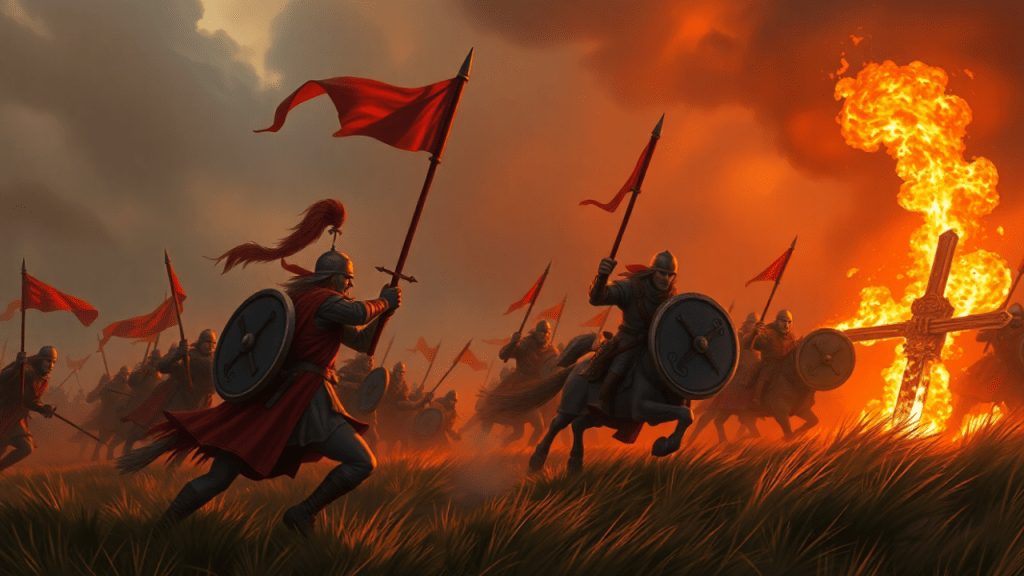
Wars and Battles are an important part of world history. In most battles, the total strength of the clashing forces generally determines the outcome. In fact, Joseph Stalin, the Soviet Leader, is often allegedly quoted as saying, “Quantity has a quality of its own.” But sometimes in history, a very small group of soldiers was able to stop and sometimes even defeat a large, powerful force. In this blog, we discuss 13 such David vs Goliath instances that happened in the last 1000 years. Ancient battles like Thermopylae, Sphacteria, Alesia, and Watling Street are excluded due to some conflicts about the authenticity of the numbers among some academic historians. Only those battles are included whose numbers are almost confirmed and accepted in the general academia, although the actual number can be a little more than that. So, let’s begin.
1. The Battle of Vitkov Hill (1420)
The first battle on our list is the Battle of Vitkov Hill, fought on July 14, 1420. The Holy Roman Empire, led by Emperor Sigismund, launched a crusade to crush the Hussite movement in Bohemia. The force had a strength of 20,000 to 25,000 supported by heavy cavalry, whose primary objective was to capture Prague, along with the reformer Jan Zizka.
The crusaders attacked through Vitkov Hill, a strategic position that controlled the food supply to Prague. But Zizka, anticipating the attack, had already fortified the hill with wooden fences and ditches, creating a funnel-like opening for the enemy to enter. The defenders numbered about 60-80 soldiers with a few hundred inexperienced townspeople.
When the crusaders entered through the funnel-shaped path, the Hussites showered arrows upon them from their crossbows. The arrows decimated the ranks of the aggressors, leading to a crushing defeat of the Holy Roman army.
2. Battle of Okehazma (1560)
During the Sengoku period of Japan, there lived the powerful warlord Imagawa Yoshimoto, who dreamt of overthrowing the rival clans. So, on June 12, 1560, he marched with an army of 20,000-25,000 towards the city of Kyoto. On the defending side stood the Daimyo of Kyoto, Oda Nobunaga, with a troop of about 2,000-3,000.
Yoshimoto’s forces captured the surrounding areas outside Kyoto and encamped at the village of Okehazama for the night. When the soldiers were celebrating their success with sake, Nobunaga used dummies and flags to mislead the scouts and used the cover of a sudden thunderstorm that appeared to approach the enemy camp.
When they finally reached the enemy camp, they suddenly attacked with deception and killed everyone, including Yoshimoto. The Battle of Okehazama transformed Oda Nobunaga from a provincial daimyo to a rising power in the whole of Japan.
3. Battle of Haengju (1593)
The Battle of Haengju was fought during the Japanese invasion of Korea in 1593. At the beginning of the invasion, Japan completely overpowered Korea. Koreans were now desperate to defend their capital, Hanseong (modern Seoul). At Haengju, General Gwon Yul stationed himself at a hilltop fortress along with 2,300 defenders, most of whom were civilians. On February 12, a group of 20,000-30,000 elite Japanese soldiers, including several veteran samurai, approached the hilltop to reach Hanseong. The Koreans used hwacha, multi-arrowed rocket launchers, along with fire arrows, spears, and boiling water to unleash hell upon the Japanese forces from top. The Japanese fought back, but the slope became a deciding factor in the battle. After eight hours of constant fighting, the Japanese finally retreated, and the battle became a turning point in the war, proving that the poorly equipped Koreans can resist and defeat the Japanese army with proper strategy and knowledge of the terrain.
4. Battle of Pavankhind (1660)
The battle occurred during the intense conflict between the Maratha Empire and the Bijapur Sultanate in India. The Maratha Emperor Chhatrapati Shivaji Maharaj was encircled by the formidable Bijapur General Siddi Masud at Panhala Fort. On July 13, 1660, the Marathas devised a daring night escape plan towards the fort of Vishalgad. But between the two forts stood the narrow mountain pass of Pawankhind. To ensure the emperor’s safe passage, the Maratha commander Baji Prabhu Deshpande volunteered to hold the mountain pass with 300-600 Maratha soldiers. The plan was simply suicidal, to delay thousands of Bijapuri forces long enough for the emperor to reach Vishalgad.
Baji Prabhu and his men formed a tight defensive line, completely blocking the narrow pass. They used swords, spears, and matchlock guns to hold off 5,000-10,000 Bijapuri soldiers. Baji Prabhu and his men continued to fight despite sustaining severe injuries. Only after the distant sound of cannon fire signaled the empire’s arrival, the mission completed. Baji Prabhu and his men were killed, but only after completing their mission, which led to the Sultanate’s downfall in the future.
5. Battle of Shiroyama (1877)
The Battle of Shiroyama, fought on September 24, 1877, marked the end of the Satsuma Rebellion and the last stand of the samurai. Saigo Takamori and around 300-500 remnant samurai, who were once a force of thousands strong, took position on Shiroyama hill. They faced the modernized Imperial Japanese Army numbering 20,000 soldiers, equipped with rifles, artillery, and naval support.
The Imperial Army surrounded the samurai on the hill, building trenches, and attacked using dynamites and mortars. The battle continued till dawn, when Saigo and others suddenly charged downhill with swords and spears and temporarily broke the imperial line, demonstrating extraordinary valor and discipline. They kept fighting till the last of the samurai was killed. Although this is an example of a lost battle, Shiroyama became a symbol of loyalty, martial honor, and the feudal transition from feudal Japan to the modern era.
6. Battle of Rorke’s Bridge
On January 22, 1879, in the Anglo-Zulu War, the British received a catastrophic defeat at the hands of the Zulu army in Isandlwana. The Zulu forces of 3,000-4,000 warriors, in high spirits after victory, approached the small British station of Rorke’s Drift, which served as a supply depot and field hospital.
The station was being defended by around 150 soldiers, led by Lieutenants John Chard and Gonville Bromhead, who fortified the station using mealie bags, biscuit boxes, and makeshift barricades.
The Zulus attacked with wave after wave with spears and shields, while the British used rifles. The battle was intense, and several times the Zulus successfully infiltrated the station, leading to the British soldiers hiding inside the hospital. The British continued their firing from the hospital. Despite being lower in numbers, their advanced weaponry helped them defend the post till dawn, after which the Zulus retreated, acknowledging the difficulty of taking the position. The British group became legendary, earning 11 Victoria Crosses – the most ever awarded in a single action.
7. Battle of Saragarhi (1897)
Saragarhi was an important tiny fort in the western frontiers of British India (now Pakistan). The fort, though small, acted as a communication link between Fort Lockhart and Fort Gulistan. The area conflicted with the Afghan tribes of Afridi and Orakzai, who often attacked the larger two forts.
On 12 September 1897, 10,000-12,000 tribes suddenly launched an attack on the tiny fort, aiming to cut the contact between the two larger forts. At that time, Saragarhi had only 21 Sikh soldiers, including Havildar Ishar Singh. The 21 soldiers repelled thousands of Afghans for hours, killing hundreds of them, as the attackers came wave after wave. The 21 soldiers fell one by one, but not before the British-Indian enforcement arrived to properly defend the region. All 21 soldiers were posthumously awarded the Indian Order of Merit, then the highest gallantry award available to native Indians.
8. Battle of Tolvajarvi (1939)
The Battle of Tolvajarvi, fought on 12 December 1939, during the Winter War, was Finland’s first major victory against the Soviet Union. The Soviets had launched a large-scale invasion, hoping to quickly conquer Finland, but in the dense forest and frozen lakes near Tolvajarvi, things unfolded differently.
When about 20,000 Soviet soldiers approached the frozen lake, Finnish Colonel Paavo Talvela planned a counterattack with only 4,500 soldiers with him. Their ski troops attacked the Soviets using the snowy terrain while the aggressors were in open sight near the lakes Hirvajarvi and Tolvajarvi. The Finnish units used grenades, submachine guns, and rapid flanking movements to completely overpower the larger army. Their attack created havoc among the Soviet ranks, forcing them to retreat.
Tolvajarvi boosted Finnish morale and proved that small, mobile (skis in this case) units could defeat larger forces by just exploiting terrain and initiative.
9. Battle of Kohima (1944)
The Battle of Kohima, nicknamed “Stalingrad of the East”, was fought from April to June 1944 in North-East India. The Imperial Japanese Army of around 15,000 soldiers finally reached British India after conquering Southeast Asia. When they reached Kohima, a major town (now a city), they were stopped by 1,500 soldiers. The Japanese, after their long campaign from Japan, had used up most of their rations and supplies. They were also tired after fighting for months. The defenders, on the other hand, were well rested and fully equipped. The defenders successfully resisted the larger Japanese army till the British 2nd Division arrived, launching a counterattack and marking the end of the Japanese campaign across Southeast Asia.
10. Battle of Jodotville (1961)
The Battle of Jodotville or the Siege of Jodotville is one of the most overlooked defensive battles in the history of mankind. In September 1961, during the Congo Crisis, 155 Irish UN peacekeepers of “A” Company, 35th Battalion, were sent to the mining town of Jodotville to protect civilians. On 13 September, more than 3,000 Katangese gendarmes, supported by European mercenaries and heavy weapons, launched a surprise attack. The Irish troop, led by Commandant Pat Quinlan, defended their stand for five days straight. Mortars, machine guns, and sniper rifles were used by the aggressors, yet the Irish defended with exceptional discipline, strategic positioning, and precise marksmanship. Hundreds of Katangese fighters were killed or wounded. But with supplies exhausted and reinforcements unable to break through, Quinlan made the difficult decision to surrender to avoid needless loss of life. His men were later released unharmed, but their heroic stand was ignored and criticized for decades, and it was only in the 21st century that they were formally honored.
11. Battle of Rezang La (1962)
During the Sino-Indian War of 1962, the Chinese Army tried to capture Ladakh, situated in Northern India. When around 3,000 Chinese troops reached the 16,000-foot-high altitude of Ladakh, they were met by Major Shaitan Singh and his troop of 123 soldiers of Charlie Company, 13 Kumaon Regiment. Major Shaitan Singh positioned his troop into three separate platoons guarding the mountain pass of Rezang La, which led straight to Chushul, a critical Indian airstrip. When the Chinese launched a pre-dawn attack, the Indians were near-frozen and fighting with limited ammunition. Yet they hold their ground. The battle soon turned into a close-quarter combat, where soldiers used bayonets, grenades, and even stones. Despite being outnumbered over 10 to 1, the Kumaonis inflicted staggering casualties. They fought till their last bullet and their last breath, successfully defending the mountain pass.
When their bodies were discovered months later, 114 of the 123 were found frozen dead at their post, mostly in their firing positions. Rezang La remains one of the greatest David vs Goliath stands carved into the snow and stone of the Himalayas.
12. Battle of Long Tan (1966)
The Battle of Long Tan, fought on 18 August 1966, during the Vietnam War, is one of the most remarkable defensive victories ever achieved by a small modern infantry company.
In the rubber plantations of Long Tan, 108 Australian and New Zealand soldiers of Delta Company, 6th Battalion, were unexpectedly attacked by an enormous Viet Cong and North Vietnamese force of 1,500-2,500 troops.
The engagement began with Viet Cong mortars hammering the Australian base at Nui Dat. The Delta Company was sent to locate the attackers, but soon they were themselves ambushed. Heavy monsoon rain, thick rubber trees, and knee-deep mud made fighting almost impossible for the foreign troop. Despite being outnumbered around 15 to 1, the Australians formed a tight defensive perimeter and held their ground with disciplined fire, coordinated maneuvering, and continuous communication. As ammunition dwindled, relief came in the form of armored personnel carriers from Nui Dat, which helped break through the Viet Cong attack, leaving thousands of casualties in the process. The Viet Cong force retreated, leading to the victory of the Australian and New Zealand forces.
13. Battle of Longewala (1971)
The Battle of Longewala was fought on 4-5 December 1971, during the Indo-Pakistan War. At a lonely desert post in Rajasthan, just 120 soldiers of the 23rd Battalion, Punjab Regiment were posted, supported by a single jeep-mounted recoilless rifle. On the night of 4th December, 2,000-3,000 Pakistani soldiers, along with 45-60 tanks, and hundreds of vehicles.
Pakistan planned to capture Longewala quickly and push deep into Indian territory before sunrise. But the Indians, led by Major Kuldip Singh Chandpuri, refused to abandon their post. They created fortified trenches and prepared to fight even though they had no anti-tank weapons.
When Pakistan’s armored columns advanced, the desert became their enemy as soft sand bogged down the tanks, and their headlights revealed their positions. Throughout the night, the defenders used precise rifle fire, machine guns, and their lone recoilless rifle to destroy advancing vehicles one by one.
At dawn, the Indian Air Force arrived, destroying the trapped armored tanks. The Mirage and the Hunter aircraft annihilated the Pakistani ranks, leading to a major victory at the western front of the war.
Longewala stands as an example where a smaller infantry halted and later defeated a larger mechanized force.
Conclusion
Thus, we saw that battles are not always won by numbers. From Vitkov Hill to Longewala, history has produced many Davids who fought and sometimes defeated Goliaths, even when every statistic was against them.
That’s all for this blog. Hope you enjoyed it. Please like, comment, and share if you feel so. Thank you all for reading this blog.
Suggested Readings
- Warfare History Network
- Military History Now
- Saragarhi And The Defence Of The Samana Forts by Amarinder Singh
- The Battle of Long Tan: As featured in The Vietnam Years by Michael Caulfield
- Heroes of Jadotville: The Soldiers’ Story by Rose Doyle
- The Battle Of Rezang La by Yadav Kulpreet
Disclosure: This post contains affiliate links. As an Amazon Associate, I earn from qualifying purchases. I only recommend books I truly value.


 The Indic Scholar
Leave a reply to satyam rastogi Cancel reply