Introduction
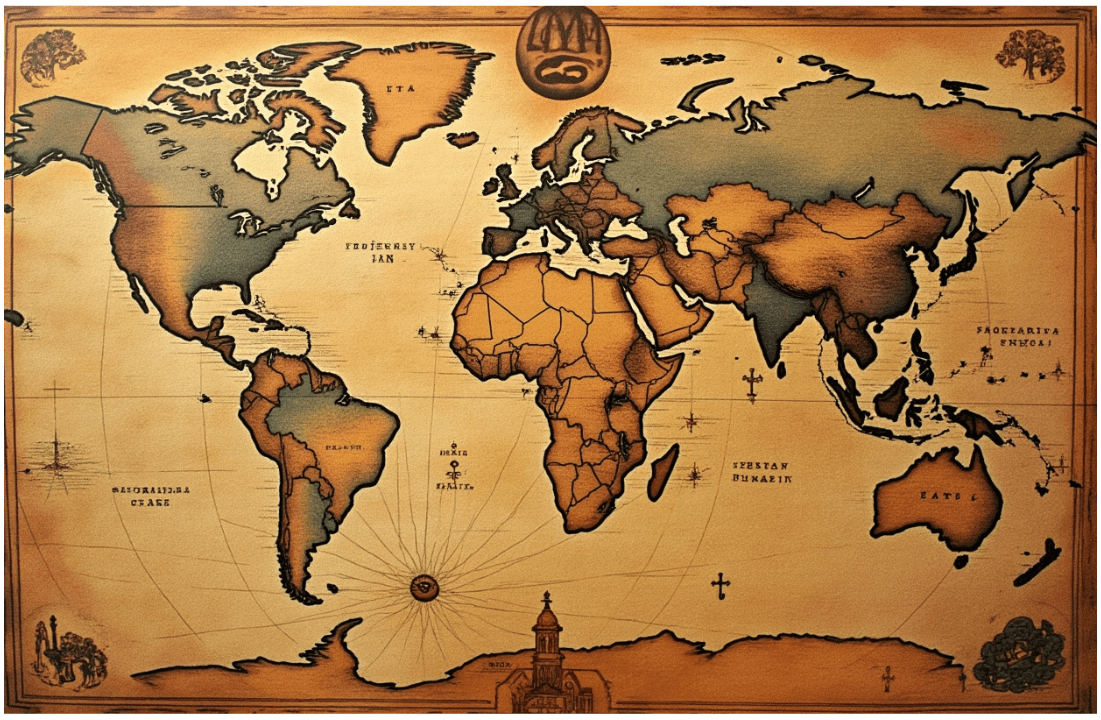
The art of cartography is more useful than we realise. Maps have become an integrated part of our daily lives. Apps like Google Earth and Google Maps are used by us almost every day, whether we are ordering food, booking vehicles, setting up vacation plans, booking hotels, researching new tourist spots, etc. But that was not always the same. The complete and accurate maps of the world are a very new invention in human society. Before that, different regions used to draw maps based on their local understandings, their own rationality, and even their culture. These maps differ from each other in almost every way possible.
In this post, the cartography from five ancient civilizations of the world has been explained: Ancient Mesopotamia (Babylon), Ancient India, Ancient China, the Greco-Roman World, and the Islamic World. Each of the civilizations had its own methodology to describe its worldview. Each Map opens a window to a different but fascinating world.
Table of Contents
Babylon- Imago Mundi, The First Map of the World
The Babylonian Map of the world, also known as Imago Mundi, is a clay tablet made around the 7th century BCE. The Map is written in the Cuneiform writing system popular in the Ancient Near East.
The map describes the world as a flat, round disc with the Euphrates River at the center. The city of Babylon is shown along the Euphrates River. Various other cities of different regions are shown, like Susa, the capital of Elam (Ancient Persia) in the south, Urartu (around Ancient Armenia) in the north-east, and Habban, the capital of the Kassites(around the fertile crescent) in the north-west. The map is surrounded by a ring, which signifies “maratum” or bitter river. The other side of the river contains darkness.
There are texts on both the front and back sides. The text in the front describes the creation of the world by the God Marduk, the chief deity of Babylon, who separated the salted ocean into land and sea. It also describes kings like Utnapishtim, Sargon, and Purushanda. The back side describes various other regions.
So this map can be considered to be deeply rooted in mythology and creation stories. This is not at all scientific, but it describes a lot about the people and culture of Babylon.
India- Jambudvipa and the sacred landmass
The ancient cartography of India was strongly influenced by cosmology. The most famous example is the concept of Jambudvipa found in Hindu, Jain, and Buddhist texts.
The Hindu puranas around the 3rd century BCE, such as Agni Purana, Matsya Purana, Vishnu Purana, and Markandeya Purana, describe the world as seven concentric island continents, namely Jambudvipa, Plaksadvipa, Salmalidvipa, Kusadvipa, Krouncadvipa, Sakadvipa, and Pushkaradvipa, with Jambudvipa as the innermost island. These island continents are separated by seven oceans of salt water, sugarcane juice, wine, ghee, yogurt, milk, and fresh water. Markandeya Purana also mentions Jambudvipa to be flattened at the north and the south with an elevated centre where the king of the mountains, Mount Meru, lies, on top of which Lord Brahma, the creator God, resides.
In Jain cosmology. Jambudvipa is at the centre of Madhyaloka, or the middle world. There are many islands in Madhyaloka. At the centre of Jambudvipa, Mount Meru is situated. These descriptions are found in a Jain text called Jambudipaprajnapti.
In Buddhist Cosmology, the world is divided into Kamadhatu(Desire realm), Rupadhatu(Form realm), and Arupyadhatu(Formless realm). In Kamadhatu, Mount Meru is located, which is surrounded by four islands; the southern island is called Jambudvipa.
So from these examples, we see that Ancient Indian Cartography was heavily influenced by Cosmology and resembled more culture and less reality.
Greco-Roman World- Ptolemy’s map, the first map using latitudes and longitudes
The Ptolemy “Maps of the World” were the iconic maps made in the Greco-Roman world, which used scientific methods for the first time. Claudius Ptolemy, a Greco-Roman astronomer and cartographer, in his book Geographia in the 2nd century CE, introduced the concepts of Latitudes and Longitudes.
The continents described are Asia, Europe, and Libya(Africa) with two large seas, the Mediterranean and the Indian. Geographia consists of 8 books.
Book 1 describes the theories behind cartography, such as the use of the position of stars to determine directions, using scales, and also Latitudes and Longitudes.
Book 2 describes Gaul, the Iberian Peninsula, and Central Europe.
Book 3 describes Italy, Greece, and the regions between
Book 4 describes North Africa, namely Morocco, Egypt plus Ethiopia
Book 5 describes Anatolia and the Middle East
Book 6 describes the Caucasus and Central Asia
Book 7 describes India, China, and Sri Lanka
Book 8 describes the maps created for the previously mentioned areas.
So, in short, Ptolemy’s map was the first scientific map, which revolutionized later cartography.
China- Cartography by Pei-Xiu and the involvement of politics
Chinese Cartography, though it had earlier examples, evolved into an iconic form under Pei-Xiu. He was a cartographer in the Three Kingdoms period and later the Jin Dynasty of China around the 3rd century CE. He later became the Minister of Works in the Jin Government. He used surveying, scales, grids, and measured distances to create precise maps. But these maps were meant for the government and the administrators and were not meant for the common folks.
Later, the Tang(7-10th century CE) and the Song (10-13th century) Dynasties used this technique to map surrounding regions and countries. The maps by Jia Dan during the Tang Dynasty represented Chinese and Non-Chinese territory and presented them to the then-emperor. Though this map is lost, later maps during the Song Dynasty show surrounding regions like Korea and Vietnam. These maps were used by the government to include military, economic, and geostrategic data.
Thus, these Chinese Maps were less about exploration and knowledge and more about statecraft, nation-building, and strategic surveillance.
The Islamic World- al-Idrisi and Tabula Rogeriana, the most detailed pre-modern world map
Muhammad ai-Idrisi was an Arabic geographer and cartographer who lived in the 12th century CE and served the king Roger II of Sicily. He created the Tabula Rogeriana, or The Book of Roger, one of the world’s first detailed atlases. In Arabic, it is known as Nuzhat-al-mushtaq fi ikhtiraq al-afaq, which means The Excursion of One Eager to Penetrate the Distant Horizons. It contains about 70 maps of the known world. His work drew inspiration from the Golden Age of Islam (8th to 13th century CE) during the Abbasid Caliphate. His other inspiration was Ptolemy’s Geographia. This atlas was done with well-researched and used latitudes and longitudes.
The book was originally written in Arabic, divided into seven climatic zones, each of which has 10 sections. Besides the accuracy and precision, the book had maps with south at the top, which was in accordance to islamic traditions. His maps also described the Islamic World as the centre of influence.
Thus, this atlas can be said to be a collection of modern maps in a pre-modern world, heavily influenced by Islamic Traditions.
Summary Table
| TRADITIONS | PERIOD | KEY MAP | CARTOGRAPHER | WORLDVIEW HIGHLIGHTS | CENTER OF THE WORLD |
| Babylonian | 7th Century BCE | Imago Mundi | Anonymous Scholars | Circular Flat Earth Surrounded by Mythological Bitter River | Babylon |
| Indian | 3rd Century BCE | Jambudwipa Cosmology | Hindu, Jain & Buddhist Texts | Mount Meru at the Center, Encircled by Concentric Continents & Sacred Oceans | Mount Meru, India |
| Greco-Roman | 2nd Century CE | Geographia | Claudius Ptolemy | Latitudes, Longitudes, Mathematical Precision, Spherical Earth | Mediterrenean |
| Chinese | 3rd Century CE | Pei Xiu’s Maps | Pei Xiu | Grid-Based Maps, Elevation Focused, Governmental & Administrative Tool | China |
| Islamic | 12th Century CE | Tabula Rogeriana | al-Idrisi | South-Up Orientation, Synthesis of Various Sources | Mecca, Islamic World |
Conclusion
We have become so used to maps that sometimes we take them for granted and fail to recognize the effort, journey, and stories behind the development of the maps we see now.
Maps have been a part of human life for the past 3000 years, although the quality, design, accuracy, and purpose of maps have always changed depending on time and place.
This post thus described 5 such instances of how different maps of the world tell different stories.
If you find this post interesting, please comment and share. Also, subscribe to my newsletter below for more updates and future blog posts.


Leave a Reply to kautilya3773 Cancel reply