Tag: Ancient Civilizations

  • Ancient Indian Trade: Exchange of Ideas With the World

    Ancient Indian Trade: Exchange of Ideas With the World

    Introduction: A Connected Ancient World

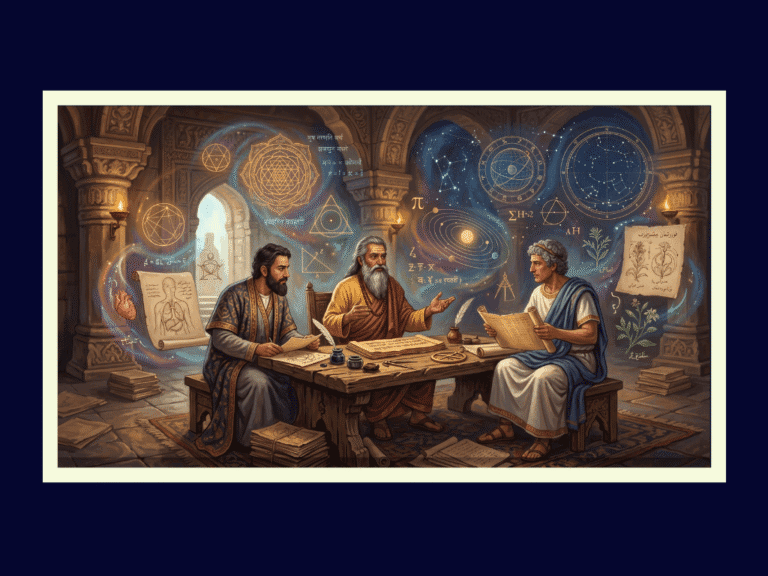
    When we think of ancient civilizations, we often imagine isolated cultures unaware of each other. Whether it was the Indian Subcontinent, the Persian Plateau, or the Mediterranean World, these cultures always had relationships through trade, such as that of goods, services, and even ideas. India was no exception. The ancient Indian trade of ideas played an important role in developing the cultural, theological, philosophical, and scientific thinking of both India and the cultures it engaged with.

    India’s unique geographical position made it a natural hub of the exchange of knowledge. Through the Indian Ocean and the North-Western passes, India traded with the Babylonians, Egyptians, Persians, Greeks, Sakas, Kushans, and even Romans. The exchange was a two-way system, as those cultures also benefited from Indian thought processes.

    In this post, we will discuss the ancient Indian trade of ideas with those cultures between the Vedic period and the Kushan Era. We will discuss the scientific impact across both sides of the exchange. Later interactions with cultures like the Chinese, Huns, and Turks are intentionally avoided as they will be covered in a future post in this series.

    Babylonians: The Language of the Stars

    The Babylonians had a sophisticated astronomical tradition, which included planetary tracking, eclipse records, and zodiac systems. They were used not just academically but also in agriculture, rituals, and kingship, which led to the establishment of accurate calendars.

    The ancient Indian trade with Babylon can be traced back to at least the 7th century BCE, creating opportunities for early exchange of ideas. The resemblance between the cultures can be found in the fact that India had a parallel body of knowledge in the Vedic period, primarily in the form of Vedāṇga Jyotiṣa and nakṣatras, both of which have been described in a previous post.

    Egyptians: Trade Across the Red Sea

    Ancient Egypt acted as a bridge between Ancient India and the Mediterranean World. The Egyptians used their Red Sea ports, like Berenice, to link the two worlds, with the city of Alexandria later emerging as the main cosmopolitan power of exchange of ideas.

    Maritime trade between India and Egypt included goods like ivory, spices, gemstones, textiles, and medicinal herbs. The growth of this trade accelerated after the discovery and utilization of seasonal monsoon routes across the Arabian Sea by navigators like Hippalus, allowing sailors to cross in roughly 40 days.

    After the Hellenization of Egypt, Alexandria became an intellectual hotspot where eastern and western medical traditions met.

    Persians: Empires, Administration, and Knowledge Systems

    Gandhāra was an intellectual hub in north-western India (modern-day Afghanistan and parts of Pakistan) and home to one of the world’s oldest universities: Takṣaśilā. Its faculty included Pāṇini, the grammarian who systematized Sanskrit, and Cāṇakya, the political strategist and author of the Arthaśāstra. Its alumni included Caraka, the father of Indian medicine, and Candragupta Maurya, founder of the Maurya Empire.

    During the 6th century BCE, the Achaemenid Empire under Cyrus the Great expanded eastwards into the Gandhāra and the Indus regions. Under Emperor Darius I, the region became a satrapy of the empire. This integration was supported by the construction of royal roads between the Persian Plateau and the Indus River, resulting in an increased exchange of systems and ideas.

    This integration drove the exchange of coinage, measurement, and taxation systems; tools the Mauryas would later develop further

    One of the biggest contributions of the Persians to Indian society was the introduction of the Kharoṣṭhī script, influenced by Aramaic, which was written from right to left, and became widely popular in Northern India.

    Greeks: Astronomy, Medicine, and Philosophy

    Alexander the Great’s invasion of Asia in the late 4th century BCE accelerated the interactions between the Indic and the Greek worlds. This subsequently led to the rise of the Indo-Greeks, a culture blending Indian, Greek, and Central Asian traditions.

    The exchange of astronomy and mathematics was substantial. The Greeks contributed through mathematical astronomy and geometric models, while the Indians presented calendar systems and the concept of nakṣatras. This cross-pollination influenced the zodiac systems and astronomical terminology in both traditions.

    In medicine, Greek humoral theory and Indian Āyurveda exchanged ideas on medicinal plants, surgical techniques, and pharmacology. They exchanged medicinal plants, surgical ideas, and even pharmacological concepts. Pepper, for instance, became a staple in Western pharmacopoeias following these interactions.

    Takṣaśilā grew into a multilingual centre of learning as a result of this exchange. And out of the cultural blending in Gandhāra emerged a new artistic tradition, the Gandhāra school, which fused Hellenistic realism with Buddhist themes. The Greco-Roman features commonly seen in depictions of the Buddha trace back to this period.

    Śakas: The Central Asian Corridors

    The Śakas (Scythians) were Indo-Iranian nomads from Central Asia who migrated to India around the 1st century BCE, pushed by chain reactions across the Eurasian steppe networks. They were among the first to open the Central Asian corridors to India, corridors that would shape medieval world history for centuries.

    They played a major role in spreading Buddhism out of India to the vast Steppes, and also the Persianization and Indianization of the Central Asian cultures for nearly a millennium.

    Kushans: The Silk Road Age

    The Kushans were a sub-tribe of the Yuezhi from the western borders of China. They migrated to India and created the Kushan Empire, expanding over Bactria (Northern Afghanistan), Gandhāra, and Northern India. At its greatest extent, Emperor Kaniṣka controlled all the major trade routes in that region, thus acting as a bridge between the Silk Roads and India.

    Places like Kashgar became cosmopolitan centres where merchants, monks, and scholars from across the known world exchanged ideas.

    The Kushans used Buddhism as a means of carrying knowledge to East Asia. Buddhism in China was brought along with literature, medicine, and astronomy, thereby heavily influencing Chinese culture.

    Romans: Maritime Trade and Global Commerce

    The Romans traded with India through the Arabian Sea, driven by an outsized appetite for Indian pepper, silk, ivory, and gemstones. The discovery of Roman gold and silver coins in South India, particularly near Calicut, is direct evidence of this. Ports like Muziris, Barygaza, and Nelcynda were key nodes in this trade.

    The Romans learned monsoon sailing techniques from Indian and Egyptian navigators and thus mastered maritime navigation in the Arabian Sea. The Indian Ocean trade also revolutionized maritime technology and shipbuilding in both civilizations.

    The Romans and the Indians also had a two-way exchange of metallurgy, glassware, and medicine, resulting in their scientific developments in the years to come.

    Conclusion: Science at the Crossroads of Civilization

    By 200 CE, India was an intellectual hub of the Afro-Eurasian world, where cultures from different directions traded their ideas. These exchanges led to cultural, economic, and scientific growth, setting the stage for the Gupta Golden Age. The import and export of astronomy, metallurgy, mathematics, and medicine led to their highest peaks in Indian history, which we will discuss in the next two posts.

    The isolationist narrative doesn’t hold up. These ancient developments were the result of constant action and reaction across connected civilizations.

    That’s all from this post. If you found this piece interesting or educational, please share it and leave your thoughts in the comments. You can also subscribe to the newsletter below to stay updated on future posts. And thank you for reading this.

    Suggested Reading