Introduction: The Iron Revolution and Urban Growth
After the Later Vedic Age came the Second Urbanization (the first being Harappan) along the Gangetic plains, around the 7th century BCE. The primary catalyst was iron technology, which gave rise to the 16 mahājanapadas or great city-states. Urbanization acted as a powerful secularising force, which encouraged philosophical and scientific debate. Cities like Vaiśālī and Rājagṛha became hubs of specialized professionals like doctors, mathematicians, and scientists.
In this blog post, we discuss the science in Iron Age India across various disciplines like astronomy, atomism, medicine, and mathematics.
Table of Contents
The Institutionalization of Rational Medicine: Early Āyurveda
As discussed in the previous post, medicine was an integral part of the Vedic age. The Atharva Veda contains some of the earliest recorded uses of medicinal herbs. This knowledge, during the mahājanapada period, became much more professionalized.
In cities like Vaiśālī, there were gilānā-sālās (ancient hospitals), indicating the institutionalization of medical care. Also, professional physicians, such as Jīvaka, were highly respected throughout society. This institutionalization laid one of the foundational pillars of Āyurveda (Indian traditional medicine), including sophisticated use of alkalis and glass in medical applications. Āyurveda will be discussed in detail in the classical period blog in the future.
Natural Philosophy: Ancient Indian Atomism
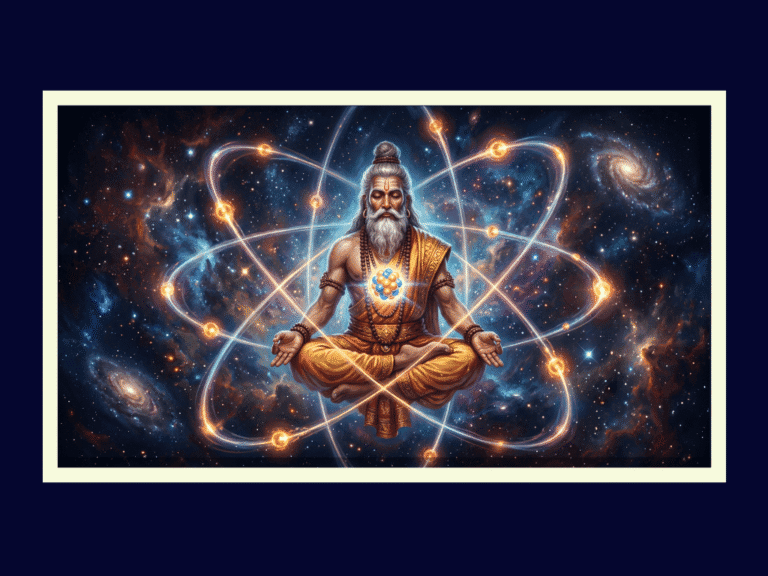
Around the same time, Vaiśeṣika Philosophy began to develop, which represented a landmark shift from the mystic cosmology to the analytical model of the universe.
The Vaiśeṣika school, founded by Kaṇāda, categorized every material in existence into specific logical categories, including substance (dravya), quality (guṇa), and motion (karma). The school theorized that the material world is made up of aṇu (fine and minute particle of matter) and paramāṇu (indivisible unit of matter).
This predates ancient Greek atomic theory by a couple of centuries.
Mathematics and the Logic of Language
The mathematics in the Iron Age India was highly influenced by linguistics.
Pāṇini was a great grammarian from North-western India, who logically structured the entire Sanskrit grammar in his famous work “Aṣṭādhyāyī,” which is still used to study Sanskrit. This systematic analysis influenced the mathematical reasoning of the contemporary work.
It was in this period that the abstract concept of śūnya (void or zero) was transforming into a proper mathematical symbol, which finally got its written form in the first half of the first millennium CE, with one of the earliest examples being the Bakhshali Manuscript (~300 CE).
The Hindu epic Rāmāyaṇam mentions large numbers such as 1057 and 1062, a feat that surpassed any other contemporary traditions. Jaina scholars also shifted the use of mathematics from ritualistic altar calculations toward practical, secular disciplines, developing number theory, permutations, and combinations.
Astronomy Beyond Ritual Calendars
The discipline of Vedānga Jyotiṣa from the early Vedic age, discussed briefly in an earlier blog of the ongoing series, was mainly directed towards ritualistic uses. Astronomy, between 500 and 1 BCE, developed into a more computational science.
Astronomy was then needed for domestic as well as administrative purposes, like calendars and timekeeping. Two important calendars that were developed at the end of this period are the Vikrama Saṁvata Calendar (~57 BCE) and the Śaka Calendar (~78 CE). The latter is currently the national calendar of India.
Astronomy will grow further after the influence of foreign cultures like the Greeks and the Parthians, and will see its “Golden Age” around the middle of the first millennium CE.
Conclusion: Foundations for the Classical Age
Thus, the science in Iron Age India acted as the bridge between the Vedic wisdom and the Classical Age. At the end of this period, India saw numerous invasions and migrations from foreign cultures like the Greeks, the Sakas, the Parthians, and the Kushans, which resulted in an epic cultural exchange, accelerating the development of Indian science.
In the next part of the ongoing series “The History of Indian Science”, we will discuss the amalgamation of those foreign cultures with India and how they helped in scientific advancement.
That’s all for this blog. If you found this piece interesting or educational, please share it and leave your thoughts in the comments. You can also subscribe to the newsletter below to stay updated on future posts. And thank you for reading this.