Tag: Vedic Philosophy

  • Into The Later Vedic Sciences: Rise of Natural Enquiries

    Into The Later Vedic Sciences: Rise of Natural Enquiries

    Introduction: The Later Vedic Transition

    Early Vedic science concentrated on the sky to ensure the precision of ritual timing. As discussed in the previous blog post, astronomy was categorized as one of the six Vedāṅgas, disciplines required to interpret and understand the Vedas. As time progressed, the later Vedic sciences shifted inquiry from cosmos to the immediate natural world. 

    The 16 mahājanapadas (great states), or the second urbanization period, further accelerated the development of natural sciences like proto-physics, botany, and medicine. The increased use of iron revolutionized daily life by enabling forest clearance and agricultural expansion, providing material security to the thinkers of that era to inquire more deeply into philosophy and science.

    In this blog post, we look at the development of later Vedic sciences and how they shaped future Indian scientific revolutions.

    Matter and Substances: Proto-Physics

    As mentioned above, the later Vedic scholars broadened their interests from astronomy to their surroundings. This included matter, particles, and physical phenomena.

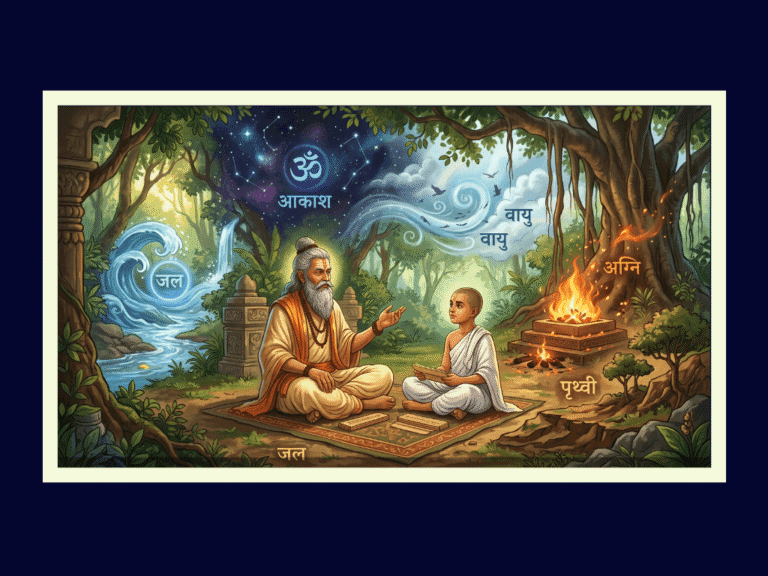
    They began categorizing the world into five fundamental elements or pañca-mahābhūtas. They were space, air, fire, water, and earth. They were classified based on observable natural properties, such as the odour and taste of substances.

    One of the earliest philosophical schools, Sāṃkhya, built a framework to explain how nature transforms from a primary state to various material forms, through constituent principles or guṇas. The guṇas were sattva (calmness and harmony), rajas (passion and movement), and tamas (ignorance and inertia).

    These ideas about matter later gave rise to the Indian school of atomism (Vaiśeṣika), which argued that nature is composed of eternal, indivisible atoms. They even speculated that these atoms combine into dyads (dyaṇuka) and triads (tryaṇuka) to form visible objects.

    The Sāṃkhya school also identified five subtle elements, the pañca-tanmātras:  sound, touch, colour, taste, and smell, which were understood to give rise to the five fundamental elements above.

    Knowledge of Plants: Proto-Botany

    Plants held deep significance in the Vedic traditions. Soma was an important sacrificial ritual plant, valued for its exhilarant or pharmacological properties. Described as the “Lord of the Forest”, its juice was studied for its ability to alter mental states and stimulate creativity. Although the exact identity of the plant is still not known, probable candidates include Ephedra, Sarcostemma, and some hallucinogenic mushrooms.

    The scholars developed botanical catalogues containing technical names of thousands of plants, like Peepal, Khadira, and Bilva, classified by their morphological and therapeutic properties, which are still used today in Indian traditional knowledge systems. 

    Plants also served as philosophical metaphors in the Upaniṣads. In the Chāndogya Upaniṣad, sage Uddālaka Āruṇi explains the nature of ātman to his son Śvetaketu. He asks the boy to cut open a banyan fruit, then a seed from within it, and finally asks what he sees at the core. The son answers: nothing. The sage responds that this invisible essence is what sustains the entire tree, and in the same way, the finest essence of all existence is the ātman.

    Beyond philosophy, plants were used for medicinal purposes. The Atharva Veda lists herbs to treat ailments like fever, and this knowledge eventually became the foundation for Vṛkṣāyurveda (Indian botanical science) and Āyurveda (Indian medical science).

    Early Medicinal Understanding: Proto-Medicine

    During the later Vedic period, systematic treatment of illness began to take shape. The Atharva Veda contains some of the earliest recorded uses of medicinal herbs.

    The scholars of that time created edible medicines like Cyavanaprāśa (made from honey, ghee, sugar, berries, and spices) and rejuvenation practices like Kayakalpa, both of which are still popular today.

    The Vedic texts also mention cataract removal and dental extractions, placing them among the world’s oldest documented surgical practices.

    The tradition was later formulated in ancient Indian medical texts like Caraka-Saṃhitā and Suśruta Saṃhitā, the two most important texts of Indian traditional medicine, which will be covered in future posts.

    Conclusion: Leaving the Vedic World

    Thus, the Indian scientific thought transitioned from the sky to the natural world in the later Vedic period. This would lay the foundation for future Indian classical physics and botany, along with the birth of specialized subjects, including arithmetic, calculus, material science, anatomy, and even surgery.

    That is all for this blog. In the next parts of the ongoing series, we will explore the organization of the classical thoughts, along with the exchange of ideas with foreign cultures, as we move beyond the Vedic landscape.

    If you found this piece interesting or educational, please share it and leave your thoughts in the comments. You can also subscribe to the newsletter below to stay updated on future posts. Thank You.

    Suggested Reading: