Introduction
In the previous blog, we discussed the developments in astronomy, mathematics, natural philosophy, and logic during the Golden Age of India. Those disciplines can mainly be classified as theoretical or theory-based sciences. In this post, we will discuss the development of applied sciences in the same period. We will decode the Gupta period architecture and technology, including metallurgy, civil engineering, medicine, and textile engineering.
To make the ongoing series, “The History of Indian Science,” concise, in this blog, we are considering developments between 200 and 800 CE, although they might be slightly outside the actual Gupta period (300-600 CE).
Table of Contents
The Rise of Structural Temple Architecture
Architecture started blooming in the Indian subcontinent around and after the Kushan Period (100-300 CE). Specialized architectural schools like the Gandhāra School and the Mathura School were popular even outside the Indosphere.
During the Gupta Empire, a clear defining characteristic of architecture was the evolution of the sacred space, as the architects made the transition from older rock-cut and wooden works to free-standing structural temples. This shift marked one of the most significant turning points in ancient Indian architecture. An example of this temple architecture can be found in the Temple 17 at Sanchi, which features a square cella and a columned varenda, a plan that would become very popular among later North Indian temples.
This era introduced the pañcāyatana (five-shrine) style temples, an elegant example of which is the “Daśāvatāra Temple” at Deogarh. In this style of temple, the main shrine is surrounded by four subsidiary shrines.
The Gupta period architecture also saw experiments in the Śikhara (tower) of the temples with beautiful curvilinear designs. An example of this can be found in the brick temple at Bhitargaon.
These developments were not only mere aesthetics, but they also required a proper understanding of load distribution, geometric planning, and stone fitting.
Cave Architecture and the Quest for Beauty
Parallel to the temple architecture, the Golden Age also saw the peak of Indian cave architecture. The Ajanta caves in Maharashtra are perhaps the best examples of it. They display a masterclass in mural art, depicting stories from the Jataka tales and the life of Buddha.
Another great example is the Udayagiri cave complex near Vidisha, which houses some of the earliest known depictions of magnificent Hindu iconography, including that of Gaṇeśa and river Goddesses like Gaṅgā and Yamunā.
Mastery in Metallurgy and Engineering
Metallurgy is perhaps one of the most era-defining fields during classical India. The Mehrauli Iron Pillar in Delhi, a 6-tonne shaft of pure iron that remained rust-proof and corrosion-free for 1,600 years, remains a principal display of the Golden Age metallurgy. Modern scientists believe this unique resistance is due to a protective layer formed by the specific iron composition and atmospheric oxygen. This technology was not available to the West till the 19th century.
The Sultanganj Buddha, an over seven-foot copper statue weighing around half a ton, is another example of the metallurgy of that time.
The age is also known for minting splendid gold coins. Many modern historians consider them the epitome of technical and sculptural finesse.
Civil Engineering and Hydraulic Systems
The Guptas were also pioneers of advanced irrigation and hydraulic systems. Administrators oversaw the construction and maintenance of vast reservoirs and canals. The repair of the Sudarṣana reservoir by Emperor Skandagupta is a prime example.
Hydraulic engineers used chains of pots for drawing water from wells, supporting urban centers like Pataliputra and Ujjaini, which featured organized roads and drainage systems.
Organization and Specialization of Medicine
India has had a rich history of medical science since the Vedic period, in the form of the Atharva Veda. The tradition progressed in the Iron Age with the contribution of pioneering physicians and surgeons.
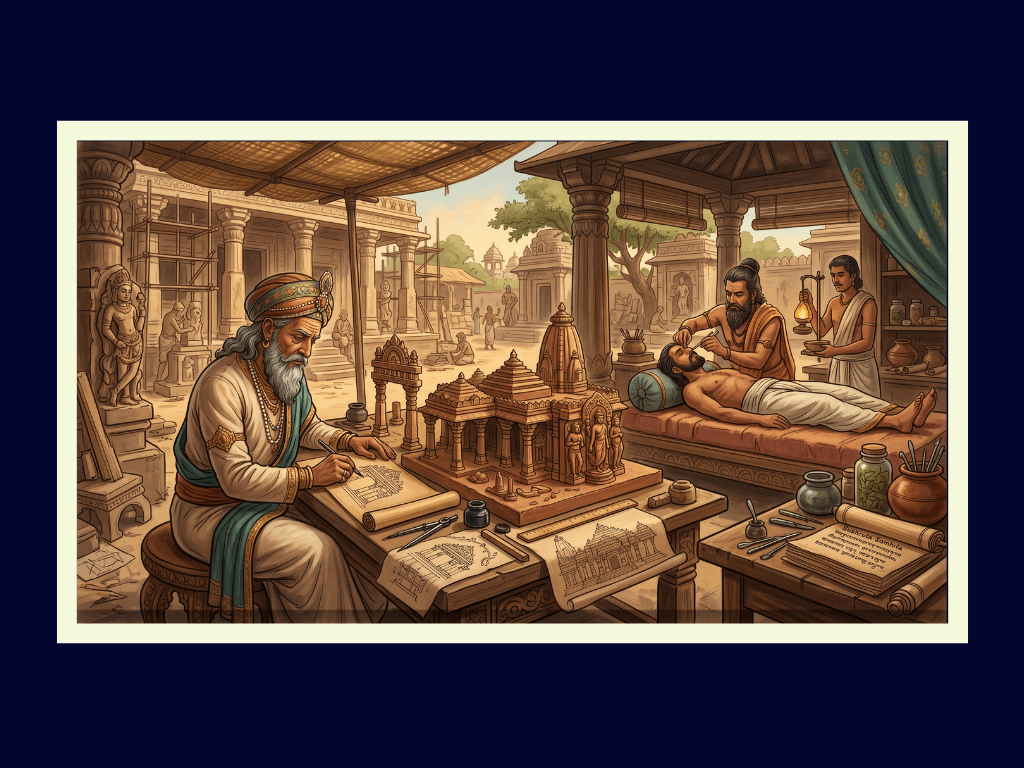
Caraka, known as the “Father of Indian Medicine,” authored the Caraka-Saṃhitā, which explained concepts including physiology, pathology, diagnosis, therapeutics, toxicology, and anatomy. Another great physician, Suśruta, the “Father of Indian Surgery,” authored the Suśrutasaṃhitā, which covered human skeletons, prevention vs cures, cataract surgery, rhinoplasty, haemorrhoidectomy, and various amputation methods. These two works became the primary texts of Indian medicine or Āyurveda.
During the Gupta period, based on Caraka’s and Suśruta’s teachings, medical science was fully organized into proper healthcare infrastructures. Specialized disciplines of Āyurveda sprang up, including holistic healing, orthopedic surgery, and even a specialized veterinary subject called Hastyāyurveda, the first specialized medical treatment for elephants.
Chemical Traditions and Textile Technology
The field of rasaśāstra or proto-chemistry flourished in that era as scholars experimented with minerals, salts, and mercury compounds. They also developed chemical procedures, including distillation, calcination, and sublimation, which benefited both the medical and metallurgical industries.
The chemical technology further transformed the textile industry as India began mass-producing and exporting textiles like fine cotton, muslin, and silk to the wider world.
Conclusion
The Golden Age was the Indian Renaissance before the Renaissance of the West. Whether it was astronomy or logic, architecture or medicine, India developed into an intellectual superpower at the close of the ancient world. The developments continued in the medieval age, although they suffered massive challenges and resistance due to foreign invasions from Arabs, Turks, and later European colonizers.
If you found this piece interesting or educational, please share it and leave your thoughts in the comments. You can also subscribe to the newsletter below to stay updated on future posts. And thank you for reading this.