Introduction: The Scientific World of Medieval India
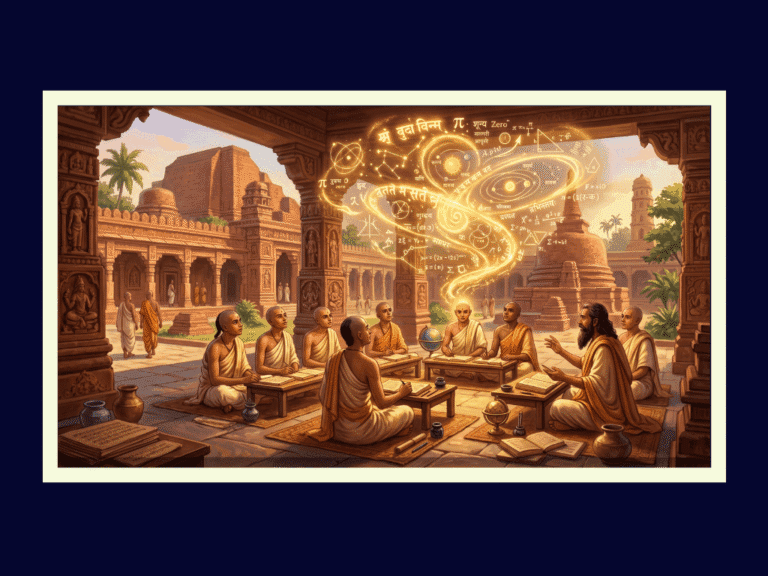
The medieval period of India is often misunderstood as a gap between the high classical age and the colonial period. Following the Gupta period, the knowledge systems diversified across various corners of the Indic civilization due to the rise of regional kingdoms and empires. Science in medieval India was also influenced by the constant invasions and conquests of the Huns, Arabs, and later, the Turks. Thus, the central theme of this era had a dual pursuit of preserving earlier Sanskrit knowledge as well as pushing toward new scientific and technical innovations.
In this part of the series, we will discuss the various Indian scientific innovations that happened between 800 and 1600 CE, based on the foundation laid by the likes of Āryabhaṭa and Brahmagupta.
Table of Contents
Mathematics, Astronomy, and the Race to Infinity
Some of the leading mathematicians in the early medieval age were Śrīdhara, Mahāvīra, and Bhāskara II.
In the 9th century, Mahāvīra authored the Gaṇita-sāra-saṅgraha, a mathematical work that explored branches including arithmetic, geometry, algebra, and combinatorics. Some of his contributions include finding the lowest common multiple (LCM) between numbers, inventing the formula for nCr, and various algebraic identities. He also stated that the square root of a negative number does not exist.
Śrīdhara, on the other hand, contributed more towards the applications of mathematics. He produced high-level calculations in accessible forms for operations in taxation, administration, and trade. Other contributions of his include various mathematical operations involving zero and the solution to quadratic equations, known as Śrīdharācārya’s formula.
The 12th century in India saw the rise of the great mathematician Bhāskara II, also known as Bhāskarācārya. His greatest work, Siddhānta Śiromaṇi, is a collection of four works, two of them being Līlāvatī and Bījagaṇita.
Līlāvatī contains 13 chapters on arithmetic, geometry, and astronomy. It uses real-life metaphors to explain arithmetic operations like multiplication and fractions. The text also gives the value of π (pi) as 22/7, but suggests a more accurate value of 3927/1250 based on astronomical calculations.
Bījagaṇita contains algebraic operations, specifically related to simple, quadratic, and indeterminate equations.
Bhāskara II was also a great astronomer and developed calculations for the prediction of eclipses and planetary positions, which were considered the gold standard for centuries. He explored the concepts of motion and gravity, centuries before their systematic formalization by Sir Isaac Newton.
In the later half of medieval India, the Kerala School of Mathematics and Astronomy became the torchbearer of Indian mathematics and astronomy. Its founder, Mādhava of Sangamagrāma (c.1340 -c.1425), is credited as the discoverer of infinite series with trigonometric functions, specifically the power series of sine, cosine, and arc-tangent. These are now known in the West as Taylor and Gregory-Leibniz series, although Mādhava discovered them two or three centuries earlier. He also calculated the value of π (pi) to 11 decimal places, a feat at the time.
Other prominent members of the school included Parameśvara, Nīlakaṇṭha Somayāji, and Jyeṣṭhadeva. Jyeṣṭhadeva’s Yuktibhāṣā is a work in Malayalam, which, unlike other mathematical texts of the time that provided only rules, provided explicit mathematical proofs for the Kerala School’s methods.
Medical Sciences and Pharmacology
This era also saw improvements and standardization of biological sciences.
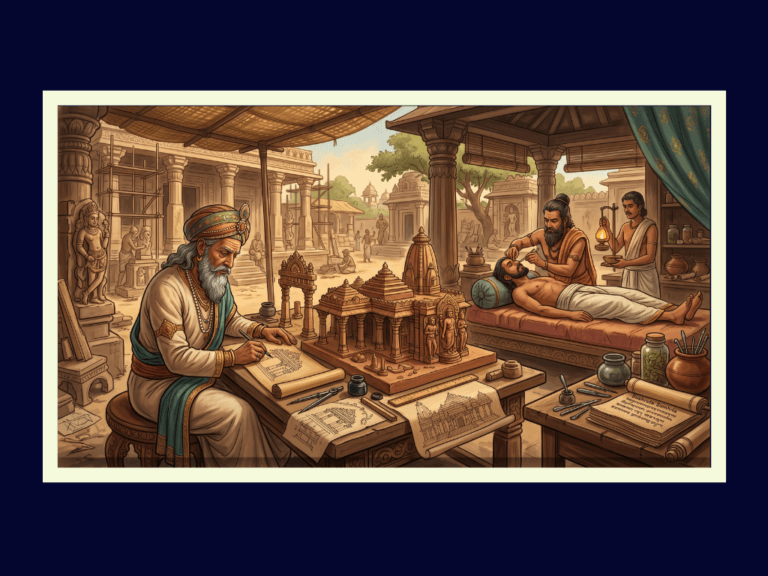
Cakrapani Datta, an Āyurvedic scholar, standardized Āyurvedic procedures through his work Cikitsa Saṃgraha, also known as Cakradatta. It is a multi-chapter text that focused on standard therapeutics over earlier diagnostics. The work also mentions mineral-based medicines, including the use of mercury and sulfur in surgical procedures involving piles and fistulas.
This era also saw the interaction between Āyurveda and Unani medicine due to invasions from the West.
Metallurgy and Material Science
Medieval India was also the largest producer of metallic zinc in the known world. Metallurgists in the Zawar mines of modern-day Rajasthan developed sophisticated distillation procedures to capture zinc, which vaporizes before it can be collected in liquid form, requiring a downward distillation technique to condense and capture it.
South India became the world leader in producing Wootz Steel. They were exported to Persia and the Middle East, where they were forged into the fabled Damascus swords, known for their toughness and distinctive surface patterns.
Engineering, Architecture, and Agriculture
Medieval India also saw magnificent structural engineering and architecture in the forms of the Konark Sun Temple and the Hoysala Temple Complexes. With the arrival of Islamic thought in India, architectural features like true arches, domes, and vaulting systems were introduced. The Gol Gumbaz is a fine example of mature Indo-Islamic architectural fusion. The Qutb Minar, built earlier in the 12th century, marks one of the first expressions of Islamic architecture on Indian soil.
This age also saw innovations in agricultural engineering, such as stepwells, irrigation tanks, and canal systems. There was large-scale production of rice, sugarcane, and cotton due to advancements in technology.
Conclusion: Medieval India’s Scientific Legacy
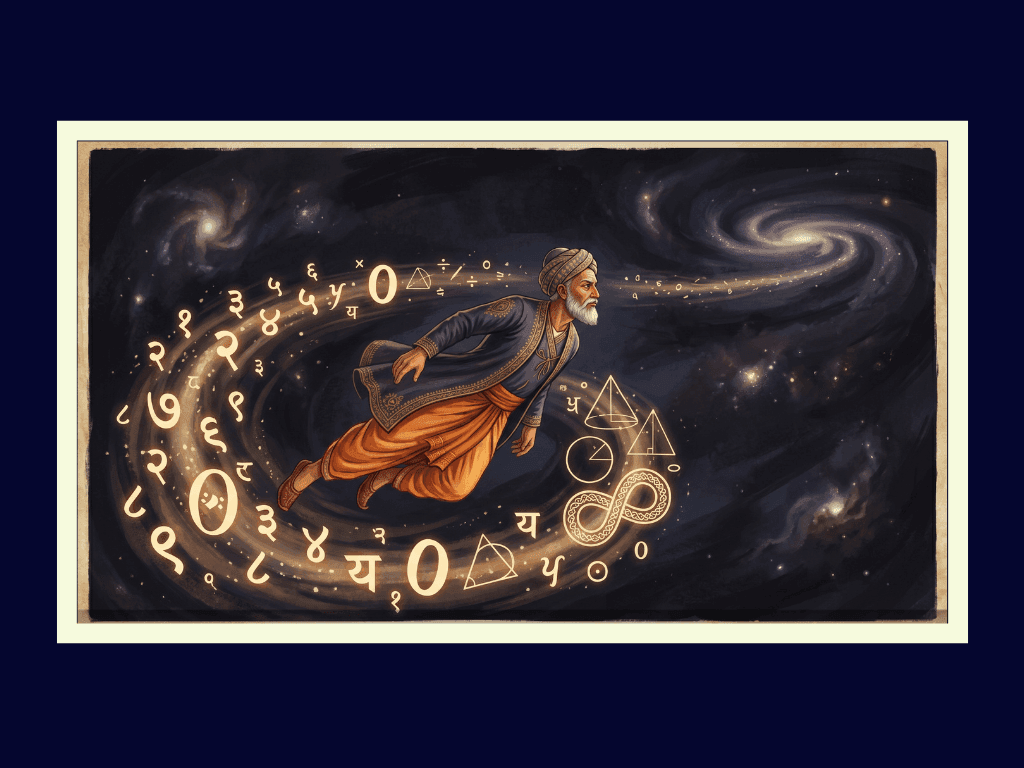
The story of science in medieval India is truly the story of the race to infinity. From the expansion of algebra by Mahāvīra and Bhāskara II to the revolutionary infinite series of the Kerala school, this era pushed human understanding to infinite possibilities.
Beyond mathematics, this spirit of inquiry was also visible in medicine, metallurgy, and even architecture. Medieval India was not a period of stagnation but a bridge that joined the Golden Age to the colonial period.
That’s all for this post. In the next one, we will explore the scientific developments in the early modern era.
If you found this piece interesting or educational, please share it and leave your thoughts in the comments. You can also subscribe to the newsletter below to stay updated on future posts. And thank you for reading this.
Suggested Readings:
- A Concise History of Science in India by B. V. Subbarayappa
- Līlāvatī by Bhāskara II
- A History of the Kerala School of Hindu Astronomy by K. V. Sarma