Introduction
The history of India, like any other culture, has its own ups and downs. During the Gupta era (4th to 6th century CE), Indian history went through its “Golden Age”. Alongside administration, the region also saw drastic developments in literature, religion, architecture, and science.
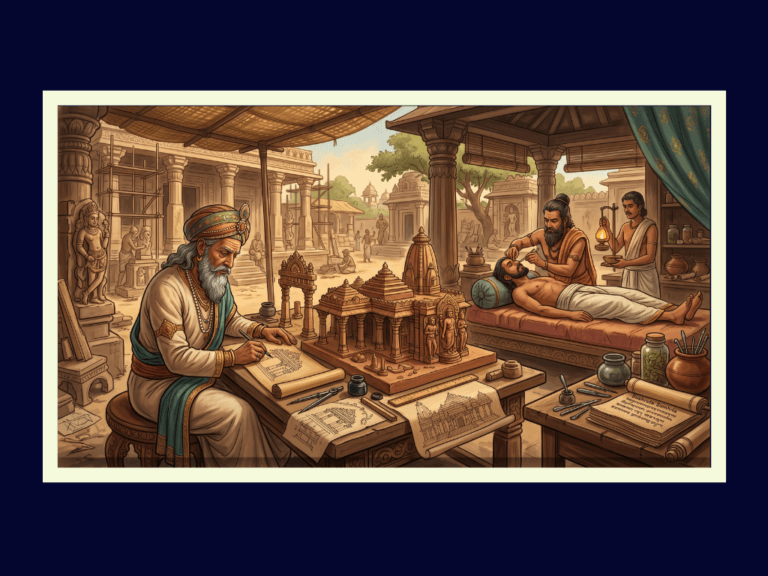
In this part of the ongoing series, we will discuss the golden age of Indian science in its various disciplines, like mathematics, astronomy, natural philosophy, and logic. For a continuous flow of the series, we have included major scientific developments between 300 and 900 CE, although a few may have happened outside the actual golden age. We have avoided medicine, architecture, and metallurgy in order to make the piece concise. Those disciplines will be discussed in detail in the next post.
Table of Contents
The Intellectual and Institutional Landscape
The classical Indian knowledge system has had a continuous tradition since the Vedic period. During the golden age, this progress was accelerated due to royal patronage by kings like Yaśodharman of Malwa, who sponsored polymaths like Varāhamihira. Intellectual environments were diverse, in which Hindu, Jain, and Buddhist scholars contributed to a systematic expansion of scientific wisdom.
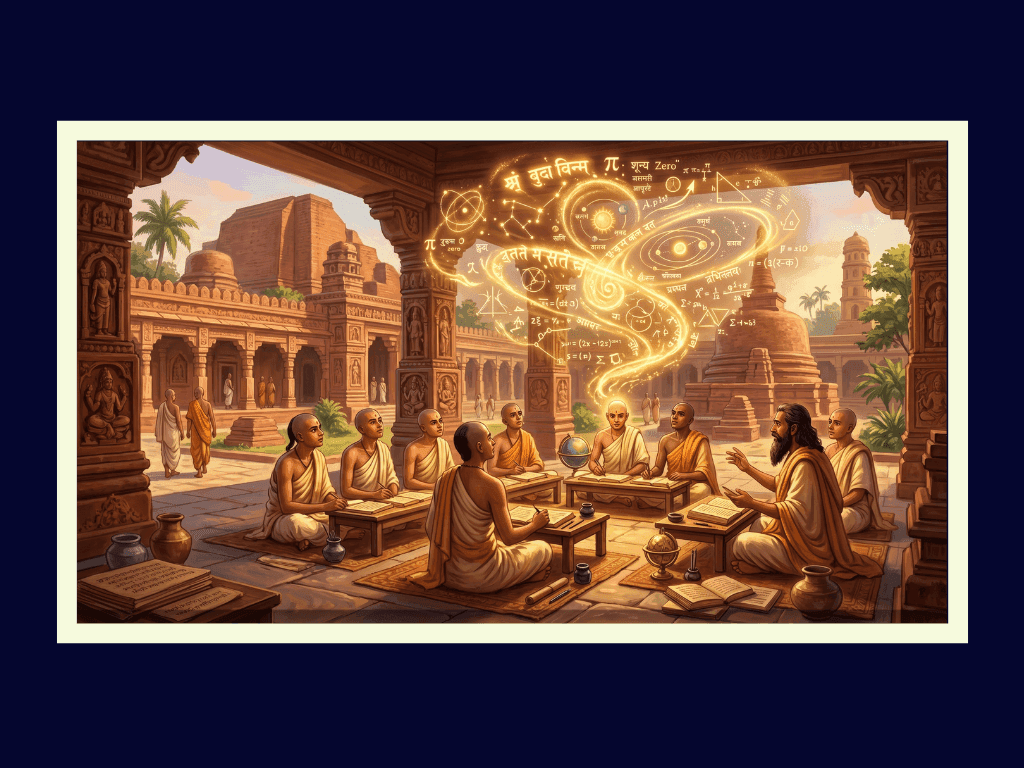
The establishment of universities as organized centers for wisdom also played an important role in the development of the golden age. Universities like Nālandā, Valabhi, and Vikramaśīla helped in the nurturing and training of scientists and mathematicians, including the great Āryabhaṭa I (allegedly). These universities maintained a continuous Guru-Śiṣya (teacher-student) tradition that preserved knowledge through the ages.
The use of Sanskrit as a scholastic language also helped ideas transcend regional boundaries. Due to the scarcity of writing materials, complex concepts were compressed into memorizable sutras or verses. These compressed hints later developed into full-scale scientific theories known as upapattis or yuktis.
The Mathematical Revolution
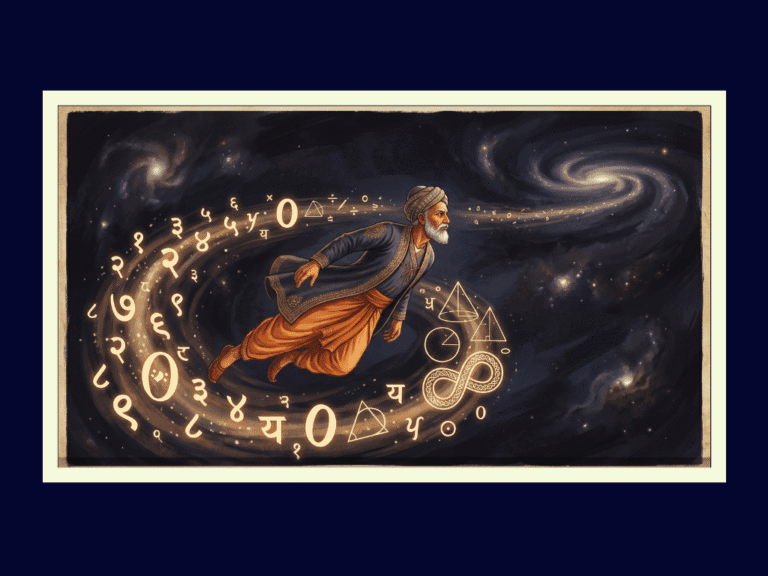
By this period, Indian mathematics had evolved from the ritual geometries of the Vedic Śulbasūtras to the introduction of zero as a concept and a standard decimal system. Indian numerals had positional notations, offering a significant advantage over their Roman counterparts.
Mathematicians like Āryabhaṭa and Brahmagupta were pioneers of the mathematical revolution in this period.
In his work, “Āryabhaṭīya,” Āryabhaṭa provided a value for 𝛑 (pi) of approximately 3.1416, which he himself noted was just an approximation. He also contributed to other sub-sections of mathematics, like solving complex linear indeterminate equations through the Kuṭṭaka method, replacing Greek chord systems with sine-based trigonometry, and developing procedures for solving square roots and cube roots using the place value system.
Brahmagupta was another great mathematician who, in his work “Brāhmasphuṭasiddhānta”, defined formal rules for zero as a number, along with positive and negative integers, for the first time. He developed early methods for solving quadratic indeterminate equations, laying the groundwork for what later mathematicians would formalize as the Cakravāla method. He was also a master in the mensuration domain, in which he developed formulas for the areas and diagonals of cyclic quadrilaterals.
Astronomy: Mapping the Cosmos
Astronomy in India also evolved from the Vedic Nakṣatra charts to more mathematically rigorous Siddhānta traditions. The city of Ujjaini (modern Ujjain) became the prime meridian for celestial studies.
Āryabhaṭa introduced revolutionary concepts like the earth rotating on its own axis, the moon and the planets shining because of reflected sunlight, and solar and lunar eclipses occurring due to the shadows of the moon and the earth.
Varāhamihira, a great astronomer, was the first to state that the precession of the equinoxes or ayanāṃśa was about 50.32 seconds. In his work, “Pañca-siddhāntikā,” he summarized 5 earlier astronomical canons or texts, preserving their knowledge, which otherwise would have been lost.
Astronomers in India also used practical instruments for their observations, including gnomons and water clocks.
Natural Philosophy and Physical Sciences
While mathematics and astronomy were the dominant subjects, classical India also developed a sophisticated view of the natural world through the Nyāya-Vaiśeṣika schools.
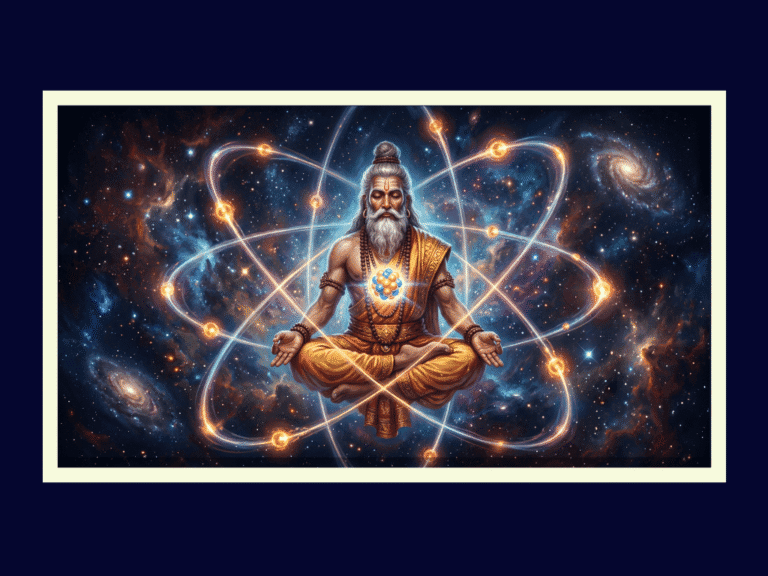
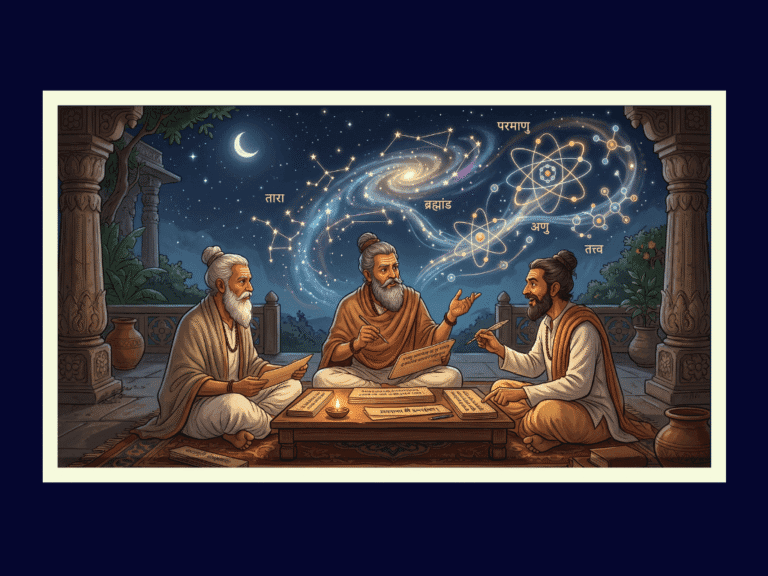
As discussed in the Iron Age post of the series, the Vaiśeṣika school proposed an atomistic model of the universe, consisting of aṇu (fine and minute particle of matter) and paramāṇu (indivisible unit of matter). This school evolved from mere independent scientific thought to a highly organized system during the golden age, under philosophers like Praśastapāda. The school also grew closer to the Nyāya school in this period, before finally merging in the 11th century.
In the realm of optics, scholars described light as indefinitely small particles, radiating in all directions at inconceivable velocity, and thereby explaining properties like the reflection of light and translucency as light particles escaping through intermolecular spaces, independent of Western thought.
Formal Logic and Thought Process
Nyāya, the Indian school of logic, also saw an acceleration during this age. It developed formal reasoning systems to classify knowledge or Pramāṇa through perception, inference, debate, and testimony. The great philosopher Vātsyāyana wrote “Nyāya Bhāṣya”, a text that organized all the logical concepts into a proper, definitive structure. Because of this systematization, the school became associated with titles like Tarkaśāstra (science of reasoning) and Ānvīkṣikī (science of critical study).
Knowledge Networks
As mentioned in the previous blog, India acted as a hub of knowledge for the known world. During the Islamic Golden Age, scholars in Baghdad became interested in Indian thought. Brahmagupta’s Brāhmasphuṭasiddhānta was translated into Arabic as “Sind Hind”. The Sind Hind later inspired the great mathematician al-Khwarizmi, famous for his contributions to algebra.
Through the Arabs, the Indian knowledge systems also reached Europe. Indian astronomical knowledge, absorbed and transformed by Arabic scholars, eventually fed into medieval European astronomy, including works like the Tables of Toledo.
Conclusion
The contributions by the Indian scholars and scientists laid a launchpad for further evolution in the medieval ages. But due to continuous invasions and conquests by the Huns, Arabs, Turks, and later European colonizers, Indian science and mathematics suffered a big setback. Yet the legacy continued through certain regional sections, like the famous Kerala school of mathematics and astronomy, which later fused with Western wisdom, creating the science in modern India.
That’s all for this post. As mentioned, we will look into the medical, material, and alchemical progress of the same age in the next one.
If you found this piece interesting or educational, please share it and leave your thoughts in the comments. You can also subscribe to the newsletter below to stay updated on future posts. And thank you for reading this.